

In This Article
Right, let’s start with the obvious question: what is deep work? In short, deep work is the ability to concentrate without distraction on cognitively demanding tasks — the kind of focus that produces your best writing, your sharpest code, your clearest thinking. It’s a skill, not a personality trait, and it can be trained. That’s the whole premise behind the wave of deep work books that have quietly become some of the most dog-eared titles on British bookshelves.

If you’ve ever sat down to write a report and found yourself, ten minutes later, deep in a Wikipedia rabbit hole about medieval siege weapons, you already know why this genre exists. According to Ofcom’s Online Nation report, UK adults now spend an average of four hours and thirty minutes online every day, with the vast majority of that time happening on a smartphone — and every one of those minutes is a minute your brain didn’t spend on the task actually in front of you. Deep work books exist to help you claw some of that attention back, using research rather than willpower alone.
This guide compares seven of the genre’s genuinely useful titles — from the foundational classic that gave the movement its name to the psychology text that quietly underpins most of what came after it. You’ll get honest analysis of who each book suits, what reviewers consistently say about them, and — because a book on a shelf changes nothing — a practical plan for actually putting the ideas to work. No fluff, no invented five-star quotes, just the straight goods on deep work books.
Quick Comparison: Deep Work Books at a Glance
| Book | Best For | Format | Price Range |
|---|---|---|---|
| Deep Work | Building a complete focus philosophy | Paperback/Hardback | £9-£13 |
| Digital Minimalism | Decluttering tech habits first | Paperback/Hardback | £11-£14 |
| Indistractable | Managing the urge to get distracted | Paperback | £13-£16 |
| Stolen Focus | Understanding the systemic causes | Paperback | £11-£13 |
| The Shallows | The neuroscience of internet browsing | Paperback | £9-£12 |
| Hyperfocus | Practical, exercise-based tactics | Paperback | £9-£12 |
| Flow | The psychology underneath it all | Paperback | £10-£14 |
Looking at the table, there’s a clear pattern: the cheaper end of the range (The Shallows, Hyperfocus) tends to hand you either the science or the tactics, while the pricier titles (Indistractable, Digital Minimalism) bundle in workbooks or newer print runs that push the cover price up. If you’re building a focus library from scratch, Deep Work and Flow sit at opposite ends of the same idea — one modern and workplace-specific, one foundational and universal — which is exactly why most people end up owning both eventually.
💬 Just one click — help others make better buying decisions too!😊
Top 7 Deep Work Books: Expert Analysis
1. Deep Work — the book that named the movement
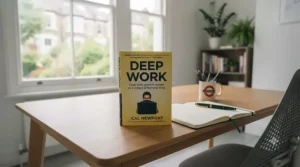
Deep Work by Cal Newport is where this entire category effectively begins, and it’s worth expanding on why. The book is split cleanly in two: a case for why concentration is now a rare and valuable skill, followed by four practical rules — Work Deeply, Embrace Boredom, Quit Social Media, and Drain the Shallows.
What most buyers overlook about Deep Work is that it isn’t really a productivity hack book at all — it’s closer to a manifesto, with the tactics arriving only after Newport has made the philosophical case that shallow, reactive work is actively damaging your career prospects. That framing matters because it’s what gives the rules staying power; you’re not just told to block your calendar, you’re told why blocking it is worth the discomfort. Reviewers consistently report that the book changed their daily habits, particularly around morning routines and social media use, with several noting they physically removed devices from their workspace after finishing it.
Pros:
- ✅ Clear four-rule framework that’s easy to revisit
- ✅ Written by a computer science academic, not a guru
- ✅ Remains the most-cited reference point in the genre
Cons:
- ❌ Some chapters lean heavily on repeated anecdotes
- ❌ Asks for lifestyle changes not everyone’s job allows
Expect Deep Work to sit in the £9-£13 range for the paperback — for a book this frequently referenced elsewhere on this list, it’s arguably the best-value starting point of the seven.

2. Digital Minimalis m— best for clearing the runway first
Digital Minimalism, also by Cal Newport, tackles a problem Deep Work assumes you’ve already solved: what to do about the apps and notifications competing for your attention before you even try to concentrate. Newport centres the book around a 30-day “digital declutter,” where you strip back non-essential technology and reintroduce only what earns its place back.
Here’s what the spec sheet won’t tell you: this book works best read as a prequel to Deep Work, not a replacement for it. Based on the structure, it’s really a philosophy of intentionality applied to technology — Newport argues that constant connectivity isn’t a personal failing but a predictable result of products engineered to be addictive. Aggregated reader sentiment consistently flags the 30-day declutter chapter as the most-used part of the book, with many readers reporting they return to it annually as a kind of digital spring clean.
Pros:
- ✅ Concrete 30-day declutter process, not just theory
- ✅ Extends beyond work into personal life and relationships
- ✅ Pairs naturally with Deep Work for a full system
Cons:
- ❌ Covers some ground already familiar from Newport’s other books
- ❌ Less specific about workplace-based distraction than Deep Work
Priced typically in the £11-£14 range, it’s a worthwhile companion purchase rather than a first pick on its own — pair it with Deep Work for the fuller philosophy.
3. Indistractable — the psychology of the urge itself
Indistractable by Nir Eyal takes a different angle entirely: rather than telling you to remove distractions, it asks why you want to get distracted in the first place. Eyal, previously known for writing the habit-design playbook Hooked, uses that same behavioural-design lens in reverse here.
What most buyers overlook about Indistractable is that its core argument is about internal triggers — boredom, anxiety, uncertainty — rather than external ones like your phone. Based on the spec comparison with Deep Work, this makes it the more psychologically-focused of the two; where Newport gives you rules, Eyal gives you a four-step model built around managing discomfort, timeboxing your calendar by values, and making “pacts” that build in accountability. Reviewers consistently praise the practical “pact” system for online distractions, though a recurring theme in aggregated feedback is scepticism about a habit-formation author writing a book about resisting habits — several reviewers note the irony without treating it as disqualifying.
Pros:
- ✅ Four-step model tackles the root cause, not just symptoms
- ✅ Strong sections on managing internal discomfort and boredom
- ✅ Includes guidance for workplace culture, not just individuals
Cons:
- ❌ Some workplace-culture chapters feel thinner than the personal ones
- ❌ A few concepts overlap with the author’s earlier work on habits
At around £13-£16 for the updated paperback edition, it’s the priciest of the seven — justified mainly if the psychology angle is what you’re after rather than a straightforward rules-based system.
4. Stolen Focus — the investigative deep dive
Stolen Focus by Johann Hari is the odd one out on this list in the best possible way: it’s journalism, not a self-help framework. Hari spent three years interviewing experts worldwide to identify what he presents as twelve separate, systemic causes of the modern attention crisis.
The spec sheet won’t tell you this, but user reports suggest Stolen Focus changes how readers think about distraction more than it changes what they do about it day-to-day — it reframes lost focus as something done to us by attention-economy business models, not a personal failing to be corrected with more discipline. That reframing is genuinely useful if the self-blame angle of other books in this list has started to feel exhausting. Aggregated reviews are broadly positive on readability, with outlets including the Wall Street Journal noting the book stays engaging despite its research density; some critics have pushed back on a handful of Hari’s specific causal claims, which is worth knowing going in. For background on the book’s reception and central arguments, Wikipedia’s overview is a useful starting point.
Pros:
- ✅ Investigative approach backed by wide expert interviews
- ✅ Reframes focus loss as systemic, reducing self-blame
- ✅ Well-sourced and unusually readable for the subject
Cons:
- ❌ Fewer concrete daily exercises than the more tactical titles here
- ❌ A handful of specific claims have drawn academic pushback
Typically priced around £11-£13 in paperback, it’s best suited to readers who want the “why” of the attention crisis rather than a step-by-step fix.
5. The Shallows — the neuroscience underneath it all
The Shallows by Nicholas Carr is the science-first pick on this list, and the oldest — originally published in 2010, now available in a 10th-anniversary edition with a new afterword covering smartphones and social media specifically.
Carr’s central argument is that the internet doesn’t just distract us, it physically reshapes how our brains process information, favouring skimming over the sustained, linear attention that deep reading requires. What most buyers overlook is that this makes The Shallows less a productivity book and more a neuroscience explainer for why the other six books on this list are even necessary — it’s the theoretical foundation, not the toolkit. Reviewers consistently describe the book as unsettling in a useful way, with several noting they struggled to finish long articles after reading it and treated that discomfort as diagnostic rather than incidental.
Pros:
- ✅ Strong scientific grounding on neuroplasticity and reading
- ✅ Updated afterword keeps the smartphone-era argument current
- ✅ A genuinely timeless argument, not a passing productivity trend
Cons:
- ❌ Denser, more academic prose than the newer titles here
- ❌ Some original tech references now feel dated despite the update
At £9-£12, it’s one of the best-value picks on this list for readers who want the evidence base rather than another rules list.
6. Hyperfocus — the most exercise-driven pick
Hyperfocus by Chris Bailey is the most workbook-like of the seven, built from a year Bailey spent running productivity experiments on himself. It centres on two states: hyperfocus, for single-task deep concentration, and scatterfocus, for the mind-wandering that generates creative insight.
Based on the spec comparison with Deep Work, Hyperfocus trades some of Newport’s philosophical grounding for something more immediately actionable — nearly every chapter ends with a specific exercise you can try that day, rather than a principle to absorb over time. What reviewers consistently note is that this makes it a good “starter” pick for readers who find Deep Work or The Shallows too dense to begin with, even if some of the exercises echo ideas found elsewhere in the genre.
Pros:
- ✅ Exercise-based chapters make the ideas easy to apply immediately
- ✅ Covers both focus and deliberate mental rest
- ✅ Shorter, more accessible chapters than several titles here
Cons:
- ❌ Less scientific depth than The Shallows or Stolen Focus
- ❌ Some exercises overlap with concepts covered by Deep Work
Priced around £9-£12, it’s a sensible entry point if you want to start doing something differently this week rather than finish a longer book first.
7. Flow — the academic backbone of the whole genre
Flow: The Psychology of Optimal Experience by Mihaly Csikszentmihalyi predates every other book on this list by decades, and arguably underpins all of them. Csikszentmihalyi’s decades of research identified “flow” — a state of complete absorption where challenge and skill are perfectly matched — as the source of genuinely satisfying concentration, in work and beyond it.
Here’s what most buyers overlook: Flow isn’t a workplace productivity book at all — its examples range across art, sport, conversation and relationships, which is exactly why later authors like Newport and Bailey cite it as their theoretical starting point. Reading it after the more tactical titles on this list often reframes them, because you start to see their “rules” as specific applications of Csikszentmihalyi’s broader theory of matching challenge to skill. Aggregated review sentiment consistently praises its scope and influence, while noting the academic prose style is a bigger commitment than the punchier, more modern titles here.
Pros:
- ✅ The foundational research behind most later focus books
- ✅ Applies far beyond work, into art, sport, and relationships
- ✅ Endorsed across positive psychology as a genuine classic
Cons:
- ❌ Denser academic writing than the newer, punchier titles
- ❌ Fewer modern, UK-specific, or workplace examples
At £10-£14 depending on edition, it’s less an immediate fix and more a long-term investment in understanding why any of this works at all.
Deep Work Books Compared: Specs, Sentiment and Value
| Book | Author | Approach | Best For | Price Range |
|---|---|---|---|---|
| Deep Work | Cal Newport | Rules-based | Building a complete system | £9-£13 |
| Digital Minimalism | Cal Newport | Declutter process | Clearing distractions first | £11-£14 |
| Indistractable | Nir Eyal | Behavioural psychology | Managing internal urges | £13-£16 |
| Stolen Focus | Johann Hari | Investigative journalism | Understanding root causes | £11-£13 |
| The Shallows | Nicholas Carr | Neuroscience | Evidence over tactics | £9-£12 |
| Hyperfocus | Chris Bailey | Exercise-based | Immediate, actionable steps | £9-£12 |
| Flow | Mihaly Csikszentmihalyi | Academic psychology | Understanding the “why” | £10-£14 |
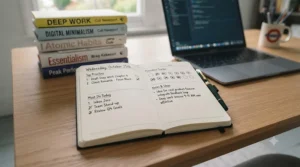
This table makes the genre’s real structure obvious: it isn’t seven versions of the same advice, it’s three layers stacked on top of each other. Flow and The Shallows supply the underlying science, Deep Work, Digital Minimalism and Indistractable turn that science into workplace and habit rules, and Hyperfocus converts the whole lot into exercises you can do this afternoon. If you only buy one, match it to the layer you’re missing rather than the one with the most impressive cover quotes.
How to Choose Deep Work Books
How do you choose the right deep work book for your situation? Match the book to the specific gap in your focus, not to the bestseller list. Here’s a five-step framework:
- Diagnose your actual problem first. If your phone is the issue, start with Digital Minimalism or Indistractable; if it’s your workplace culture, Deep Work goes further on that specifically.
- Decide whether you want theory or exercises. Flow and The Shallows build understanding; Hyperfocus gets you doing something within a chapter.
- Check your appetite for density. Academic prose (Flow) rewards patience; newer titles (Hyperfocus, Indistractable) are written for a faster read.
- Consider whether you want personal responsibility or systemic framing. Stolen Focus is deliberately less “it’s your willpower” than the others.
- Budget for a pair, not a single book. Reviewers consistently note the biggest behaviour change comes from combining a philosophy book with an exercise-based one.
Distraction-Free Books: Building a Practical Deep Work Routine
Owning distraction free books does nothing on its own — the value comes from turning their ideas into a repeatable routine. Start small: pick one 90-minute block each day, phone in another room, and treat it as non-negotiable for two weeks before judging whether it’s working.
Common first-30-days mistakes include starting with a four-hour block (too ambitious), keeping notifications “just for emergencies” (they rarely are), and abandoning the habit after a single missed day rather than simply resuming the next one. Newport’s shutdown ritual from Deep Work and Eyal’s timeboxing from Indistractable both solve the same underlying problem from different angles: giving your brain a clear, repeatable signal for when deep work starts and stops, which reduces the mental friction of beginning each session.
A simple maintenance schedule works well: review your calendar weekly to protect at least three deep work blocks, audit your app notifications monthly, and revisit Digital Minimalism‘s declutter chapter roughly twice a year as habits inevitably creep back in.
✨ Ready to Build Your Focus Library?
🔍 Compare the seven picks above against your own biggest distraction, and start with the one that actually solves it. Click through on any title to check current availability and pricing.
Focused Work Guides: Real-World Scenarios for Every Reader
Focused work guides land differently depending on who’s holding them. Consider three common profiles:
The remote-working freelancer, juggling client Slack messages and email all day, is usually best served starting with Indistractable, since the core problem is managing constant external interruption rather than lacking a system.
The postgraduate student writing a thesis over several months benefits most from Deep Work paired with Flow — the former for scheduling long, undisturbed writing blocks, the latter for understanding why those blocks feel so different from scattered study sessions.
The mid-career manager whose calendar is genuinely full of unavoidable meetings gets more from Stolen Focus and Hyperfocus together — Hari’s book explains why the problem often isn’t personal discipline at all, while Bailey’s shorter chapters fit into the gaps a packed diary actually leaves.
Problem → Solution: Fixing the Most Common Focus Failures
Problem: You start deep work sessions but abandon them within twenty minutes. Solution: use Bailey’s scatterfocus technique from Hyperfocus for a five-minute warm-up walk before sitting down, rather than diving straight into difficult work cold.
Problem: Notifications pull you out even during “focus mode.” Solution: Eyal’s pact system in Indistractable — a pre-agreed consequence for checking your phone — outperforms simple willpower for most reviewers.
Problem: You feel guilty stepping away from email for hours. Solution: Newport’s “drain the shallows” rule in Deep Work explicitly schedules shallow work into fixed windows, so it isn’t ignored, just contained.
Problem: You can concentrate at your desk but not while reading longer material. Solution: Carr’s diagnosis in The Shallows suggests deliberately rebuilding reading stamina with slightly longer texts each week, rather than assuming the skill is simply gone.
Problem: You don’t know if the underlying cause is you or your environment. Solution: Stolen Focus is worth reading specifically to separate personal habits from structural, product-design causes before you blame yourself unnecessarily.
Attention Management Books vs Productivity Apps and Focus Trackers
It’s worth addressing directly: could an app do this job instead of a book? Attention management books and productivity apps solve overlapping but distinct problems. Apps like screen-time trackers measure and restrict behaviour; books explain why the behaviour happens and build a durable mental model you can apply even when the app isn’t running.
| Factor | Deep Work Books | Productivity Apps |
|---|---|---|
| Best For | Understanding root causes, building lasting habits | Quick, in-the-moment restriction |
| Depth of explanation | High — psychology and neuroscience-backed | Low — usually just statistics |
| Cost over time | One-off purchase | Often subscription-based |
| Works without the tool present | Yes, once habits form | No — relies on the app running |
The analysis here is straightforward: apps are excellent short-term scaffolding, but reviewers of books like Indistractable and Deep Work consistently report the habits stuck around after they stopped actively using any tracking software, because the books changed their understanding of why they were distracted, not just their access to distraction. The most durable setups tend to combine both — a book for the mental model, an app for the daily nudge.
✨ Don’t Miss These Exclusive Deals!
🔍 Whichever gap in your routine you’re trying to close, there’s a title above built for exactly that problem — check current pricing and grab the one that fits.

Common Mistakes When Buying Deep Work Books
The most common mistake is buying based on cover quotes alone rather than matching the book to your actual bottleneck — a reader whose problem is workplace meetings gains little from The Shallows‘ neuroscience focus, however well-reviewed it is.
A second mistake is buying several titles at once and reading none of them properly; reviewers across this genre consistently note that finishing and applying one book beats skimming three. A third is assuming newer always means better — Flow, published decades before the rest, remains the theoretical basis several newer authors explicitly credit. Finally, some buyers overlook format: if you know you won’t sit and read, an audiobook edition (several of these titles, including Deep Work and Stolen Focus, are available as audiobooks) may get better results than a paperback that sits unread on a shelf.
Focus Improvement Books for Every Type of Reader
Focus improvement books aren’t one-size-fits-all, and matching format to reader type matters as much as matching content.
Beginners to the genre generally do best starting with Hyperfocus or Digital Minimalism — both are structured around clear, bite-sized actions rather than assuming prior familiarity with productivity theory.
Advanced readers who’ve already tried the basics tend to get more value from Stolen Focus and Flow, since both push past personal tactics into systemic and psychological territory that beginner-focused books rarely cover.
Budget-conscious readers should note that The Shallows and Hyperfocus consistently sit at the lower end of the price range while still ranking among the most-cited titles in the genre, making them sensible starting points before committing to pricier options.
Time-poor readers, meanwhile, are usually better served by Hyperfocus‘s short, exercise-driven chapters than by Flow‘s denser academic style, however influential the latter is.
Concentration Techniques Books: Separating Fact From Hype
Not every idea marketed as a concentration technique is equally well supported. Time-blocking, for example — central to Deep Work — has strong practical backing across multiple books in this list because it addresses a genuinely common failure point: vague intentions without protected time.
By contrast, some popularised “productivity hacks” circulating online promise instant focus improvements with no underlying mechanism, which is precisely what separates a properly researched concentration techniques book from a listicle. It’s also worth noting that research summarised in Nature suggests our underlying capacity to pay attention may be less diminished than headlines often claim — it’s the competing digital demands on that attention that have genuinely increased. Flow‘s core insight — that concentration improves when challenge is closely matched to skill level — has held up across decades of psychological research, which is more than can be said for most viral productivity trends. When evaluating any new technique, a useful filter borrowed from this genre is simple: does it change your environment, your schedule, or your understanding, or does it just add another thing to remember? The first three tend to work; the fourth rarely does.
Productivity Focus Books and Long-Term Value: Are They Worth It?
On a cost-per-use basis, productivity focus books are hard to beat. A £10-£15 paperback that genuinely changes how you structure your working day pays for itself within a single focused session that would otherwise have been lost to distraction — and unlike a subscription app, there’s no recurring cost once you’ve internalised the ideas.
The realistic long-term cost isn’t the cover price at all, it’s the time investment: Deep Work and Stolen Focus both run past 300 pages, while Hyperfocus can be read and partially implemented in a weekend. Total cost of ownership, in other words, includes the hours spent reading as much as the pounds spent buying — which is another reason matching the book to your actual problem, rather than buying several “just in case,” is the better long-term strategy.
Safety, Screen Time and Digital Wellbeing While You Read
It’s worth a brief, practical note: several of these books are read on screens, which raises its own attention and wellbeing considerations. The UK Health and Safety Executive recommends that display screen work be planned so it’s periodically interrupted by breaks or changes of activity, noting that short, frequent breaks are generally more effective than long, infrequent ones. That guidance applies just as well to an e-reader or tablet session as it does to a spreadsheet.
If you’re building a deep work practice around screen-based reading, consider printed editions for the denser titles (Flow, The Shallows) specifically to reduce total screen time, and reserve tablets or e-readers for the more exercise-driven books you’ll want to reference repeatedly, like Hyperfocus.
Buyer’s Decision Framework: Which Deep Work Book Should You Buy?
Use this simple priority checklist:
- If you’re starting from zero, choose Deep Work, because it builds the full philosophy and the rules in one place.
- If your phone is the main problem, choose Indistractable or Digital Minimalism, because both target device-driven distraction directly.
- If you want the science before the system, choose Flow or The Shallows, because they explain the mechanism, not just the fix.
- If you’re short on time and want quick wins, choose Hyperfocus, because its chapters are built for immediate action.
- If you’re tired of blaming yourself, choose Stolen Focus, because it reframes the problem as systemic rather than personal.

FAQ
❓ What is the best deep work book for beginners?
❓ Are deep work books actually backed by research?
❓ Should I buy the audiobook or paperback version?
❓ Do I need to read these books in a specific order?
❓ How long does it take to see results from applying these books?
Conclusion
There’s no single best deep work book, because there’s no single kind of distracted reader. What the seven titles here share is an insistence that focus is trainable rather than fixed — whether you approach that training through Newport’s rules, Eyal’s psychology, Hari’s systemic reporting, Carr’s neuroscience, Bailey’s exercises, or Csikszentmihalyi’s original theory of flow.
The honest takeaway from comparing all seven side by side is that depth beats breadth: one book, genuinely finished and applied for a month, will change your working life more than a shelf of unread bestsellers ever will. Pick the one that matches your actual bottleneck from the framework above, start with a single protected block this week, and let the results tell you whether a second title is worth adding.
✨ Ready to Start Reading With Purpose?
🚀 Pick the deep work book that matches your biggest distraction from the list above, click through to check current pricing, and give it a proper two-week trial before judging the results.
Recommended for You
- Best Productivity Books 2026: 7 Life-Changing Reads Ranked
- Mindfulness Meditation Books: 7 Best UK Picks for 2026
- Stress Management Books: 7 Best Reads to Try in 2026
Disclaimer: This article contains affiliate links. As an Amazon Associate, I earn from qualifying purchases. If you purchase products through these links, we may earn a small commission at no additional cost to you.
✨ Found this helpful? Share it with your friends! 💬🤗
