In This Article
Somewhere between “what even is GDP” and “why does everything cost more than it did last year,” most of us hit a wall with economics. It’s taught like a foreign language full of graphs, Greek letters and men in tweed jackets — which is a shame, because at its core, economics is just the study of how people make choices when they can’t have everything they want. That’s it. That’s the whole dismal science, minus the dismal bit. Economics books for beginners exist precisely to strip away the jargon and hand you that core idea in plain English, using stories about coffee shops, second-hand cars and washing machines instead of indifference curves.

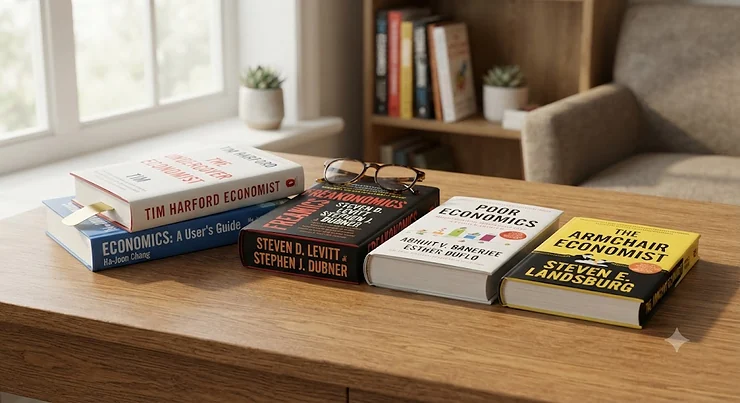
This guide rounds up seven real, currently available titles — from a slim 1946 classic that fits in a coat pocket to a doorstop that covers the entire discipline in one volume — and gives you an honest, researched breakdown of who each one suits. As the Bank of England’s own explainer series puts it, economics is essentially “a system for distributing limited resources,” and every book below tackles that idea from a different angle: some through wit and pop-culture puzzles, some through history, one entirely through cartoons. None of them assume you’ve touched a supply-and-demand curve since school, and none of them will bore you into putting the book down by chapter two.
Quick Comparison Table
| Book | Author | Best For | Price Range |
|---|---|---|---|
| Economics in One Lesson | Henry Hazlitt | Absolute beginners on a budget | Under £10 |
| Freakonomics | Levitt & Dubner | Readers who want a page-turner | £8-£12 |
| The Undercover Economist | Tim Harford | UK-based, everyday examples | £8-£12 |
| Naked Economics | Charles Wheelan | A fuller, still-friendly overview | £12-£17 |
| Basic Economics | Thomas Sowell | Serious self-study, one book to rule them all | £20-£28 |
| Economics: The User’s Guide | Ha-Joon Chang | Balanced, non-ideological grounding | £9-£13 |
| The Cartoon Introduction to Economics | Klein & Bauman | Visual learners and gifting | £13-£18 |
Look at that spread and a pattern emerges fast: price and page count rise together, but “best for beginners” doesn’t always mean “cheapest.” Economics in One Lesson wins on brevity and cost, but it’s a persuasive essay from one particular school of thought rather than a balanced survey — pair it with something like Economics: The User’s Guide if you want the other side of the argument. Meanwhile, Basic Economics costs two or three times as much as the paperbacks on this list, but at 600-plus pages it’s genuinely a library’s worth of economics in a single spine, which changes the value maths considerably if you only ever want to buy one economics book in your life.
💬 Just one click — help others make better buying decisions too!😊
Top 7 Economics Books for Beginners: Expert Analysis
1. Economics in One Lesson — the shortest route to understanding basic economics
Henry Hazlitt wrote this in 1946 after a career as a financial journalist, and it shows: the whole book is built around a single argument, applied over and over to different scenarios, so the logic sticks. The core idea — that good economic thinking traces the effects of a policy on everyone, not just the group it’s designed to help — gets tested against tariffs, minimum wages, public works and rent control across a tight 218 pages. Based on the spec comparison with everything else on this list, this is by far the fastest read; you could realistically finish it in a couple of long train journeys.
Who it’s for: readers who want the absolute minimum viable introduction before deciding whether economics is even worth pursuing further, and readers already sympathetic to free-market thinking who want the classic articulation of the case. What most buyers overlook is that this is closer to a persuasive essay than a neutral textbook — it’s from the Austrian School tradition, and it argues a position rather than surveying the field. Reviewers consistently note that the prose has aged remarkably well for an 80-year-old text, though some flag that a handful of the historical examples (Second World War rationing, 1940s American housing) need a little mental translation for a 2026 UK reader.
Pros:
- ✅ Extremely short and genuinely finishable in a weekend
- ✅ One clear argument applied consistently throughout
- ✅ Cheapest entry point on this whole list
Cons:
- ❌ Presents one economic school of thought as settled fact
- ❌ Examples are dated and US-centric
Price sits comfortably under £10 in paperback, and at that price the value case is hard to argue with even if you only read it once.

2. Freakonomics — the book that made economics a bestseller
Steven Levitt and Stephen Dubner didn’t set out to teach economics so much as demonstrate what an economist’s brain does with weird questions: why do drug dealers still live with their mums, what do sumo wrestlers and schoolteachers have in common, and did legalised abortion really lower US crime rates two decades later? Structurally, it’s less a coherent introduction to economic theory and more a series of case studies in incentives and data detective work, which is exactly why it reads more like narrative journalism than a course textbook.
Here’s what to weigh: this is the book to hand someone who thinks economics sounds boring, because it proves the opposite chapter by chapter. It’s less useful if you specifically want the vocabulary and frameworks — supply, demand, opportunity cost — that show up in every other title here, since Levitt’s specialism is applied microeconomics and data analysis rather than foundational theory. Aggregated reader sentiment across major retailers has stayed remarkably consistent for two decades: people describe it as addictive and quick, with the most common criticism being that some of its headline claims (the abortion-crime link especially) attracted serious academic pushback in the years after publication, which is worth knowing going in.
Pros:
- ✅ Genuinely page-turning, more true crime than textbook
- ✅ Brilliant at showing how incentives shape behaviour
- ✅ Huge, easy-to-find secondhand market keeps cost low
Cons:
- ❌ Light on core economic theory and vocabulary
- ❌ Some central claims have been academically disputed
Expect to pay in the £8-£12 range for a fresh paperback, though secondhand copies frequently turn up for a fraction of that given how many millions have sold.
3. The Undercover Economist — Tim Harford’s London-eyed take on everyday economics
Where Levitt is playful and data-obsessed, Tim Harford — a Financial Times columnist and Radio 4’s More or Less presenter — writes with an eye specifically trained on British life: Waterloo Station coffee prices, the London property ladder, supermarket loyalty cards. That grounding in UK context is what earns this book its own H3 rather than a footnote under Freakonomics; the two are often mentioned in the same breath, but Harford spends more time on genuine macroeconomic ground — trade, development, market failure — alongside the microeconomic puzzles.
Based on the spec comparison, this sits nicely between Hazlitt’s brevity and Wheelan’s fuller scope: not a quick single-argument essay, but not an exhaustive survey either. Reviewers consistently note that no prior economic knowledge is needed to follow Harford’s arguments, and several point out that it holds up better on a second reading than most books in this genre, since a few of the puzzles only click once you’ve absorbed the underlying framework. What most buyers overlook is that “the dismal science” tag Harford jokes about in his subtitle is doing real work — this book is trying to convince you economics isn’t dismal at all, and largely succeeds.
Pros:
- ✅ British examples that UK readers will instantly recognise
- ✅ Balances micro puzzles with real macroeconomic ground
- ✅ Witty, accessible prose from an experienced broadcaster
Cons:
- ❌ Slightly denser in the later chapters on globalisation
- ❌ Older editions reference pre-2008 financial conditions
Typical UK paperback pricing runs £8-£12, with the revised and updated edition commanding a small premium over the original.
4. Naked Economics — the fullest “just tell me how it all works” option
Charles Wheelan, a former Economist correspondent, wrote this specifically for readers who want the whole picture — markets, government, trade, incentives, financial markets — without a single equation or graph getting in the way. At roughly 400 pages in its fully revised edition, it’s noticeably longer than Hazlitt, Harford or Levitt’s books, and that extra length buys genuine breadth: this is closer to “economics degree, module one” condensed into plain English than a themed collection of puzzles.
What the spec sheet won’t tell you, but reader reports suggest, is that this extra scope comes with a slightly more textbook-like rhythm in places, particularly the chapters on financial markets and macroeconomic policy. That’s not a criticism so much as a trade-off: readers who finish Hazlitt or Harford and want the next step up, without yet being ready for something as dense as Sowell’s Basic Economics, consistently land here. The revised edition folds in genuinely current material — automation, trade tensions, inequality, national debt — which matters more for this title than most, since a stale edition of an “explain the whole economy” book ages faster than a themed essay collection does.
Pros:
- ✅ Covers the full breadth of introductory economics in one book
- ✅ Regularly updated with current economic issues
- ✅ Written by a former Economist correspondent, so credible without being dry
Cons:
- ❌ Longer commitment than the punchier titles on this list
- ❌ A few chapters lean more academic in tone
Expect £12-£17 for the current fully revised paperback edition — a fair step up from the shorter titles, reflecting the extra 150-plus pages of content.
5. Basic Economics — the one-book-for-life option
Thomas Sowell’s Basic Economics is the heavyweight of this list in every sense: the fifth edition runs to more than 700 pages and covers essentially every major branch of the subject — prices, labour markets, financial markets, government, international trade, the economic history of nations — all without a single graph or equation, a discipline Sowell maintains deliberately so the book stays readable by anyone. Key spec, real meaning: where a 250-page paperback picks two or three themes to explore deeply, this one tries to be the only economics book you’d ever strictly need to own.
Honest analytical take: this is not a weekend read, and it’s not trying to be. It’s for the person who’s already tried a shorter book on this list, got hooked, and wants the comprehensive version rather than a sequel. Reviewers consistently flag two things — first, that Sowell’s prose stays genuinely accessible even at this length, which is a real achievement for a book this size; second, that Sowell writes from a fairly consistent free-market perspective throughout, similar in spirit to Hazlitt, so readers wanting a more heterodox or state-sceptical counterweight should read it alongside something like Ha-Joon Chang’s work rather than instead of it.
Pros:
- ✅ Covers virtually every branch of economics in one volume
- ✅ No jargon, graphs or equations despite the huge scope
- ✅ Genuinely usable as an ongoing reference, not just a read-once book
Cons:
- ❌ Significant time investment given the page count
- ❌ Single-perspective framing throughout
This is the premium pick on the list, generally sitting in the £20-£28 range depending on paperback versus hardback and current print run — worth weighing against buying two or three of the shorter titles instead.
6. Economics: The User’s Guide — the balanced, no-agenda starting point
Ha-Joon Chang teaches at Cambridge and writes for The Guardian, and this Pelican Introduction was deliberately commissioned as the flagship relaunch title for Penguin’s classic non-fiction imprint — a signal of how seriously it’s taken as an entry point. Structurally it’s built around twelve chapters that move from “what actually is economics” through the history of capitalism to modern debates on inequality and finance, and its defining feature is that Chang presents multiple competing schools of economic thought side by side rather than arguing for just one.
Based on the spec comparison with Hazlitt and Sowell specifically, this is the title on the list least tied to a single ideological camp — Chang, a self-described heterodox economist, spends real page count explaining where classical, Keynesian, Marxist and institutional economics disagree, and why none of them has the whole picture. What most buyers overlook is how much history is packed in here: roughly sixty pages trace two and a half centuries of capitalism’s global development, which gives the later theory chapters far more context than a themed puzzle book ever could. Reader sentiment consistently praises the “cheerful style” and clarity, with the occasional note that readers hoping for a single confident answer to “which economic system is right” may find the deliberate balance less satisfying than a more opinionated book.
Pros:
- ✅ Presents multiple schools of thought instead of just one
- ✅ Rich historical grounding across the whole book
- ✅ Written specifically as an entry-level Pelican Introduction
Cons:
- ❌ Less decisive than single-perspective books like Hazlitt or Sowell
- ❌ Denser in the historical middle chapters than the punchier titles
Typical UK pricing sits in the £9-£13 range for the paperback, making it one of the better value-for-depth picks here.
7. The Cartoon Introduction to Economics — the one you’ll actually finish, and the best gift
Illustrator Grady Klein and “the world’s only stand-up economist” Yoram Bauman built this as a genuine graphic-novel-style course, working through the core concepts of microeconomics — optimisation, trade-offs, game theory, price theory — panel by panel rather than paragraph by paragraph. It sounds like a novelty, but the content underneath the cartoons is a real, structured introductory course; Bauman has taught at both university and high-school level, and that curriculum-building experience shows in how deliberately the chapters build on each other.
Who should care: visual learners who bounce off dense prose no matter how well written it is, complete beginners who want the lowest possible barrier to entry, and anyone shopping specifically for one of the economics gift books on this list rather than a book for themselves. What the format won’t tell you outright, but the structure implies, is that this trades some depth for accessibility — it’s a genuinely thorough microeconomics primer, but readers wanting the macro side (inflation, government policy, trade) need the companion Volume II on macroeconomics, sold separately. Reviewers consistently describe it as surprisingly rigorous under the jokes, which matters if you were worried “cartoon” meant “dumbed down.”
Pros:
- ✅ Lowest barrier to entry of any book on this list
- ✅ Genuinely structured, curriculum-style content underneath the art
- ✅ Stands out as a distinctive, thoughtful gift
Cons:
- ❌ Covers microeconomics only; macro is a separate volume
- ❌ Less useful if you want to quote or reference specific passages later
Prices typically run £13-£18 for the paperback edition, occasionally more if you pick up both volumes as a set.
Practical Usage Guide: How to Actually Read and Retain an Economics Book
Buying the right economics book solves half the problem; actually absorbing it solves the other half, and this is the part most listings skip entirely. First 30 days, in practice: don’t start with the most ambitious book on your shelf. If you’ve picked up Basic Economics alongside something shorter, read the short one first — it gives you a scaffold of vocabulary that makes the longer book far less intimidating in week two. A common early mistake is treating these books like novels, reading passively cover to cover; economics concepts compound, so a five-minute pause after each chapter to summarise the argument in your own words does more for retention than ploughing straight through.
Set a modest, specific target — three chapters a week is realistic alongside a full-time job — rather than an open-ended “read more economics” resolution that quietly dies by February. Keep a single running note, digital or paper, of any term that keeps recurring (opportunity cost, marginal utility, comparative advantage): by the third or fourth time you meet a concept across different books, it stops being jargon and starts being intuition. Finally, resist the urge to buy every title on this list at once. Pick one entry point that matches your current appetite, finish it, and only then decide whether you want Hazlitt’s brevity, Wheelan’s breadth, or Sowell’s completeness as your next step — sequencing beats stockpiling every time.
Real-World Scenarios: Which Economics Book Fits Your Life
Picture three different readers browsing the same shelf. First, a university fresher who’s just been told they need “basic economic literacy” before their first politics seminar, with almost no budget and two weeks before term starts — Economics in One Lesson is built for exactly this: short, cheap, and it teaches you to argue like an economist even if you disagree with Hazlitt’s conclusions. Second, a thirty-something professional who commutes an hour each way and wants something genuinely entertaining rather than dutiful homework — Freakonomics or The Undercover Economist both fit a commute perfectly, chapter-length episodes that don’t demand you remember page 40 by page 200.
Third, someone buying for a relative who’s newly retired, curious about the world but allergic to anything that smells like a textbook — this is where the format matters as much as the content, and The Cartoon Introduction to Economics solves the “will they actually open it” problem that plagues most economics gift books. And if you’re the kind of reader who finishes one book and immediately wants the next, the honest sequencing looks like this: start with Hazlitt or Harford for the shortest possible foundation, move to Wheelan’s Naked Economics for full breadth once the vocabulary feels comfortable, then treat Basic Economics as the capstone you reach for once you’re genuinely hooked rather than the book you start with.
✨ Ready to pick your starting point? Check current availability and start reading this week!
🔍 Build Your Own Economics Shelf Take your reading list further with a smart mix of budget and premium picks. Click through on any highlighted title above to check current pricing and availability, and start building an economics collection that actually gets read cover to cover.
How to Choose Economics Books for Beginners
There’s no single “best” economics book, which is exactly why a five-minute checklist beats a single recommendation. Run through these in order and you’ll land on the right pick faster than scrolling another ten “best of” lists:
- Decide your time budget first. A weekend read (Hazlitt) and a month-long project (Sowell) solve completely different problems — pick the commitment level before the content.
- Check whether you want theory or story. Books like Freakonomics teach through narrative case studies; books like Naked Economics teach through structured explanation. Neither is “better,” but they suit different readers.
- Look for UK-relevant examples if you’re new to the subject. A book written around British institutions, prices and policy — like Harford’s — removes one layer of mental translation for a first-time reader.
- Weigh single-perspective versus balanced framing. Hazlitt and Sowell argue from a consistent free-market position; Chang deliberately presents competing schools. Knowing which you’re getting avoids the surprise of feeling “argued at” partway through.
- Consider the format, not just the words. Visual learners genuinely retain more from a structured graphic guide than a dense paragraph, whatever the subject matter.
- Think about whether this is the only economics book you’ll ever buy, or the first of several. That single question is the cleanest way to decide between a comprehensive doorstop and a themed, shorter title.
- Match price to commitment, not the other way round. As the standard definition of economics reminds us, the subject is fundamentally about allocating scarce resources — your reading budget included, so there’s no shame in starting with the cheapest option and upgrading later.

Common Mistakes When Buying Economics Books for Beginners
The single most common mistake is buying based on bestseller status alone, without checking whether the book actually teaches foundational concepts or simply entertains around them — Freakonomics is brilliant at what it does, but a reader hoping to walk away fluent in supply and demand will be disappointed if it’s their only purchase. A close second is buying the longest, most comprehensive title first out of a sense that “more thorough must mean better,” when in practice a 700-page book with zero prior vocabulary is far more likely to stall on a shelf than a 200-page one finished in a week.
Third, readers often overlook edition dates, assuming any copy of a given title is equivalent — but a pre-2018 printing of Naked Economics, for instance, won’t include the updated material on automation and inequality that the current edition covers, which matters if currency is part of why you’re reading. Fourth, and perhaps most avoidable: buying only one perspective. If your first economics book argues confidently from a single school of thought — as several excellent titles on this list do — pairing it with a more balanced or opposing view later gives you the fuller picture that any single author, however good, simply can’t provide alone.
Economics Made Simple Books vs Academic Textbooks
The gap between an economics made simple book and a university textbook isn’t really about accuracy — it’s about what gets cut to make room for readability. A first-year economics textbook will walk through indifference curves, formal proofs of comparative advantage, and pages of algebra behind supply and demand; every title on this list deliberately strips that out, trading mathematical rigour for narrative, analogy and real-world example. That’s not “dumbing down” so much as choosing a different tool for a different job: a textbook is built to be tested on, a beginner-friendly book is built to be understood and remembered.
The practical trade-off shows up clearest with Sowell’s Basic Economics, which is the closest thing on this list to textbook scope without textbook mechanics — full topic coverage, but zero graphs or equations by deliberate authorial choice. Compare that with a standard introductory economics textbook, and the difference in approachability is stark, even though both aim to cover similar ground. If you eventually want to test your understanding more formally — say, ahead of a course or exam — a beginner book is still the right first step; it builds the intuition that makes the textbook’s formal notation click far faster than starting cold with equations ever would.
| Approach | Learning Style | Best For | Typical Length |
|---|---|---|---|
| Beginner-friendly books (this list) | Narrative, analogy, real examples | Self-directed learning, general curiosity | 200-700 pages |
| University textbooks | Formal theory, graphs, worked problems | Structured courses, exams, assessment | 500-900 pages |
The table above makes the real distinction obvious: length alone doesn’t separate the two categories — Basic Economics is genuinely textbook-length while staying textbook-free in method, and that combination is precisely why it earns its premium price tag on this list. If your goal is confident dinner-table fluency rather than passing an exam, every book above the table gets you there faster than a textbook ever will.
Popular Economics Books for Different Types of Readers
Not every popular economics book suits every kind of reader, and matching format to personality matters more than most buying guides admit. Story-driven readers — the sort who finish a Malcolm Gladwell book in a weekend — will get on best with Freakonomics or The Undercover Economist, since both lean on narrative hooks and real puzzles rather than structured argument. Readers who prefer a clear, linear case they can follow from A to B, the kind who enjoy a well-argued opinion column, tend to gravitate toward Economics in One Lesson, where a single thesis carries the whole book.
Readers who genuinely want comprehensive understanding — the “teach me the whole subject properly” crowd — are best served by Naked Economics or, for the fully committed, Basic Economics. And for readers who specifically distrust single-narrative books and want to see competing ideas argued fairly against each other, Economics: The User’s Guide is the standout, precisely because Chang built balance into the book’s structure rather than treating it as an afterthought. Matching the format to how you already like to read — story, argument, survey, or balanced debate — does more for whether you’ll actually finish the book than any ranking by sales figures ever could.
Economics Gift Books: What Makes a Good Present
Buying economics gift books is its own small art form, because the calculus is different from buying for yourself: you’re optimising for “will they open it” over “is this the most comprehensive option.” Format does most of the heavy lifting here. The Cartoon Introduction to Economics consistently outperforms denser titles as a gift precisely because it looks inviting on a coffee table and doesn’t demand a study session to get started — a genuine advantage when you don’t know exactly how motivated the recipient will be.
For a slightly more serious gift — a graduate starting their first job, say, or a friend who’s mentioned wanting to “understand the news better” — Economics: The User’s Guide works well as a Pelican Introduction with real gift-shelf credibility, while still being genuinely approachable rather than intimidating. If budget allows and the recipient is a committed reader who finishes books rather than starts them, Basic Economics makes a memorable, substantial present precisely because of its scope; nobody gifts a 700-page book casually, and that weight (literal and otherwise) communicates thoughtfulness. Whichever you choose, a hardback or a nicer paperback edition tends to read as more “gift-appropriate” than the cheapest print run, even when the content inside is identical.
Accessible Economics Guides: Features That Actually Matter (And Those That Don’t)
Marketing copy on economics books leans hard on words like “revolutionary” and “groundbreaking,” so it’s worth separating what genuinely helps a beginner from what’s just cover-copy noise. What actually matters: whether the book defines its terms the first time they appear, whether examples are recent and locally relevant, and whether chapters build on each other or can be read in any order — that last point determines whether you can dip in and out or need a solid uninterrupted stretch. Naked Economics and Basic Economics both score well here, deliberately structured so concepts compound in a logical sequence.
What doesn’t matter nearly as much as marketing suggests: page count as a proxy for quality (Hazlitt proves 200 pages can teach a durable framework just as well as 700 can), and whether a book has “bestseller” splashed across the cover, since bestseller status reflects marketing reach and readability more than instructional value. Illustrations and cartoons are sometimes dismissed as gimmicky, but reader reports on Klein and Bauman’s book consistently show the opposite — visual structuring genuinely aids retention for a meaningful share of readers, so treat “cartoon” as a legitimate pedagogical choice rather than a lesser one. The most accessible economics guides succeed on clarity and sequencing, not on how many superlatives appear in the blurb.
Economics for Laymen: Long-Term Value and What You’ll Actually Get Back
Thinking about economics for laymen purely as a purchase, rather than an investment, undersells what a good book actually returns over time. A £10 paperback that genuinely changes how you read the news — inflation figures, interest rate announcements, budget headlines — pays that back within a month simply through better-informed decisions, whether that’s understanding why your >savings buy less than they used toor why a mortgage rate moved. Cost-per-use is a genuinely useful lens here: a book you read once and shelve costs you its full price per use, while one you reference again — Sowell’s, in particular, functions more like an ongoing reference than a single read — effectively gets cheaper every time you return to it.
| Book | Price Range | Typical Read Time | Best Value If |
|---|---|---|---|
| Economics in One Lesson | Under £10 | 2-4 hours | You want the cheapest possible entry point |
| Freakonomics | £8-£12 | 5-7 hours | You want high entertainment-per-pound |
| Basic Economics | £20-£28 | 20-30 hours | You only ever want to buy one economics book |
Looking at the table above, the value verdict depends entirely on what “value” means to you: cost-per-hour-of-entertainment clearly favours the shorter, cheaper titles, while cost-per-topic-covered swings hard toward Basic Economics despite its higher sticker price. Total cost of ownership also has to include the realistic risk of an unfinished book — the cheapest option you actually complete beats the most comprehensive one gathering dust, which is the strongest argument for starting small and upgrading only once you know your appetite.
Economic Principles Books: Core Concepts You’ll Actually Use
Strip away the different writing styles across these seven titles and a shared core of economic principles keeps resurfacing, because it’s genuinely the backbone of the whole discipline. Opportunity cost — the idea that choosing one thing always means giving up the next-best alternative — shows up explicitly in Hazlitt’s central thesis and implicitly in nearly every case study Levitt and Dubner build. Supply and demand gets the fullest treatment in Wheelan and Sowell, both of whom use it to explain everything from rent control to labour markets without ever drawing a formal graph.
Incentives — arguably the single most quoted idea from this entire genre — sit at the heart of Freakonomics specifically, but Harford, Chang and Sowell all lean on the same underlying logic: people respond to the costs and benefits they actually face, not the ones policy intends for them to face. Comparative advantage, the principle explaining why trade benefits both sides even when one party is better at everything, gets its clearest beginner-friendly treatment in Chang’s historical chapters and Wheelan’s trade sections. The genuinely useful takeaway is that these principles books aren’t teaching seven different subjects — they’re teaching the same handful of core economic principles through seven different doors, so reading more than one rarely feels repetitive; it feels like triangulating the same idea from a new angle each time.
Frequently Asked Questions
❓ What is the best economics book for a complete beginner?
❓ Do I need to be good at maths to read an economics book?
❓ What's the difference between economics books for beginners and university textbooks?
❓ Are economics gift books actually a good present idea?
❓ How long does it take to read a beginner economics book?
Conclusion
There’s no universally “correct” first economics book, only the right one for where you’re starting from and how much time you’re genuinely willing to give it. If you want the fastest possible foundation, Economics in One Lesson remains hard to beat for under a tenner. If you want to be entertained while you learn, Freakonomics and The Undercover Economist both deliver on that promise without sacrificing real substance. If you’re ready to commit to the fuller picture, Naked Economics and eventually Basic Economics will take you there, while Economics: The User’s Guide offers the fairest, most balanced route through competing schools of thought for anyone wary of a single ideological lens.
Whichever you choose, the goal isn’t to become an economist — as organisations like the Royal Economic Society would be the first to say, that takes years of formal study. The goal is simply to stop feeling lost when the news talks about inflation, interest rates or trade, and every book on this list gets you there without a single equation standing in the way..
Recommended for You
- 7 Best Leadership Books for Gifts in 2026
- Management Books Bestsellers: 7 Top Picks for 2026
- Best Leadership Books 2026: 7 Top Picks Every UK Manager Needs
Disclaimer: This article contains affiliate links. As an Amazon Associate, I earn from qualifying purchases. If you purchase products through these links, we may earn a small commission at no additional cost to you.
✨ Found this helpful? Share it with your friends! 💬🤗
