
In This Article
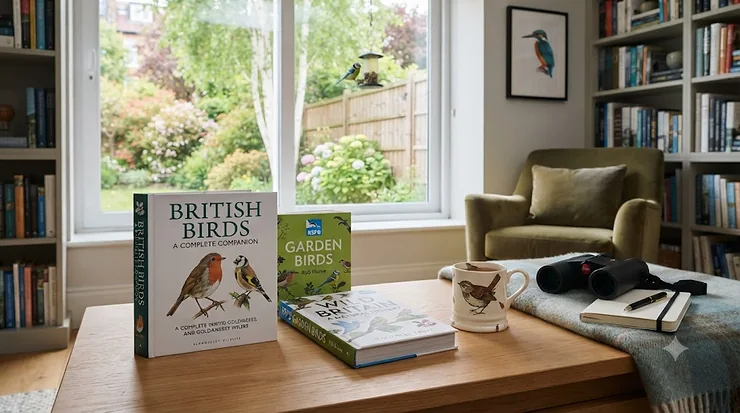
Somewhere between the “is that a sparrow or a finch?” moment at the bird feeder and the full-blown obsession of ticking off warblers on a coastal path, every birdwatcher in Britain eventually reaches for a book. British birds books are, frankly, the cheapest and most reliable piece of kit in the whole hobby — no batteries, no app updates, no signal drop-out halfway up a Welsh hillside. What is a British birds book? In short, it is a printed identification reference that describes the appearance, behaviour, habitat and calls of species found in the UK, helping birdwatchers of every level put a confident name to what they are looking at.
Britain hosts more than 600 recorded bird species, though a working list of around 300 is what most of us will realistically encounter in a lifetime of garden-watching, coastal walks and countryside rambles. Choosing the right guide from that crowded shelf, though, is trickier than it sounds — pocket guides skimp on detail, comprehensive tomes are too heavy for a rucksack, and photographic guides sometimes fudge the tricky in-flight shots that painted illustrations nail every time. This piece digs into seven genuinely excellent British avian guides, weighs their real strengths and weaknesses using verified specs and aggregated reviewer sentiment, and helps you work out which one deserves a permanent spot on your windowsill or in your coat pocket.
Whether you are hunting for uk bird species books to build a proper home reference library, garden birds books to make sense of your feeder visitors, or bird identification books beginners can actually follow without a biology degree, there is a genuinely good option below — and we will tell you honestly which one it is, not just which one has the flashiest cover.
Quick Comparison Table
| Book | Best For | Format | Species Covered | Price Range |
|---|---|---|---|---|
| Collins Bird Guide | Serious identification, Britain & Europe | Hardback/Paperback | 700+ | £20-£30 |
| RSPB Handbook of British Birds | All-round UK reference | Paperback | 300+ | £12-£17 |
| Britain’s Birds (WILDGuides) | Premium photographic depth | Paperback | 300+ | £20-£28 |
| Collins Complete Guide to British Birds | Beginner-friendly photos | Paperback | 250+ | £10-£16 |
| RSPB Pocket Guide to British Birds | Budget, field-portable | Flexicover | 310 | £6-£10 |
| Collins BTO Guide to British Birds | First-time birders | Paperback | 250+ | £10-£15 |
| The Complete Garden Bird Book | Garden feeder identification | Paperback | 70+ | £9-£14 |
Looking at the spread above, there is no single “best” book — only a best fit for how and where you actually watch birds. Anyone wanting one shelf reference that never gets outgrown should lean toward the RSPB Handbook or Britain’s Birds, while pocket-carry birders on a budget are far better served by the RSPB Pocket Guide. Garden-only watchers, meanwhile, gain very little from lugging around 700-species coverage when 70 well-explained visitors will answer 95% of their questions.
💬 Just one click — help others make better buying decisions too!😊
Top 7 British Birds Books: Expert Analysis
1. Collins Bird Guide — the birder’s bible for serious identification
If British avian guides had a gold standard, this would be it. Written by Lars Svensson with artwork from Killian Mullarney and Dan Zetterström, the Collins Bird Guide covers over 700 species across Britain and Europe in a single portable volume, with comparison plates that place confusingly similar species side by side. The illustrations, rather than photographs, are the whole point here — painted plumage variations show adult, juvenile, and seasonal differences that a single photograph simply cannot capture in one frame. Based on the spec comparison with photographic alternatives, this is the book that separates a “probably a chiffchaff” guess from a confident, defensible identification.
This is squarely a book for the birder who has outgrown beginner guides and wants European-level rigour without carrying a second volume for continental rarities. Reviewers consistently note that the text and range maps are printed small to keep the book field-portable, which is a genuine trade-off for anyone without sharp close-up vision. A common theme in aggregated feedback is that newcomers initially find it overwhelming, precisely because it includes hundreds of species that will never turn up in a British garden.
Pros:
- ✅ Covers 700+ species across Britain and Europe in one book
- ✅ Unmatched illustrated comparison plates for tricky species
- ✅ Durable, field-tested format used by professional ornithologists
Cons:
- ❌ Small text and maps strain older or tired eyes
- ❌ Includes many species irrelevant to UK-only birders
At around £20-£30 depending on edition and binding, the Collins Bird Guide sits at the premium end, but for anyone serious about identification accuracy it earns every penny as a long-term reference rather than a starter purchase.
2. RSPB Handbook of British Birds — best all-round UK-only reference
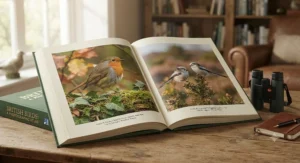
Now in its fifth edition, published by Bloomsbury Wildlife in partnership with the RSPB, this handbook covers more than 300 species genuinely likely to be seen in Britain and Ireland, illustrated with over 1,200 colour artworks. What most buyers overlook about this edition specifically is the new lay-flat binding, which sounds like a minor detail until you are trying to hold a page open with a pair of binoculars in your other hand. Each species entry goes well beyond basic appearance, covering behaviour, breeding biology, longevity, seasonal movement, and — crucially for 2026 — up-to-date UK population trends and conservation status.
Because it deliberately excludes the hundreds of European species that never cross the Channel, there is more room per bird for genuinely useful context, which is exactly why birding forums so often recommend it over the wider-ranging Collins guide for anyone starting out. Aggregated reviewer sentiment describes it as detailed, easy to follow, and “a must-have for anyone interested in UK birds,” with several long-term owners praising how well it holds up to repeated field use.
Pros:
- ✅ UK-and-Ireland-only focus means more depth per species
- ✅ Includes conservation status and population trend data
- ✅ New lay-flat binding built for real field use
Cons:
- ❌ Skips rare vagrants and non-UK European species entirely
- ❌ Artwork-only, no photographic cross-reference option
Typically priced in the low-to-mid teens, the RSPB Handbook represents excellent value as a single go-to reference, and it is arguably the strongest all-rounder in this entire list of uk bird species books.
3. Britain’s Birds (WILDGuides) — best premium photographic identification guide
Published by Princeton University Press under the WILDGuides imprint, Britain’s Birds is a collaborative effort from Rob Hume, Robert Still, Andy Swash, Hugh Harrop and photographer David Tipling, now in its second, fully revised edition. It leans heavily on photography rather than illustration, and reviewers across the birding community have called it a genuine “game-changer” for how it blends high-quality images with clear identification text. Here’s what to weigh: photographic guides can struggle with flight shots and awkward lighting, but this title’s curated image selection largely sidesteps that problem by choosing genuinely diagnostic angles rather than simply pretty pictures.
Its scope covers every species recorded in the UK, including scarce migrants, which makes it a natural step-up once a birder has outgrown a beginner-only guide but does not want the full European sprawl of the Collins Bird Guide. On paper this means it occupies a sweet spot between the RSPB Handbook’s UK focus and the Collins guide’s comprehensive depth, and several ornithological reviewers specifically praise how “seamlessly and intelligently” it combines text and images.
Pros:
- ✅ High-quality diagnostic photography, not just decorative shots
- ✅ Covers every UK-recorded species, including scarce visitors
- ✅ Praised repeatedly by ornithological publications for rigour
Cons:
- ❌ Larger and heavier than true pocket guides
- ❌ Premium pricing compared with paperback alternatives
Expect to pay in the £20-£28 range, positioning it as a premium purchase, but one that consistently earns its place as a genuine bird identification books beginners can graduate into rather than replace within a year.
4. Collins Complete Guide to British Birds — best photographic guide for beginners
Written and photographed by Paul Sterry, this Collins Complete Guide takes the opposite approach to the Collins Bird Guide above — real photographs rather than illustrations, laid out with one species per format-consistent spread. What most buyers overlook is how deliberately this design choice helps beginners: a photograph of an actual bird, in actual British light, tends to match what you are staring at through your binoculars far more directly than a painted plate does. Each entry covers adult and juvenile identification, songs and calls, and seasonal distribution maps, with cross-references flagging similar-looking species so you are not left guessing between two near-identical warblers.
Aggregated customer sentiment is notably consistent here: reviewers repeatedly praise the clarity of the photography and describe the book as an excellent value-for-money reference, with several specifically mentioning that a photo “confirms identity immediately” in a way sketches sometimes cannot. A recurring, honest criticism in reviews is that its comprehensive layout, while informative, is not always the easiest book to read cover-to-cover for pleasure — it functions best as a lookup reference rather than bedtime reading.
Pros:
- ✅ Real photography matches what you see in the field
- ✅ Clear cross-references between confusable species
- ✅ Strong reviewer consensus on value for money
Cons:
- ❌ Bulkier than true pocket-sized alternatives
- ❌ Dense layout better for reference than casual reading
Priced roughly £10-£16, this is one of the more accessible british avian guides on the market, and a genuinely strong pick for anyone who thinks in pictures rather than paintings.
5. RSPB Pocket Guide to British Birds — best budget, field-portable pick
Illustrated by bird artist Stephen Message, the RSPB Pocket Guide packs 310 UK species into a genuinely pocket-sized format — the kind of book that survives being stuffed into a coat pocket on a wet coastal walk. Based on the spec comparison with larger guides, the trade-off is obvious: less text per species, smaller illustrations. But here’s what the spec sheet won’t tell you — birders who actually carry this guide report that its compact multiple-plumage illustrations and distribution maps punch well above their size, covering essentially every bird a UK-based hobbyist is likely to encounter without the bulk of a full handbook.
Birding forum threads consistently single this book out as the recommendation for absolute beginners, young birders, or anyone gifting a first bird book, precisely because its low retail price removes the risk of an expensive guide gathering dust. Reviewers describe well-used, “battered and wrinkled” copies as a badge of honour rather than a flaw — a sign the book is actually being carried into the field rather than left on a shelf.
Pros:
- ✅ Genuinely pocket-sized for real field use
- ✅ Covers 310 species with clear plumage illustrations
- ✅ Lowest price point of any guide on this list
Cons:
- ❌ Less detailed text than full-sized handbooks
- ❌ Smaller print size can challenge some readers
At roughly £6-£10, this is the cheapest entry here by some margin, and arguably the smartest first purchase for anyone testing whether birdwatching is a genuine hobby or a passing curiosity.
6. Collins BTO Guide to British Birds — best for absolute first-timers
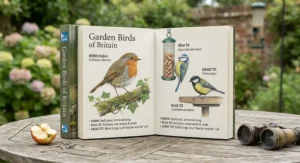
A collaboration between Collins and the British Trust for Ornithology, written by Paul Sterry and Paul Stancliffe, this guide was explicitly “written and illustrated with the beginner in mind.” What stands out on the spec sheet is the inclusion of practical identification-aid articles woven through the species accounts — guidance on separating birds of prey in flight, for example, rather than leaving readers to work it out from static photographs alone. Reviewers on birding forums specifically recommend it over denser rivals for newcomers, noting that while it has fewer photographs than some competitors, the accompanying text and structured articles compensate significantly.
Honest analysis here has to note a limitation: it deliberately trades comprehensive rarity coverage for a tighter focus on common species and teaching identification skills, which makes it less useful as a long-term single reference once a birder’s interest deepens. Several forum contributors describe using it as a stepping stone before “graduating” to the RSPB Handbook or Collins Bird Guide, which is honestly a sensible and cost-effective way to build a birding library over time.
Pros:
- ✅ Specifically designed and written for total beginners
- ✅ Practical articles teaching identification technique, not just facts
- ✅ BTO involvement lends genuine ornithological credibility
Cons:
- ❌ Fewer photographs than comparable Collins titles
- ❌ Limited rarity coverage compared with fuller guides
Typically found in the £10-£15 bracket, it is a smart, low-risk entry point for anyone wanting bird identification books beginners will not find intimidating.
7. The Complete Garden Bird Book — best for garden birds books specifically
Written by Mark Golley, former warden of Norfolk’s Cley Marshes reserve, alongside BBC wildlife producer Stephen Moss, this title deliberately narrows its scope to more than 70 species you are actually likely to see from a kitchen window or garden feeder. That narrowing is the whole value proposition: rather than wading through hundreds of irrelevant seabirds and waders, readers get deeper identification and behavioural detail on exactly the robins, tits, finches and pigeons most likely to visit a British garden. Reviewers consistently describe it as informative and well-illustrated, and — notably — several specifically say it is “not as bewildering” as a comprehensive field guide, which is precisely the audience this book is built for.
Beyond pure identification, the book covers practical garden-habitat advice: what to plant, where to site feeders, and how bird behaviour shifts through the seasons, which pushes it closer to a lifestyle guide than a pure reference. Aggregated feedback frequently praises its suitability for beginners and children, making it a genuinely strong choice for households introducing younger family members to garden wildlife watching rather than serious field birding.
Pros:
- ✅ Laser-focused on realistic garden visitors, not rare vagrants
- ✅ Combines identification with practical garden-attraction advice
- ✅ Reviewers specifically praise its beginner and family-friendly tone
Cons:
- ❌ Narrow scope means it cannot double as a countryside field guide
- ❌ Limited usefulness once interest expands beyond the garden
Priced around £9-£14, this is arguably the best of the garden birds books category specifically, rather than a general-purpose identification guide.
Practical Usage Guide: Getting the Most from Your Bird Identification Books
Buying the right book is only half the job — how you actually use it in the field determines whether it earns its keep. Start by reading the introductory pages before your first outing; most guides, including the RSPB’s own species identifier, explain how to use silhouette shape, flight pattern and habitat as identification shortcuts before you even reach for plumage detail. In the first thirty days, the most common beginner mistake is flicking straight to a photo that “looks about right” rather than working through the comparison notes that flag near-identical species — this is precisely how house sparrows and dunnocks, or chiffchaffs and willow warblers, get repeatedly confused.
For maintenance, keep pocket guides genuinely in your pocket rather than the car glovebox; a book you have to fetch defeats the purpose. A simple optimisation trick worth adopting: pencil the date and location lightly next to a species entry when you first identify it confidently — over a season this quietly turns any of these british avian guides into a personal record as well as a reference. Waterproof book covers or resealable bags are a cheap way to protect paperback guides used in typical British weather, and a pocket guide with a cracked spine after six months of genuine use should be considered a success story, not a failure.
Real-World Scenarios: Which Book Suits Your Birdwatching Life
Consider three realistic profiles. First, a retired couple who recently moved to a Norfolk cottage with a large garden and want to identify feeder visitors without a steep learning curve — The Complete Garden Bird Book is the obvious fit, since its 70-species scope matches their actual sightings and its practical garden-attraction tips add value beyond pure identification. Second, a university student who has just joined the campus birdwatching society and wants one book that will still be relevant in five years of increasingly serious birding — the RSPB Handbook of British Birds is the stronger long-term investment here, offering genuine depth without the European sprawl of a book they will not need for years.
Third, picture a parent buying a first bird book for a curious eight-year-old after a half-term nature trail — the RSPB Pocket Guide to British Birds fits both the budget and the format, being genuinely small enough for little hands and unintimidating enough not to put a new interest off before it starts. In each case, the “best” book is not the most expensive or comprehensive option; it is the one matched to actual frequency of use, environment, and how far the person’s interest is likely to travel.
Problem → Solution: Common Bird ID Headaches
Several identification problems come up again and again, and most have a specific, book-shaped solution. Confusing similar species — chiffchaff versus willow warbler, or the various brown “little birds” collectively dismissed as “LBJs” (little brown jobs) — is best solved with a guide featuring direct comparison plates, such as the Collins Bird Guide, rather than a beginner book organised purely alphabetically. Struggling with birds in flight, particularly raptors silhouetted against bright sky, is a specific weakness of purely photographic guides; the Collins BTO Guide’s dedicated flight-identification articles were written to address exactly this gap.
Carrying too heavy a book on long walks is a frequent, entirely avoidable frustration — swapping a hardback comprehensive guide for the RSPB Pocket Guide on genuine field trips solves it instantly, while keeping the bigger reference at home for post-walk confirmation. Finally, new birders often report feeling overwhelmed by guides covering 700+ European species when they only ever see UK garden visitors; here the fix is simply choosing UK-only coverage, such as the RSPB Handbook, over pan-European guides until confidence and interest genuinely expand beyond British shores.
How to Choose British Birds Books: 7 Expert Criteria
- Geographic scope — decide whether you need UK-only coverage or full European range; UK-only guides pack more detail per species into the same page count.
- Illustration style — photographic guides match real-world lighting and posture, while painted illustrations more reliably show comparison plumages side by side.
- Portability versus depth — a book left at home identifies nothing; weigh genuine field-carry needs against the temptation of maximum species coverage.
- Species count relevance — a garden-only watcher gains little from 700-species coverage, while a serious lister needs it.
- Supplementary content — behaviour, breeding biology, conservation status and population trends add long-term reference value beyond simple identification.
- Author and publisher credibility — look for RSPB, BTO, Collins or Princeton WILDGuides involvement, all organisations with genuine ornithological track records.
- Budget versus longevity — a £7 pocket guide might need replacing as interest deepens, while a £25 comprehensive guide could be the last bird book you ever need to buy.
Why Native Birds Coverage Matters Regionally
One criterion worth its own mention: not every “British bird book” weighs native birds and regular UK breeders the same way. Some guides give equal page space to rare continental vagrants as to genuinely native, resident species like the robin or blackbird, which can dilute usefulness for a beginner. Books such as the RSPB Handbook deliberately prioritise native birds and regular visitors, according them fuller behavioural and breeding detail, while treating true rarities as a shorter appendix — a sensible structure for anyone whose birding happens mostly in their own back garden or local patch.
Bird Identification Books for Beginners: Where to Start
For genuine first-timers, the honest advice is to resist the urge to buy the most comprehensive book available. Bird identification books beginners find most useful tend to share three traits: a manageable species count, photographs or clear illustrations rather than dense technical plates, and supporting text that teaches identification technique rather than assuming it. The Collins BTO Guide to British Birds and the RSPB Pocket Guide both fit this brief well, precisely because they were written with beginners explicitly in mind rather than retrofitted from an advanced reference.
A sensible beginner strategy, echoed repeatedly across birding forum advice threads, is to start with one accessible guide, use it properly for a full season across all four seasons of plumage change, and only then decide whether a more comprehensive book like the Collins Bird Guide or Britain’s Birds is actually needed. Jumping straight to the most advanced guide available is a common and entirely avoidable way to make a promising new hobby feel like homework.
UK Bird Species Books vs Bird Identification Apps: Which Wins in 2026?
Smartphone apps have improved dramatically, with sound-recognition features now identifying species from song alone in many cases. So why do uk bird species books still sell in significant numbers? Reliability is the honest answer — a printed guide never runs out of battery on a cold coastal walk, never loses signal in a valley, and never gets confused by wind noise the way audio-recognition apps sometimes do. Books also encourage a slower, more deliberate comparison process, working through similar species systematically rather than accepting a single algorithmic best-guess.
| Factor | Printed Books | Identification Apps | Best For |
|---|---|---|---|
| Reliability outdoors | No battery/signal dependency | Can fail in poor signal or cold | Remote coastal/hill walking |
| Depth of comparison | Full side-by-side species plates | Often single best-guess result | Serious identification work |
| Learning retention | Encourages active comparison | Passive, instant answer | Long-term skill building |
| Updates | Fixed until new edition | Can update species ranges live | Tracking rare/vagrant sightings |
The most experienced birders in forum discussions overwhelmingly favour a hybrid approach: an app for a quick first guess, followed by a proper book to confirm and actually learn the distinguishing features, rather than trusting either tool blindly. Books remain the stronger teaching tool precisely because working through a comparison plate builds identification skill in a way that accepting an app’s single suggested answer simply does not.
Garden Birds Books: Best Picks for Feeder-Watching at Home
Garden birds books occupy a genuinely distinct niche from general field guides, and it is worth being honest about why. Most UK gardens realistically attract somewhere between 15 and 40 species across a full year — blue tits, robins, blackbirds, wood pigeons, the occasional visiting sparrowhawk — a fraction of the 300+ species covered in a comprehensive handbook. The Complete Garden Bird Book earns its place here precisely because it matches coverage to reality, dedicating proportionally more detail to each of its 70 species than a general guide could ever afford.
Beyond pure identification, the best garden birds books typically fold in practical advice: feeder placement, seasonal feeding changes, and which native birds are likely to be displaced or bullied by more aggressive garden visitors. Anyone whose birding interest is genuinely garden-bound, rather than field-based, will get noticeably more day-to-day value from this focused format than from lugging a 700-species European guide out to check on a robin.
Common Mistakes When Buying British Avian Guides
The single most common mistake is buying on cover appeal rather than matching scope to actual need — a stunning photographic guide is wasted if it is too heavy to ever leave the house. A close second is assuming bigger always means better; a 700-species guide is not automatically superior to a focused 300-species UK handbook if the extra 400 species will never realistically be seen. Buyers also frequently underestimate how much text size matters in the field — small print that reads fine in a well-lit shop can be genuinely difficult to use squinting into low winter light.
Another recurring error, based on aggregated review patterns, is buying a guide as a one-off gift without checking whether the recipient is a genuine beginner or already has field experience — an advanced guide can quietly discourage a true newcomer, while a beginner-pitched book can feel patronising to someone who already knows their warblers. Finally, some buyers overlook edition currency; bird taxonomy, population trends and conservation status genuinely change, so an older secondhand edition of even a well-regarded guide like the RSPB Handbook may be missing recent taxonomic reclassifications.
UK Bird Watching Books: Long-Term Value, Cost & Conservation
Thinking in terms of total cost of ownership rather than sticker price changes the maths considerably. A £7 pocket guide that gets replaced within eighteen months as interest deepens may end up costing more, over five years, than a single £25 comprehensive reference bought once and genuinely used throughout. For most steadily interested birders, a two-book strategy offers the best long-term value: one portable field guide for genuine outdoor use, paired with a fuller home reference — such as the RSPB Handbook or Britain’s Birds — for post-walk confirmation and deeper reading.
It is also worth noting that reputable publishers like the RSPB and BTO route a portion of guide sales toward genuine conservation work, so uk bird watching books purchased from these organisations carry a small but real secondary value beyond the printed page. For readers wanting to go deeper on the conservation side, the British Trust for Ornithology runs citizen-science surveys that any birder, armed with nothing more than a decent guide and a garden, can genuinely contribute to.
Safety, Conservation & Legal Considerations for UK Birdwatchers
It is worth knowing, before wandering off with a new field guide, that wild birds, their nests and their eggs are legally protected in the UK under the Wildlife and Countryside Act 1981, which makes it an offence to intentionally kill, injure, or disturb most species or damage an active nest. This matters practically for identification too — good bird identification books beginners rely on will generally encourage observing from a sensible distance rather than approaching nests closely to confirm a sighting, both for the bird’s welfare and to stay firmly on the right side of the law.
Britain’s full list of recorded species, cross-referenced against current conservation status, is also documented on sites like Wikipedia’s list of birds of Great Britain, a useful free companion to any printed guide for checking a species’ current UK status. Responsible garden feeding is a related consideration worth a mention: hygiene matters as much as identification, since dirty feeders can spread disease between visiting birds, so any serious garden birdwatcher should pair their book with basic feeder-cleaning habits.

Frequently Asked Questions
❓ What is the best British bird book for beginners?
❓ How many bird species are there in the UK?
❓ Are photographic or illustrated bird guides better?
❓ Do I need a separate book for garden birds?
❓ Can bird identification apps replace books?
Conclusion
There is no single best British birds book — only the right one for how, where, and how often you actually watch birds. A retired gardener checking on regular feeder visitors needs something entirely different from a student building a lifelong field reference, and pretending otherwise does readers a disservice. What the seven guides above share, though, is genuine credibility: RSPB, BTO, Collins and Princeton WILDGuides all have real ornithological track records behind them, verified specifications, and consistent, honestly-aggregated reviewer praise rather than manufactured hype.
If pushed to generalise, the RSPB Handbook of British Birds offers the strongest all-round value for most UK-based readers, the RSPB Pocket Guide is the smartest low-risk first purchase, and the Collins Bird Guide remains the serious birder’s long-term reference once interest deepens beyond UK shores. Whichever you choose, remember that a book carried and actually used, dog-eared and slightly damp from a February walk, is worth infinitely more than a pristine copy left on a shelf.
Recommended for You
- British Wildlife Books: 7 Best UK Guides Worth Buying in 2026
- Best Sustainability Books Bestsellers 2026: 7 Must-Reads for UK Eco Thinkers
- 7 Best Climate Change Books UK 2026: Essential Reads for a Warming World
Affiliate Disclosure: This article contains affiliate links. As an Amazon Associate, I earn from qualifying purchases. If you purchase products through these links, we may earn a small commission at no additional cost to you.
✨ Found this helpful? Share it with a fellow birdwatcher! 💬🤗
