

In This Article
There’s a particular kind of silence that falls over a garden the moment you finally identify the bird that’s been driving you mad for a week — that flash of rusty orange wasn’t a robin at all, it was a redstart, and suddenly the whole hedge feels different. Bird watching books are the reference works, field guides, and companion volumes that teach identification, behaviour, and habitat, turning a vague blur of feathers into a species you can name with confidence. They range from slim pocket guides you can shove in a coat pocket to hefty photographic tomes that live permanently on the coffee table, and choosing the right one — or the right combination — makes an enormous difference to how quickly your eye actually learns. According to the British Trust for Ornithology’s Garden BirdWatch project, tens of thousands of ordinary households across the UK now contribute weekly bird sightings to genuine scientific research, and a decent book is usually the thing that tips a casual garden-watcher into a genuine contributor. This guide covers seven real, currently available titles, why each one earns its shelf space, and how to build a small library that actually gets used rather than gathering dust.

Affiliate disclosure: This article contains affiliate links. As an Amazon Associate, I earn from qualifying purchases, at no extra cost to you.
Quick Comparison Table
| Book | Format | Price Range | Best For |
|---|---|---|---|
| RSPB Birdwatching for Beginners | Paperback | Under £15 | Absolute newcomers |
| RSPB Pocket Guide to British Birds | Compact paperback | Under £10 | Field use, pocket-sized |
| RSPB Handbook of British Birds | Paperback reference | £10-£15 range | All-round home reference |
| Collins Bird Guide | Large paperback | £15-£25 range | Serious identification work |
| Britain’s Birds (WILDGuides) | Large paperback/hardback | £20-£30 range | Photographic identification |
| RSPB Children’s Guide to Birdwatching | Paperback | Under £10 | Children aged 8-12 |
| My Bird Watching Journal | Spiral/paperback journal | Under £10 | Gifts, recording sightings |
Looking at the spread, there’s a genuine sweet spot forming around the RSPB range for anyone starting from zero, while the Collins and WILDGuides titles are where you graduate once garden birds stop being a mystery and you want to tackle waders on an estuary. Price rises roughly in line with page count and photographic detail, though the journal is the odd one out here — it’s not an identification tool at all, it’s a way of making the hobby stick.
💬 Just one click — help others make better buying decisions too!😊
Top 7 Bird Watching Books: Expert Analysis
Choosing the right bird watching books early on genuinely shapes how quickly you progress, because a guide that’s too dense just gets left in a drawer while one that’s too thin leaves you guessing. Here are seven real, currently available titles spanning complete beginner through to serious enthusiast.
1. RSPB Birdwatching for Beginners — best true starting point for newcomers
Written by Rob Hume, a 24-year RSPB veteran who now edits the society’s own Birds magazine, this book does exactly what its title promises without drowning a total newcomer in Latin names and wing-formula jargon. Based on the spec comparison with denser field guides further down this list, the real value here is structural: it walks through what equipment you actually need, how to attract birds to a garden, and only then moves into identification, which is the order most beginners genuinely need. Reviewers consistently describe it as “beautifully produced” and credit it with helping them separate confusingly similar finches at a garden feeder for the first time — a small win that, anecdotally, is often what keeps someone hooked on the hobby. What most buyers overlook is that this book works just as well as a gift for a curious eight-year-old as it does for an adult starting from scratch, since several reviewers mention buying it for grandchildren who then dragged a grandparent back into birding too.
Pros:
- ✅ Written by a genuine 24-year RSPB expert
- ✅ Structured for complete beginners, not enthusiasts
- ✅ Works equally well as a gift for children or adults
Cons:
- ❌ Too basic once you’re identifying beyond garden regulars
- ❌ Limited depth on migration and rarer species
At under £15, this is the sensible first purchase for anyone who’s just started noticing birds and wants to know more.

2. RSPB Pocket Guide to British Birds — most pocketable field companion
Simon Harrap’s pocket guide covers 215 of the UK’s most commonly encountered species with roughly 950 colour illustrations and matching distribution maps, all compressed into something that genuinely fits in a coat pocket rather than merely claiming to. Here’s what to weigh: covering only 215 species rather than the thousand-plus in a full European guide sounds like a limitation, but in practice it means more space per bird and considerably less time flicking through pages of species you’ll never actually encounter in a British hedge. Aggregated review sentiment is strongly positive, with well over a hundred reviewers specifically praising how informative it is relative to its size, and several noting the inner cover folds out into a bookmark — a small design touch that repeatedly gets singled out as more useful than it sounds. On paper this means it’s the ideal second purchase after a beginner’s book: small enough to actually carry on a walk, detailed enough to nail identification on the spot rather than trying to remember details for later.
Pros:
- ✅ Genuinely pocket-sized for field use
- ✅ Over 100 verified reviewers praise its informativeness
- ✅ Fold-out bookmark built into the cover
Cons:
- ❌ Covers only common species, not rarities
- ❌ Text is necessarily brief given the compact format
Priced under £10, it’s one of the best-value bird watching guide books on this entire list.
3. RSPB Handbook of British Birds — best all-round RSPB reference
Now in its fifth edition, this handbook from Peter Holden MBE and Professor Richard Gregory covers more than 300 species with hand-painted illustrations rather than photographs — a deliberate choice, since illustrations can show a bird standing, in flight, and in both male and female plumage on a single page in a way photography often can’t manage as cleanly. What most buyers overlook about rspb bird books in this reference category is that they’re not purely identification tools; this one details breeding biology, population trends, and conservation status for each species, meaning it doubles as a genuine primer on British ornithology rather than a spotter’s checklist. Reviewers consistently praise its compact size relative to the depth of information packed in, with several specifically noting it’s “easy to use” and strikes a good balance for both beginners and more experienced birdwatchers working the same shelf. Based on the spec comparison with the pocket guide above, this is the natural next step once you want the “why” behind a bird’s behaviour and not just the “what it looks like.”
Pros:
- ✅ Over 300 species with behaviour and conservation detail
- ✅ Hand-painted illustrations show multiple plumages per bird
- ✅ Praised repeatedly for ease of use despite its depth
Cons:
- ❌ No photographs, which some readers prefer for realism
- ❌ Larger and less pocketable than the dedicated pocket guide
In the £10-£15 range, this is arguably the best-value all-round RSPB bird book a UK household can own.
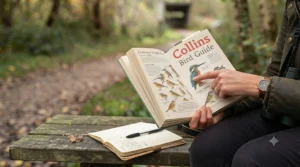
4. Collins Bird Guide — most comprehensive for serious identification
Now in its third edition, the Collins Bird Guide by Lars Svensson, Killian Mullarney and Dan Zetterström covers the birds of the entire Western Palaearctic — Britain and Europe plus North Africa and parts of the Middle East — across 478 pages containing more than 4,000 colour illustrations, and has been described by reviewers as one of the most influential field guides of the modern era. What the spec sheet doesn’t fully convey is just how much this widens your net compared with UK-only guides: if you ever travel for birding, or a genuine rarity blows in on a UK coast, this is the book that will actually contain it. Reviewers who’ve used it for years consistently call it “the richest, most comprehensive of the current guides,” though a recurring and entirely fair criticism from earlier editions is that illustrations and text can feel cramped given how many species are squeezed onto each page — the third edition’s extra 32 pages specifically address this for several tricky groups like raptors, owls and terns. Honestly, this isn’t the first book anyone should buy; it’s the one serious birders reach for once they’re regularly seeing something that isn’t in their beginner guide.
Pros:
- ✅ Covers the whole of Europe, not just Britain
- ✅ Over 4,000 detailed colour illustrations
- ✅ Third edition specifically expanded tricky species groups
Cons:
- ❌ Can feel dense and cramped for absolute beginners
- ❌ Bulkier than UK-only field guides, less pocket-friendly
Expect to pay in the £15-£25 range depending on edition and format — a fair price for what’s widely regarded as the standard reference among serious ornithology books.
5. Britain’s Birds (WILDGuides) — best photographic identification guide
Authored by a team including Rob Hume and Andy Swash, this WILDGuides title takes the opposite approach to Collins: rather than painted illustrations, it uses roughly 3,600 real photographs to cover every bird species ever recorded in Britain and Ireland, in every plumage you’re likely to encounter. Based on the spec comparison with illustrated guides, the advantage here is realism — photographs capture the exact lighting, posture and colour variation you’ll actually see through binoculars, which illustration, however skilled, can only approximate. Reviewers across the birding community consistently rank this among the best photographic bird spotting guides available, with one describing the photo quality as delivering “an art gallery experience,” though a genuinely honest drawback that recurs in reader discussion is bulk — at 576 pages it’s too large for a coat pocket and works better as a car-boot or desk reference than a walking companion. What most buyers overlook is that this makes it an excellent complement to a pocket guide rather than a replacement for one; use the pocket guide in the field and this one to confirm a tricky sighting once home.
Pros:
- ✅ Roughly 3,600 real photographs across every UK species
- ✅ Shows realistic plumage variation better than illustrations
- ✅ Consistently rated among the best photographic guides available
Cons:
- ❌ Too large and heavy for regular field carrying
- ❌ Premium price compared with pocket-sized alternatives
At £20-£30, it’s a genuine investment, but one that reviewers overwhelmingly consider worth it for the identification confidence it provides.
6. RSPB Children’s Guide to Birdwatching — best introduction for young birders
Written by David Chandler and Mike Unwin, both long-serving RSPB and BirdLife International writers, this guide is aimed squarely at children aged 8-12 and structured in two clear halves: general birding advice first — where to go, what to bring, how to attract birds to a garden — followed by a genuine field guide to more than 130 common UK and Irish species. Here’s what to weigh honestly: it’s more detailed than many similar children’s titles, which is exactly why reviewers repeatedly describe it as better laid out and more accessible than competing books aimed at the same age group, without feeling like a watered-down adult guide. Aggregated review sentiment is strongly positive for gifting specifically, with parents and grandparents describing it as the book that turned an afternoon glance at the garden into a genuine shared hobby across generations. What most buyers overlook is that the second-hand market for this exact title is healthy and the content dates gracefully, since UK garden bird species haven’t changed dramatically since publication.
Pros:
- ✅ Written by genuine RSPB and BirdLife International authors
- ✅ Covers over 130 species without oversimplifying
- ✅ Consistently praised as a cross-generational gift
Cons:
- ❌ Aimed narrowly at the 8-12 age bracket
- ❌ Less useful once a young birder outgrows beginner content
Priced under £10, this is one of the most thoughtful bird watching gifts for a child showing early curiosity about wildlife.
7. My Bird Watching Journal — best bird watching gift for recording sightings
Written by Rene V. Downs, this is a genuinely different category of book: not an identification guide at all, but a structured journal for logging sightings, dates, locations and observations, explicitly marketed as a gift idea for kids, teens and adults alike. What most buyers overlook about journals like this one is that they’re not meant to replace a field guide — they’re meant to sit alongside one, giving a birder somewhere to actually record what a guide book helped them identify, which is how a life list starts to take shape over months and years. Reviewer sentiment here is honestly mixed, and it’s worth reporting that honestly: several buyers loved it as a gift, including for an elderly relative kept mentally engaged by garden birds, while others expected more built-in bird information and were surprised to find a genuine one-bird-per-page journal format instead. The spec sheet won’t tell you this, but it’s worth reading a sample of the interior pages before buying if you’re hoping for a hybrid reference-and-journal rather than a pure logging book.
Pros:
- ✅ Doubles as a thoughtful, low-cost gift for any age
- ✅ Encourages genuinely building a personal life list
- ✅ Works well alongside any of the identification guides above
Cons:
- ❌ Contains minimal built-in bird identification content
- ❌ Some buyers found the one-bird-per-page format unexpected
At under £10, it’s an inexpensive add-on gift that pairs naturally with any of the identification-focused books above.
Top 7 Books: Full Comparison
| Book | Species Covered | Illustration Type | Page Count | Price Range |
|---|---|---|---|---|
| RSPB Birdwatching for Beginners | Common UK species | Photos & illustrations | Compact | Under £15 |
| RSPB Pocket Guide to British Birds | 215 species | Illustrations | Pocket-sized | Under £10 |
| RSPB Handbook of British Birds | 300+ species | Hand-painted illustrations | Compact reference | £10-£15 |
| Collins Bird Guide | Western Palaearctic (1,000+) | Illustrations | 478 pages | £15-£25 |
| Britain’s Birds (WILDGuides) | Every UK/Irish species recorded | ~3,600 photographs | 576 pages | £20-£30 |
| RSPB Children’s Guide to Birdwatching | 130+ species | Photos & illustrations | Compact | Under £10 |
| My Bird Watching Journal | N/A (logging journal) | N/A | ~100+ pages | Under £10 |
The clearest signal in this table is that species coverage and price rise together almost in lockstep, which makes sense — more species means more illustrations or photographs, which means more pages and production cost. Practically, that means nobody needs to start at the top: a beginner who buys Britain’s Birds before the RSPB Pocket Guide will likely find it overwhelming, whereas working upward through this table roughly mirrors how most birders’ actual libraries grow over a few years.
✨ Build Your Birding Library Today!
🔍 Click through on any of the seven titles above to check current pricing and availability. Whether you’re buying your first guide or your fifth, the right book makes every walk outside noticeably more rewarding!
Practical Usage Guide: Getting the Most from Your Bird Watching Guide Books
Owning bird watching guide books and actually using them well are two different things, and the gap between them is usually just a few small habits. Start by keeping your most-used pocket guide somewhere genuinely accessible — by the back door, in a coat pocket, in the car — rather than on a shelf, since a book you have to fetch is a book you’ll stop reaching for within a fortnight. When you spot something unfamiliar, note the size, silhouette, and behaviour before diving into the book, because flicking straight to pictures without first fixing those details in your head makes misidentification far more likely, especially between similar species. In the first thirty days of using a new guide, resist the urge to skip straight to “interesting” rare birds at the back of the book; spend that time thoroughly learning your ten or so most common garden visitors first, since confident identification of common species is what actually trains your eye for spotting when something unusual turns up. A common mistake is treating a photographic guide and an illustrated guide as interchangeable — use the illustrated guide to understand structural features like wing bars and eye-stripes, then cross-check against a photographic guide like Britain’s Birds to confirm what that actually looks like in real lighting conditions.
Real-World Scenarios: Matching Bird Watching Books to Your Life Stage
Picture a parent whose eight-year-old has suddenly become obsessed with the blue tits at the feeder — the RSPB Children’s Guide to Birdwatching paired with My Bird Watching Journal as a small gift set gives that curiosity somewhere structured to go, without overwhelming a young reader with adult-level detail. Now consider someone newly retired who’s decided this is finally the year they take up a proper hobby: RSPB Birdwatching for Beginners followed within a month by the RSPB Pocket Guide to British Birds covers both the “how do I even start” question and the practical field companion they’ll need on countryside walks. Finally, imagine a birder who’s been doing this for three or four years and has started noticing that the local reserve has waders and warblers their existing books don’t quite nail — that’s exactly the point at which the Collins Bird Guide or Britain’s Birds earns its higher price tag, since both were built for exactly this level of curiosity.
Buyer’s Decision Framework
If you’ve genuinely never identified a bird beyond “it was brown,” start with RSPB Birdwatching for Beginners rather than jumping straight to a comprehensive field guide that will only overwhelm you. If you already know your garden regulars and want a book to carry on walks, choose the RSPB Pocket Guide to British Birds for its combination of portability and depth. If your household is building a shared reference shelf rather than a single field companion, the RSPB Handbook of British Birds gives the best balance of detail and usability for multiple skill levels reading the same copy. If you travel for birding or want to be ready for a genuine rarity, choose the Collins Bird Guide for its European-wide coverage, and if photographic realism matters more to you than illustrated clarity, Britain’s Birds is the stronger pick. Whichever route you take, pairing any identification guide with a simple journal turns passive reading into an active, trackable hobby.
How to Choose Bird Watching Books
- Match the book to your actual skill level, not the level you aspire to — a beginner guide used thoroughly teaches more than a comprehensive guide skimmed nervously.
- Decide whether you need illustrations or photographs, since illustrations often show multiple plumages clearly while photographs capture realistic lighting and posture.
- Check the geographic scope, since UK-only guides devote more space per bird than European or global guides covering thousands of species you’ll rarely encounter.
- Consider portability separately from depth — a book that stays at home because it’s too heavy to carry provides no field value at all.
- Look for aggregated review themes around usability, not just star ratings, since a 4.5-star book that reviewers describe as “cramped” may not suit your eyesight or patience.
- Factor in who else will use it, since a household reference benefits from broader accessibility than a single enthusiast’s specialist guide.
- Add a journal alongside your first identification guide, since recording sightings from day one builds a genuinely rewarding long-term life list.
RSPB Bird Books: What Makes Them Different
RSPB bird books carry a specific kind of authority that comes from the organisation’s decades of hands-on conservation and monitoring work rather than purely commercial publishing. Authors across the RSPB range — Rob Hume, Peter Holden MBE, Professor Richard Gregory and others — have typically spent twenty, thirty, sometimes forty years working directly for the society, which shows up in details general nature publishers often miss, such as population trend data and conservation status alongside straightforward identification. What most buyers overlook about rspb bird books specifically is that buying them, whether directly or via the RSPB’s own shop, contributes in a small way to the charity’s wider conservation work, since RSPB Sales operates as a trading subsidiary that gifts its profits back to the society. Honestly, the RSPB range isn’t always the most visually striking on a shelf next to something like Britain’s Birds, but reviewers consistently rate the underlying content as trustworthy precisely because it’s written by people whose day job was UK bird conservation, not just nature writing.
Bird Watching Gifts: Choosing Books People Actually Use
The best bird watching gifts avoid two common traps: buying something too advanced for the recipient’s current interest level, and buying something so generic it never gets opened. A genuinely thoughtful gift pairs a book with the recipient’s actual circumstances — the RSPB Children’s Guide to Birdwatching for a curious child, the RSPB Pocket Guide to British Birds for an adult who’s mentioned wanting to learn but hasn’t taken the plunge, or My Bird Watching Journal as a low-cost add-on for someone who already owns an identification guide but has never actually logged a sighting. What most gift-buyers overlook is that a beautiful, comprehensive book like Britain’s Birds can actually intimidate a total beginner rather than delight them — reserve the impressive, expensive titles for someone who’s already shown sustained interest, not as an opening gift to spark it. Reviewer patterns across several of these titles consistently show that gifts pairing a simple book with binoculars or a garden feeder tend to get used far more than a book given alone, since the book then has an immediate, practical purpose from day one.

Birding Guides vs Ornithology Books: What’s the Difference
Birding guides and ornithology books sound interchangeable but serve genuinely different purposes, and understanding the distinction saves you buying the wrong thing twice. A birding guide — like the RSPB Pocket Guide or Collins Bird Guide — is fundamentally an identification tool, organised for speed: you see a bird, you flick to the relevant page, you compare features, you get an answer. Ornithology books, by contrast, tend to explore the science behind birds more broadly — breeding biology, migration patterns, population dynamics, evolutionary relationships — and the RSPB Handbook of British Birds sits comfortably in the middle of this spectrum, functioning as both. In practice, a household with genuine curiosity about birds usually ends up owning both categories: a quick-reference birding guide for the moment of spotting, and something with more scientific depth for evenings spent actually understanding what you saw and why it behaves the way it does.
| Category | Primary Purpose | Example from This List | Best Used |
|---|---|---|---|
| Birding guides | Fast species identification | RSPB Pocket Guide, Collins Bird Guide | In the field, in the moment |
| Ornithology books | Understanding behaviour and biology | RSPB Handbook of British Birds | At home, for deeper study |
This split matters practically because buying only birding guides leaves genuine gaps in understanding why a bird behaves the way it does, while buying only ornithology books without a fast field reference leaves you unable to actually name what’s in front of you outdoors.
Bird Spotting Guides: Field Use and Portability
Bird spotting guides live or die on portability, and the honest truth is that the single most important spec for this category isn’t page count or species covered — it’s whether you’ll genuinely carry it. The RSPB Pocket Guide to British Birds succeeds here specifically because its dimensions were designed around actually fitting a coat pocket, not merely described as “compact” in marketing copy. What most buyers overlook is that a spotting guide doesn’t need comprehensive coverage to be effective; narrowing to 215 regularly-seen UK species, as the RSPB pocket guide does, means faster page-flipping under real field conditions than a thousand-species European guide ever could manage. Britain’s Birds, while an outstanding photographic reference, simply isn’t built for this role — its bulk makes it better suited as a car-boot or desk reference you consult after a walk rather than during one, which is a genuinely useful distinction to keep in mind before buying based on review scores alone.
Common Mistakes When Buying Bird Watching Books
The single most common mistake is buying the most comprehensive, expensive guide available on the assumption that more species coverage automatically means a better book — for a genuine beginner, this usually backfires into an intimidating volume that gets shelved unread. Another frequent error is buying purely on Amazon star rating without checking whether reviewers are experienced birders or complete beginners, since a book rated highly by enthusiasts may be entirely unsuitable for someone who’s never identified a bird before. Buyers also commonly assume a journal like My Bird Watching Journal functions as an identification guide, when it’s genuinely a separate category meant to complement rather than replace a proper field guide. Finally, many people buy a single book and expect it to serve every purpose — field portability, home reference, and gift-worthy presentation rarely coexist in one title, so building a small, complementary collection generally serves a genuine birder better than searching for one perfect book.
Birdwatching Etiquette and the Law: What Every Guide Book Should Teach You
A detail that surprises many newcomers is that UK wild birds carry genuine legal protection, and a good bird watching book should at least touch on this alongside identification tips. Under the Wildlife and Countryside Act 1981, it is an offence to intentionally damage or destroy the nest of any wild bird while it’s in use or being built, and certain rarer species listed on Schedule 1 are additionally protected from deliberate disturbance while nesting. According to GOV.UK’s guidance on wild bird protection, this protection applies broadly across England, Scotland and Wales, with some variation in Northern Ireland under separate legislation, and it’s worth knowing before getting too close to a nest for a better photograph or clearer view. In practice, this rarely affects casual garden birdwatching, but it matters considerably more for anyone photographing nesting birds of prey or exploring hedgerows and woodland during spring and early summer, when the temptation to get closer for a better look is strongest.
Long-Term Value: Building a Birding Library Over Time
Viewed over several years, most genuine birders end up owning three or four books rather than one, and the total cost — typically £60-£90 across a beginner’s guide, a pocket field guide, a deeper reference, and perhaps a journal — compares favourably against almost any other outdoor hobby’s entry costs. This mirrors the pattern seen in organised citizen science too: the British Trust for Ornithology, founded back in 1932 to harness the efforts of amateur birdwatchers, has long shown that modest, sustained personal investment in books and observation skills pays off far beyond the initial outlay. Unlike equipment that wears out or becomes obsolete, a good bird watching book retains its value for years, since UK garden and countryside species haven’t changed dramatically, and even older editions of titles like the RSPB Handbook remain broadly useful even after a newer edition arrives. The genuine ongoing cost is minimal: perhaps a periodic upgrade to a newer edition of a field guide as species status and distribution maps are revised, and the odd replacement journal once the current one fills up. When you weigh the total cost of a small, well-chosen library against years of use, bird watching books represent one of the best value entry points into any wildlife hobby available in the UK today.
Frequently Asked Questions
❓ What is the best bird watching book for a complete beginner?
❓ Do I need more than one bird watching guide book?
❓ Are RSPB bird books better than other publishers?
❓ What makes a good bird watching gift for someone new to the hobby?
❓ Is it legal to get close to a bird's nest to take photographs?
Conclusion
Choosing among bird watching books really comes down to matching the guide to where you genuinely are in the hobby, not where you’d like to imagine yourself. Across the seven titles covered here, the honest pattern is that beginners are best served by the RSPB’s accessible range, while Collins Bird Guide and Britain’s Birds earn their higher price and larger footprint once curiosity has genuinely deepened. Ornithology books and birding guides serve different purposes, gifts work best when matched thoughtfully to the recipient’s actual interest level, and a simple journal turns passive reading into an active, trackable hobby. Whichever combination you land on, the real value of any of these books only shows up once you actually take them outside.
✨ Start Your Birding Library Today!
🔍 Ready to pick your first, or next, bird watching book? Click through on any of the seven titles above to check current pricing and availability, and consider pairing your choice with a simple journal to start building your own life list right away!
Recommended for You
- British Birds Books: 7 Best UK Guides to Buy in 2026
- British Wildlife Books: 7 Best UK Guides Worth Buying in 2026
- Best Sustainability Books Bestsellers 2026: 7 Must-Reads for UK Eco Thinkers
Disclaimer: This article contains affiliate links. As an Amazon Associate, I earn from qualifying purchases. If you purchase products through these links, we may earn a small commission at no additional cost to you.
✨ Found this helpful? Share it with your friends! 💬🤗
