

In This Article
Somewhere between “I really should sort my money out” and actually opening an investment account, most people stall. Not because investing is genuinely complicated — it isn’t, not at the beginner level — but because nobody hands you a map. That’s precisely what good investing books for beginners are meant to do: turn the vague anxiety of “I should probably be doing something with my savings” into a plan you can actually follow on a wet Tuesday evening with a cup of tea.
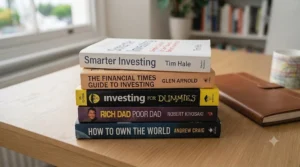
So, what is it we’re actually talking about? Investing books for beginners are guides written specifically to take someone with no financial background from “what’s a share, actually?” through to opening an account and building a simple, diversified portfolio, using plain language instead of City jargon. The best ones combine mindset, mechanics and a bit of scepticism about get-rich-quick promises.
This piece isn’t a repackaged Amazon listing. Every book below has been picked, compared and critiqued on its actual merits — where it shines, where it drags, and who it genuinely suits — because a book that transformed one reader’s finances can leave another cold. According to MoneyHelper’s beginner’s guide to investing, investing only really makes sense once your short-term finances are stable and you’re prepared to leave money untouched for several years — which is exactly the kind of groundwork a decent book should walk you through before you touch a single share. We’ve covered budget paperbacks, UK-specific strategy guides, and a couple of premium editions worth the extra spend, so whatever your starting point, there’s something here that fits.
Quick Comparison Table
| Book | Best For | Price Range | Difficulty |
|---|---|---|---|
| Rich Dad Poor Dad | Mindset reset, absolute beginners | Under £10 | Easy |
| The Naked Trader | UK share-picking with personality | £10-£15 range | Easy-Moderate |
| Smarter Investing | Long-term UK index strategy | £15-£20 range | Moderate |
| How to Own the World | Practical global investing on a UK budget | £10-£15 range | Easy-Moderate |
| The Little Book of Common Sense Investing | Wealth building via index funds | £10-£15 range | Easy |
| The Intelligent Investor | Serious value-investing foundations | £15-£20 range (premium hardback around £25) | Challenging |
| How to Fund the Life You Want | Structured UK financial planning | £12-£18 range | Easy-Moderate |
Here’s the pattern worth noticing: the cheapest option isn’t automatically the easiest read, and the most famous title on the shelf — The Intelligent Investor — is genuinely the hardest one here for a true novice to get through cover to cover. If you want something you’ll actually finish in a fortnight, Rich Dad Poor Dad or How to Own the World are far friendlier starting points, while Smarter Investing rewards readers who stick with it by handing them an entire UK-specific strategy at the end.
💬 Just one click — help others make better buying decisions too!😊
Top 7 Investing Books for Beginners: Expert Analysis
1. Rich Dad Poor Dad — best mindset reset for total beginners
Before you can pick a single fund, you need a reason to bother — and that’s precisely the gap Robert Kiyosaki’s contrast between his own father and his best friend’s father fills, using their differing attitudes to money as a springboard into ideas about assets, liabilities and financial independence. This isn’t a spreadsheet-heavy book: there’s no ISA walkthrough, no fund comparison, no British context whatsoever, since it’s written for a general American audience with a strong emphasis on financial mindset over mechanics.
Where this earns its place is in reframing how a reader thinks about money before the “how” of investing even comes up — the difference between buying things that make you money and things that just look like wealth is a genuinely useful lens, even if the specific real-estate examples don’t map onto the UK market. Based on the spec comparison with the more technical books on this list, it’s best treated as the on-ramp rather than the destination: read this first, then move to something with actual UK mechanics like Smarter Investing or How to Own the World.
Reviewers consistently note two things: the mindset shift genuinely sticks with people years later, and the specific financial claims and anecdotes have been challenged by several personal-finance commentators over the years for oversimplifying risk. A common complaint in reader feedback is that it’s long on motivation and short on concrete UK steps — treat it as chapter one of your journey, not the whole book.
Pros:
- ✅ Genuinely reframes how beginners think about assets vs liabilities
- ✅ Short, conversational chapters that don’t demand financial literacy
- ✅ Widely available secondhand, so cost is rarely a barrier
Cons:
- ❌ No UK-specific guidance on ISAs, pensions or platforms
- ❌ Some claims and anecdotes are contested by finance commentators
Prices typically sit under £10 for the paperback, which makes it one of the cheapest ways to test whether investing content actually holds your attention — decent value as a first purchase, poor value if it’s the only investing book you ever buy.

2. The Naked Trader — best UK share-picking guide with personality
Robbie Burns built a real, documented trading track record before writing this, and it shows in how unapologetically specific the advice is — screen-shots of actual trades, honest admissions of losses, and a running commentary that reads more like a mate down the pub than a finance textbook. The core mechanics — reading company results, spotting momentum, position sizing, using stop losses — are all explained with practical, small-account UK examples rather than abstract theory.
What most buyers overlook about this one is that it’s specifically about active share-picking on platforms like the London Stock Exchange’s AIM market, which is a materially different (and riskier) approach than the passive index investing most other books on this list recommend. That makes it a fascinating second or third read once you understand the basics, rather than book one — jumping straight into individual share-picking before you’ve grasped diversification is exactly the kind of mistake that empties beginner portfolios.
Aggregated reader sentiment is unusually consistent for a finance title: people repeatedly praise the humour and readability, and just as often note that the extroverted, confident tone can make risky active trading sound more reliably profitable than it is in practice. That tension is worth sitting with before you copy any specific trade idea.
Pros:
- ✅ Distinctly British examples using real UK shares and platforms
- ✅ Refreshingly honest about losing trades, not just wins
- ✅ Genuinely funny, which keeps you turning pages
Cons:
- ❌ Focused on active trading, which suits few true beginners
- ❌ Easy to underestimate the risk given the confident tone
Expect to pay in the £10-£15 range for a recent paperback edition — solid value if you’re specifically curious about UK share-picking, less essential if you already know you want a simple, passive approach.
3. Smarter Investing — best long-term UK index strategy
Tim Hale writes for an audience that’s slightly further along than total-novice, and it’s worth knowing that going in: this isn’t a “what is a share” primer, it’s a rigorous, evidence-based case for low-cost, globally diversified index investing, built specifically around the UK tax wrapper system (ISAs, pensions, the works). The 500-something pages cover asset allocation, rebalancing, cost drag and behavioural pitfalls in more depth than almost anything else aimed at retail UK investors.
Here’s what the spec sheet won’t tell you outright: the payoff for the extra effort is a genuinely complete framework you can implement and basically never need to revisit, rather than a string of hot takes that age badly. Based on the comparison with the other UK-specific titles here, this is the one investing-books-for-beginners readers graduate to once How to Own the World or Rich Dad Poor Dad have got them comfortable with the basics — think of it as the “do this once, properly” manual.
User reports across retail investing forums consistently flag it as one of the most-recommended books on UK investing communities, precisely because it doesn’t chase trends or stock tips — the flip side, mentioned just as often, is that its length and density can feel like homework for readers who wanted something breezier.
Pros:
- ✅ Deeply UK-specific: ISAs, pensions and tax wrappers covered properly
- ✅ Evidence-based approach avoids stock-tipping and hype
- ✅ One thorough read replaces years of scattered research
Cons:
- ❌ Denser and longer than most beginner-branded titles
- ❌ Assumes a little more starting knowledge than absolute zero
At £15-£20 range for the paperback, it costs more than the lighter titles here, but measured against the years of platform fees a well-chosen index strategy can save you, it’s arguably the best value-per-pound entry on this whole list.
4. How to Own the World — best practical global investing guide for UK readers
Andrew Craig set out to write the book he wished someone had handed him decades earlier, and the result reads less like a finance manual and more like a friend walking you through, step by step, how to actually open an account and buy your first diversified holding — currencies, gold, property and shares all get a plain-English treatment rather than being siloed into separate expert-only chapters. It’s aimed squarely at readers who’ve never invested a penny.
The standout feature here is accessibility without dumbing down the maths: fees, compounding and diversification are explained with enough real-world grounding that you can act on the advice within a weekend rather than needing a follow-up course. What most first-time readers overlook is that the platform and product recommendations date quickly in a fast-moving fintech market, so treat the specific app suggestions as a starting point for your own research rather than gospel — always cross-check current options and, per FCA guidance, confirm any platform is properly regulated before committing money.
Reviewers consistently describe it as the book that finally got them to actually open an account, rather than just feel informed — the most repeated theme in reader feedback is momentum: people report doing something within days of finishing it, which is rarer than it sounds in this genre.
Pros:
- ✅ Genuinely action-oriented — readers report actually opening accounts
- ✅ Covers currencies, gold and property alongside shares
- ✅ Written specifically with UK beginners in mind
Cons:
- ❌ Specific platform recommendations can go out of date
- ❌ Lighter on nuance than Smarter Investing for advanced planning
Typically priced in the £10-£15 range, this sits comfortably as one of the best-value picks here if your priority is actually starting rather than researching indefinitely.
5. The Little Book of Common Sense Investing — best introduction to wealth building through index funds
John C. Bogle founded Vanguard and effectively created the modern index fund, so when he argues that low-cost, broad-market tracking beats almost all professional stock-picking over the long run, it’s not a marketing line — it’s the thesis of an entire career, laid out here in short, digestible chapters rather than a dense textbook. The book leans heavily on historical US market data, but the underlying argument about costs eating returns applies just as directly to a UK stocks and shares ISA.
What most buyers overlook about this one is how much of its power comes from arithmetic rather than opinion: a 1% annual fee difference, compounded over 30 years, quietly consumes a genuinely startling share of your final pot, and Bogle walks through exactly why with real numbers rather than hand-waving. Based on the spec comparison with actively managed fund marketing, this book is the clearest, shortest case for why “boring” often beats “exciting” in a long-term portfolio.
Aggregated review sentiment is remarkably uniform for a finance book: readers consistently describe it as the single title that changed how they think about fund fees, with the most common critique being that a handful of chapters feel repetitive if you’ve already absorbed the core message early on.
Pros:
- ✅ Makes the maths of fund fees vivid and hard to ignore
- ✅ Short, focused chapters that don’t overstay their welcome
- ✅ Written by the person who actually built the index fund industry
Cons:
- ❌ US-centric examples need translating to UK products
- ❌ Some repetition once the core argument is established
Paperback copies sit in the £10-£15 range, with a hardback gift edition running closer to £20 — either is genuinely good value given how directly the fee-arithmetic argument can translate into pounds saved over decades.

6. The Intelligent Investor — best foundation in serious value investing
Benjamin Graham wrote the book that famously shaped a young Warren Buffett, and this revised edition — updated with modern commentary explaining how Graham’s mid-century examples map onto today’s markets — remains the closest thing the genre has to a canonical text. The core ideas (buying with a margin of safety, treating Mr Market’s mood swings as noise rather than signal, distinguishing investing from speculation) are foundational rather than beginner-friendly bedtime reading.
Here’s the honest analytical take: this is genuinely the toughest read on this list for a true beginner, and putting it in front of someone in week one of their investing journey is a common reason people abandon the whole project. Based on the spec comparison with the other titles here, it earns its “premium” position not through price but through depth — this is the book you return to once How to Own the World or Rich Dad Poor Dad have got the basics bedded in, not the one you start with.
Reviewers consistently flag the density of the prose and the dated stock examples as real barriers, even while near-universally praising the modern annotated commentary chapters for translating Graham’s principles into today’s context — a common piece of practical advice in reader discussions is to read the commentary sections first, then the original text.
Pros:
- ✅ The foundational text behind modern value investing
- ✅ Modern annotated commentary bridges old examples to today
- ✅ Principles hold up decades after first publication
Cons:
- ❌ Genuinely dense — a poor choice as your very first book
- ❌ Original stock examples feel dated without the commentary
Standard paperback editions run £15-£20 range, while a hardback or boxed collector’s edition can push toward £25 — worth the premium if you want a book you’ll actually keep and reread, less so if you just want a quick primer.
7. How to Fund the Life You Want — best structured UK planning guide, second edition
Robin Powell and Jonathan Hollow built this book around a different premise than most: rather than being something you read once and shelve, it comes with a companion workbook and six practical rules designed to get you actually doing something with your pension pots and savings, not just understanding them intellectually. The second edition, with a foreword from a well-known Financial Times consumer finance editor, updates the guidance for 2026’s ISA and pension landscape.
What most buyers overlook about this lesser-known pick is that it solves a specific, very common UK problem — scattered old workplace pensions nobody’s consolidated — with concrete, sequential steps rather than general encouragement. Based on the spec comparison with Smarter Investing, this is more workbook than manual: less theory, more “here’s exactly what to do this week,” which suits readers who found denser titles overwhelming.
The most frequently repeated response among readers, echoed across several review platforms, is regret at not having found a book like this decades earlier — a sentiment specifically tied to finally organising long-neglected pension pots. That’s a genuinely useful signal about who this book helps most: anyone with financial admin they’ve been avoiding.
Pros:
- ✅ Comes with a practical workbook, not just theory
- ✅ Specifically tackles pension consolidation, a common UK gap
- ✅ Updated second edition reflects 2026 ISA and pension rules
Cons:
- ❌ Less well-known, so fewer secondhand copies in circulation
- ❌ Workbook format needs active participation, not passive reading
Expect a price in the £12-£18 range for the current edition — strong value if pension admin is genuinely the thing holding you back, since the workbook structure pushes you toward action rather than just information.
Practical Usage Guide: Getting the Most from Your Investing Books
Buying the right book is only half the job — how you actually read it determines whether it changes anything. First, resist the urge to read passively on a commute with one eye on your phone; the ideas in books like Smarter Investing or The Intelligent Investor genuinely reward a notebook next to you, jotting down the two or three actions you’ll take once you finish the chapter. Second, pair theory with immediate small action: after reading the opening chapters of How to Own the World, open (but don’t fund) a stocks and shares ISA the same week, so the mechanics stop feeling abstract.
A common first-30-days mistake is trying to apply everything at once — reading about index funds on Monday and individual shares from The Naked Trader on Tuesday, then freezing because the advice seems contradictory. It isn’t contradictory; it’s two different strategies with different risk profiles, and beginners do best picking one lane (almost always passive index investing) before experimenting with the other. Set a simple maintenance rhythm too: a single hour each quarter to check contributions are still automated and fees haven’t crept up is genuinely all a passive strategy needs — resist the temptation to check daily, which several of these books explicitly warn against as a route to panic-selling during normal market wobbles.
Real-World Scenarios: Matching the Book to Your Situation
Picture three very different readers. First, a 24-year-old graduate with £150 a month spare and zero financial background — for her, Rich Dad Poor Dad followed immediately by How to Own the World is the sensible sequence: mindset first, then concrete UK account-opening steps, without the density of Graham or Hale overwhelming week one.
Second, a 45-year-old with three old workplace pensions scattered across former employers and a vague sense he’s “behind” — How to Fund the Life You Want is built almost precisely for him, with its workbook forcing the pension-consolidation admin he’s been avoiding for years. Third, a confident 30-something who already has an emergency fund and a maxed cash ISA but wants to actually understand what she’s buying rather than just clicking “invest” on an app — Smarter Investing, and eventually The Intelligent Investor, give her the depth that lighter titles simply don’t attempt.
None of these readers need all seven books simultaneously. The through-line, per MoneyHelper’s own guidance on understanding investment risk, is that investing only suits money you won’t need for at least five years — so whichever book you start with, that’s the first box to tick before any of the strategy advice matters.

Common Problems New Investors Face (and Which Book Solves Them)
Problem one: analysis paralysis, where the sheer number of platforms, funds and acronyms stalls any action for months. How to Own the World solves this directly by walking through the exact steps rather than presenting endless options. Problem two: panic-selling during a market dip, usually because nobody explained beforehand that volatility is normal — The Intelligent Investor‘s “Mr Market” analogy, treating price swings as noise rather than a verdict on your decisions, is the single best antidote in this list.
Problem three: chasing individual “hot” shares before understanding diversification, a mistake The Naked Trader itself warns against even while teaching share-picking — read the risk-management chapters twice. Problem four: ignoring fees because a 0.75% platform charge sounds trivial — The Little Book of Common Sense Investing exists almost entirely to fix this misconception with real compounding arithmetic. Problem five: forgetting about old pensions entirely — How to Fund the Life You Want‘s workbook format is designed specifically to force that admin into your calendar rather than your “someday” list.
✨ Don’t Miss These Exclusive Deals!
🔍 Take your investing journey to the next level with these carefully selected picks. Click through to check current pricing and availability, and start building the reading list that gets your money actually working for you.
How to Choose Investment Guide Books
Picking the right one from a crowded shelf gets easier with a checklist rather than gut instinct alone:
- Match the level to your actual starting point — if you’ve never opened a savings account beyond a basic one, start with mindset and mechanics (Rich Dad Poor Dad, How to Own the World) rather than dense strategy texts.
- Prioritise UK-specific tax and account guidance — ISA and pension rules materially change what “optimal” investing looks like, so a US-only book leaves real gaps.
- Check whether it teaches passive or active investing — these are different skill sets, and beginners generally get more reliable early results from passive, diversified approaches.
- Look for honesty about risk, not just upside — books that gloss over volatility and losses tend to set readers up for a bad first market dip.
- Consider the format that suits how you actually read — a workbook like How to Fund the Life You Want helps readers who need structure; a narrative style like The Naked Trader suits readers who’ll only finish something entertaining.
- Weigh density against your available time — Smarter Investing and The Intelligent Investor are genuinely rewarding, but only if you’ll actually finish them rather than let them stall on a shelf.
- Read a sample chapter before buying — most retailers let you preview the opening pages, which is the fastest way to judge whether the tone suits you.
Common Mistakes When Buying Beginner Investor Guides
The single biggest mistake is buying based on bestseller rankings alone rather than matching the book to your actual knowledge level — a title that’s brilliant for someone with five years of investing experience can be genuinely offputting for someone on day one. A closely related mistake is buying only US-focused titles and assuming the tax advice transfers directly; UK ISA and pension rules are different enough that this genuinely matters, which is precisely why pairing an American classic like Rich Dad Poor Dad with a UK-specific title like Smarter Investing works better than either alone.
A third common error is buying several dense books at once, intending to “power through” them in a weekend — this almost always backfires, and readers usually finish more when they commit to one title before starting the next. Finally, some buyers assume a higher price signals better quality; as the comparison table above shows, some of the most genuinely useful, action-oriented guidance here — How to Own the World, Rich Dad Poor Dad — sits at the cheaper end of the range, while price mainly reflects page count and edition, not necessarily practical value.
Stock Market Books vs Online Courses and YouTube Channels
It’s worth addressing directly, since it comes up constantly: why read a book at all when free YouTube content and paid online courses exist? Books win on structure and accountability — a well-edited title like Smarter Investing presents a complete, tested argument from beginning to end, whereas YouTube content is algorithmically optimised for watch time, which tends to reward drama and hot takes over patient, boring, evidence-based advice. Courses can be excellent for hands-on platform walkthroughs, but they’re frequently tied to a specific paid platform or app, creating a subtle conflict of interest that an independently published book generally doesn’t have.
That said, books lose on timeliness — specific platform fees or ISA allowance figures can shift between print runs, which is exactly why titles like How to Fund the Life You Want pair the book with a workbook and why it’s worth cross-checking current numbers against MoneyHelper’s investing section before acting. The realistic answer for most beginners is both: a book for the durable framework, then a quick platform tutorial for the specific mechanics of opening an account today.
What to Expect: Turning Book Knowledge into Real Portfolio Performance
Reading The Little Book of Common Sense Investing on Sunday doesn’t produce a diversified portfolio by Monday — there’s a translation gap between understanding an idea and implementing it that catches almost every beginner out. What typically happens in practice: you finish a book feeling clear-headed and motivated, open an account within the week if the momentum holds, then hit a genuinely dull middle stretch where nothing dramatic happens for months because that’s what sensible long-term investing actually looks like day to day.
That flatness is, counterintuitively, the sign things are working — books like The Intelligent Investor exist partly to prepare readers for exactly this anticlimax, so they don’t mistake boredom for failure and start chasing more exciting, riskier bets out of impatience. The real performance shift shows up years later, in the form of avoided panic-sells during downturns and avoided fee-drag from actively managed funds, neither of which feels dramatic in the moment but both of which compound significantly over a decade or two.
Wealth Building Books for Different Types of UK Readers
Students and early-career readers with small, irregular amounts to invest generally get the most from Rich Dad Poor Dad for mindset and How to Own the World for the concrete “how,” since both assume no prior capital or complex tax situations. Parents juggling childcare costs and a mortgage tend to respond better to How to Fund the Life You Want, precisely because its workbook format fits around fragmented free time better than a 500-page strategy text does.
Self-employed readers, who lack an employer pension scheme doing half the work automatically, benefit disproportionately from Smarter Investing‘s depth on tax wrappers, since they’re making every pension and ISA decision unassisted. And readers approaching retirement, who care more about capital preservation than aggressive growth, tend to find The Intelligent Investor‘s margin-of-safety thinking more relevant than the growth-focused chapters in lighter titles aimed at younger beginners.
UK Investment Strategies: What British Beginners Need That US Books Miss
Most bestselling investing books are written for an American audience, which creates real gaps for UK readers: 401(k)s aren’t ISAs, US brokerage tax treatment doesn’t match UK capital gains rules, and the specific platforms recommended often aren’t even available here. Smarter Investing and How to Own the World exist specifically to close that gap, walking through stocks and shares ISAs, SIPPs and UK platform fee structures rather than leaving readers to translate American advice themselves.
The practical upshot: a UK beginner is generally better served pairing one strong mindset book (which travels fine across borders — Rich Dad Poor Dad works regardless of tax jurisdiction) with one UK-specific mechanics book, rather than relying entirely on US bestseller lists. According to Wikipedia’s overview of the Individual Savings Account, ISAs have offered UK residents tax-free investment growth since 1999 across cash, stocks and shares, innovative finance and lifetime ISA variants — a structure genuinely worth understanding properly before following any generic global investing advice.
Long-Term Value: The Real Cost of Skipping the Reading
It’s tempting to treat a £15 book as an unnecessary expense when investing platforms are free to join. But the real cost comparison isn’t book price versus zero — it’s book price versus the cost of avoidable mistakes, and those mistakes are expensive. The Little Book of Common Sense Investing makes this case with hard numbers: a 1% higher annual fee, compounded over three decades, can quietly consume a genuinely large share of an otherwise identical portfolio’s final value, dwarfing the one-off cost of any book on this list many times over.
The same logic applies to behavioural mistakes a book like The Intelligent Investor helps prevent — panic-selling during a downturn and buying back in later, after prices recover, is one of the most common and costly patterns among self-taught beginners. Measured against either of those risks, £10-£20 spent understanding the basics properly first is close to the best-value purchase most new investors will ever make.
Safety, Regulations and Scams: What Every Beginner Should Know
None of these books replace basic regulatory diligence, and every one of them, implicitly or explicitly, assumes you’ll check that any platform you actually use is properly authorised. In the UK, that means confirming a provider is regulated by the Financial Conduct Authority before depositing any money — the FCA maintains a public register precisely so beginners can verify this in minutes rather than taking a slick website at face value.
Scam awareness matters just as much as fund selection: unsolicited investment offers, promises of guaranteed high returns, and pressure to act immediately are consistent red flags across genuine and fraudulent schemes alike. MoneyHelper’s own guidance is blunt on this point, encouraging anyone considering an unfamiliar investment offer to seek regulated advice and check the FCA Firm Checker before committing funds — a five-minute habit that every book on this list would endorse, even though none of them can enforce it for you.
Share Investing Books: Building Confidence to Pick Your First Shares
If individual share-picking genuinely interests you — rather than a diversified index approach — The Naked Trader is the most UK-relevant entry point on this list, walking through real trades on real UK-listed companies rather than abstract theory. But confidence here should be earned gradually: the book itself repeatedly stresses starting with small position sizes and strict stop losses precisely because early share-picking losses are common even among careful beginners.
Pairing this with the risk-management thinking in The Intelligent Investor — margin of safety, distinguishing genuine value from short-term hype — gives a more complete picture than either book alone. The realistic sequencing most experienced readers recommend: build a diversified core using the passive approach from Smarter Investing first, then experiment with a small, clearly bounded portion of your portfolio in individual shares once the fundamentals feel automatic rather than effortful.

Frequently Asked Questions
❓ What is the best investing book for a complete beginner?
❓ Do I need to read a UK-specific investing book?
❓ Is The Intelligent Investor too advanced for beginners?
❓ How much should I expect to spend on investing books?
❓ Can a book replace a financial adviser?
Conclusion
There’s no single “best” investing book for every reader, and treating this list as a strict ranking rather than a set of genuinely different tools would miss the point. Rich Dad Poor Dad earns its place by reframing how beginners think about money before mechanics even matter; How to Own the World and Smarter Investing hand UK readers the specific, tax-aware steps that American bestsellers simply can’t provide; The Little Book of Common Sense Investing makes the fee-arithmetic case that changes how you evaluate every fund you’ll ever consider.
The Naked Trader and The Intelligent Investor both reward readers who’ve got the basics settled and want to go deeper into share-picking and value investing respectively, while How to Fund the Life You Want solves a distinctly practical UK problem — scattered pensions nobody’s got round to sorting — better than any other title here. Pick based on where you’re actually starting from, not where you’d like to be in five years’ time, and the right next chapter tends to follow naturally.
Recommended for You
- Personal Finance Books: 7 Best UK Picks for 2026
- Global Economics Books 2026: 7 Best Reads Compared
- british economy books: 7 Best Picks for UK Readers in 2026
Disclaimer: This article contains affiliate links. As an Amazon Associate, I earn from qualifying purchases. If you purchase products through these links, we may earn a small commission at no additional cost to you.
✨ Found this helpful? Share it with your friends! 💬🤗
