
In This Article
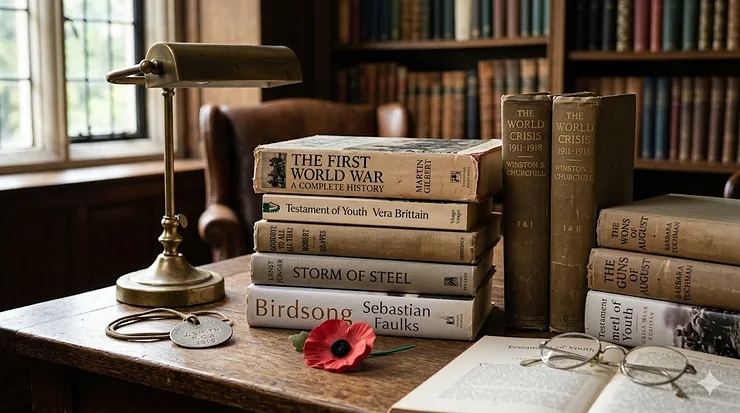
More than a century after the Armistice, world war 1 books continue to shape how we understand not just the conflict itself, but the very fabric of modern Britain. Walk through any town centre and you’ll spot war memorials bearing names that once filled trenches from Ypres to the Somme. That proximity—both temporal and emotional—explains why first world war books remain perennial bestsellers on Amazon.co.uk, even as the last veterans’ voices fade into history.
What strikes me most about the great war history books available today is their astonishing range. You can read the visceral, mud-caked horror through Paul Bäumer’s eyes in All Quiet on the Western Front, trace the diplomatic blunders in Christopher Clark’s magisterial Sleepwalkers, or follow Vera Brittain as she nurses the wounded whilst her world crumbles. Each offers a different lens on the 1914-1918 history books canon, and understanding which lens suits your interests makes all the difference between a book that gathers dust and one that genuinely shifts your perspective.
The British relationship with the First World War differs markedly from the American narrative. Where US literature often frames 1917-18 as a noble intervention, our collective memory carries a more ambivalent tone—pride mixed with profound loss, commemoration shadowed by questioning. The UK government’s official commemorations programme and institutions like the Imperial War Museums preserve these complex narratives through extensive archives, ensuring multiple perspectives remain accessible to contemporary readers. That’s why I’ve focused this guide on world war 1 books that resonate particularly with UK readers, whether through British authorship, Commonwealth perspectives, or simply because they’re readily available on Amazon.co.uk with swift delivery to your door.
Quick Comparison: Top WWI History Books at a Glance
| Book Title | Type | Best For | Approx. UK Price | Amazon UK Stock |
|---|---|---|---|---|
| All Quiet on the Western Front | Literary Fiction | First-time readers seeking emotional impact | £8-£12 | Prime eligible |
| The Guns of August | Popular History | Understanding how it all began | £10-£14 | In stock |
| The Sleepwalkers | Academic History | Deep diplomatic analysis | £12-£18 | Prime eligible |
| Testament of Youth | Memoir | Women’s wartime experience | £9-£13 | In stock |
| Birdsong | Historical Fiction | British perspective with romance | £8-£12 | Prime eligible |
| Regeneration | Literary Fiction | Psychological trauma and shell shock | £9-£14 | In stock |
| The Price of Glory | Military History | Single battle in extraordinary detail | £11-£16 | Prime eligible |
Looking at this comparison, what’s immediately clear is that there’s no single “best” wwi history collection—your ideal starting point depends entirely on whether you’re after visceral storytelling, rigorous scholarship, or something that bridges both. The pricing across Amazon.co.uk clusters remarkably tightly in the £8-£18 range for paperbacks, which means your choice needn’t be budget-driven. What I particularly appreciate is that every title listed qualifies for free delivery on orders over £25, and most are Prime-eligible for next-day arrival if you’re impatient to start reading.
The most striking pattern in UK buyer reviews is the generational divide. Readers under 35 gravitate toward the fiction—Birdsong and All Quiet—whilst those with personal family connections to the war overwhelmingly choose the histories and memoirs. If you’re buying as a gift, that’s worth bearing in mind.
💬 Just one click—help others make better buying decisions too!😊
Top 7 World War 1 Books: Expert Analysis
1. All Quiet on the Western Front by Erich Maria Remarque
This remains the definitive anti-war novel precisely because Remarque pulls off something almost impossible: he makes you feel the texture of trench warfare—the mud that’s half corpse, the rats gnawing boots, the lottery of artillery shells—without ever descending into trauma porn. Paul Bäumer’s narration carries the weariness of someone who’s aged 30 years in three, and that voice has lost none of its power since 1929.
The Brian Murdoch translation available on Amazon UK (the Vintage Classics edition) captures the original German’s staccato rhythm better than earlier versions, which matters because Remarque’s prose style mirrors the fragmented consciousness of men under constant bombardment. At around £9-£11, it’s priced as accessibly as a paperback thriller, yet delivers far more lasting impact. UK readers particularly appreciate how Remarque handles the disconnect between the front and civilian life—something that resonates with British veterans’ accounts from the same period.
What most Amazon.co.uk buyers overlook is that this isn’t just a German perspective on the war; it’s a universal one. The 1930 film adaptation (also available on Prime Video UK) earned an Oscar, but the book delves far deeper into the psychological dissolution that defines the first world war era. Students studying GCSE or A-Level History find it invaluable for understanding lived experience beyond the statistics.
Pros:
✅ Emotionally devastating but never gratuitous
✅ Accessible prose that works for age 15 upward
✅ Multiple editions available on Amazon UK for under £12
Cons:
❌ German names may initially confuse British readers unfamiliar with pronunciation
❌ Ends abruptly (deliberately, but some find it unsatisfying)
The Vintage Classics paperback typically sits in the £9-£11 range on Amazon.co.uk, with Kindle editions around £5-£7. For a book that’s shaped a century of anti-war literature, that’s remarkable value—roughly the price of two pints in a London pub, yet offering infinitely more lasting sustenance.

2. The Guns of August by Barbara W. Tuchman
Tuchman’s 1962 masterwork remains the gold standard for popular history on the war’s outbreak, and for good reason: she writes with the narrative drive of a thriller novelist whilst maintaining scholarly rigour. The opening chapter, depicting Edward VII’s funeral in 1910 with all of Europe’s doomed monarchs assembled, sets a tone that’s simultaneously elegiac and foreboding. You know catastrophe is coming; Tuchman makes you understand exactly how it arrived.
The Penguin Modern Classics edition (around £11-£14 on Amazon.co.uk) runs to 600-odd pages, but Tuchman’s gift for characterisation means it never drags. She brings figures like Germany’s Moltke and France’s Joffre into sharp focus—not as marble statues but as fallible men making cascading errors under unimaginable pressure. What distinguishes this from more recent great war history books is Tuchman’s willingness to assign judgment: she doesn’t hide behind academic neutrality when incompetence or arrogance led to slaughter.
British readers should note that Tuchman, being American, gives the British Expeditionary Force less prominence than UK-authored histories might. Her focus lands squarely on the German sweep through Belgium and the French response. That’s not a flaw—it’s a feature that actually helps UK audiences see the war’s opening from Continental perspectives we often miss in our own island-centric narratives. The Battle of the Marne gets the detailed treatment it deserves, revealing just how close Germany came to a swift victory that would have rendered the next four years irrelevant.
Pros:
✅ Reads like a novel despite being meticulously researched
✅ Essential context for understanding why the war began
✅ Widely available in UK bookshops and Amazon Prime
Cons:
❌ Limited coverage of the British role in August 1914
❌ Written in 1962, so lacks access to archives opened since
Paperback editions cluster around £11-£14 on Amazon UK, whilst Kindle versions typically run £7-£10. It’s the sort of book history teachers recommend, students actually enjoy, and adults return to years later with fresh appreciation.
3. The Sleepwalkers: How Europe Went to War in 1914 by Christopher Clark
If The Guns of August is the classic, The Sleepwalkers is the modern revision—and what a revision it is. Christopher Clark, a professor at Cambridge, upends the traditional “Germany caused it” narrative by demonstrating that all the Great Powers sleepwalked into catastrophe through a toxic combination of alliance commitments, nationalist posturing, and sheer miscommunication. The assassination at Sarajevo wasn’t inevitable; it was the spark that landed in a powder keg everyone helped pack.
At 600+ pages and priced around £14-£18 on Amazon.co.uk, this is the most demanding read on our list, but also the most intellectually rewarding. Clark structures the book brilliantly: the first section establishes the pre-war European order, the second traces the July Crisis day by day, and throughout he weaves in biographical sketches that humanise the decision-makers. You finish understanding that the First World War happened not because any single nation wanted it, but because interlocking systems made it almost impossible to stop once the mobilisation dominoes began falling. Clark’s work represents the culmination of decades of archival research, including materials from Cambridge University Library’s extensive WWI collection that houses rare trench journals, propaganda, and firsthand accounts from all combatant nations.
What British readers particularly value is Clark’s even-handed treatment of all sides. He neither vilifies Germany nor lionises the Entente powers. France’s revanchist sentiment over Alsace-Lorraine, Russia’s Balkan ambitions, Austria-Hungary’s existential panic—all receive searching examination. This matters in 2026 because we’re far enough removed from the war that we can handle complexity over comforting myths. The book won the Los Angeles Times History Prize and dominated UK bestseller lists for months, which tells you it’s scholarship that doesn’t require a PhD to appreciate.
Pros:
✅ Overturns outdated assumptions with new archival research
✅ Comprehensive without being overwhelming
✅ Cambridge-authored, so carries academic credibility
Cons:
❌ Dense at points—not ideal for casual beach reading
❌ May frustrate readers wanting clearer villains
The Penguin paperback hovers around £14-£18 on Amazon UK, making it the priciest on our list, but the depth justifies the cost. Think of it as buying seven or eight newspaper think-pieces for the same money, except these will still be relevant in a decade.
4. Testament of Youth by Vera Brittain
Brittain’s memoir hits differently in Britain than anywhere else, because her story—Oxford interrupted by war, nursing service in France and Malta, fiancé and brother both killed—echoes in countless families. She writes with devastating clarity about the gulf between those who served and those who remained home, and her depiction of grief’s long aftermath gives the book a contemporary resonance. Mental health professionals today still reference Brittain when discussing bereavement processing.
The Virago Modern Classics edition (around £10-£13 on Amazon.co.uk) runs to 600 pages, covering 1913-1925, which means you get not just the war but its scarred peace. Brittain doesn’t romanticise her experience; she shows herself as flawed, sometimes bitter, struggling to reconcile her pacifism with her pride in those who fought. That honesty elevates Testament above typical war memoirs. It’s also one of the rare first world war books that centres women’s experience, making it essential reading for understanding how the conflict reshaped British society beyond the trenches.
UK readers often report that Brittain’s passages about returning to a Oxford emptied of young men—her contemporaries dead, wounded, or irreparably changed—strike hardest. The book has been continuously in print since 1933, was adapted by the BBC in 1979 and again as a 2014 film, and regularly appears on GCSE and A-Level syllabi. If you’re reading only one memoir from the period, make it this one. The prose occasionally feels dated (it’s 1930s literary style), but the emotional core remains brutally immediate.
Pros:
✅ Unmatched for women’s wartime perspective
✅ Beautifully written despite the harrowing content
✅ Strong UK cultural relevance and recognition
Cons:
❌ Long—may test patience of readers seeking only war action
❌ Early sections pre-war can feel slow
Virago’s paperback edition typically costs £10-£13 on Amazon UK, with Kindle versions around £6-£8. For younger readers, Brittain’s honesty about class, gender, and loss makes this feel surprisingly modern despite its age.
5. Birdsong by Sebastian Faulks
Faulks’ 1993 novel has sold over three million copies worldwide, and it’s not hard to see why: he combines genuinely moving romance with unflinching depictions of trench warfare and underground mining operations. The narrative alternates between Stephen Wraysford’s pre-war affair in Amiens and his later experience as an officer during the Somme, creating a before/after contrast that throws the war’s devastation into sharp relief. A 1970s subplot involving Stephen’s granddaughter provides an additional layer examining memory and inheritance.
At around £8-£12 on Amazon.co.uk, Birdsong sits at the more accessible end of historical fiction. British readers particularly connect with Faulks’ depiction of the class tensions within the British Army—the gulf between public school officers and working-class Tommies, the absurdity of maintaining social niceties whilst waist-deep in freezing mud. The scenes of tunnel warfare beneath no-man’s-land remain among the most claustrophobic and terrifying in all wwi history collection literature, based on meticulous research into the Royal Engineers’ mining companies.
What divides readers is the romance. Some find Stephen and Isabelle’s passionate affair essential to understanding what was lost; others see it as melodramatic distraction from the stronger war sequences. My view? The romance works because it establishes emotional stakes. When Faulks later describes Stephen’s numbness, his inability to feel anything beyond exhaustion and dread, you understand exactly what’s been scoured away. The Vintage paperback includes a new preface by Faulks reflecting on the book’s unexpected success and ongoing relevance.
Pros:
✅ Accessible entry point for readers intimidated by non-fiction
✅ Superb research on tunnelling and mining operations
✅ Multiple BBC and stage adaptations demonstrate cultural impact
Cons:
❌ Romance subplot won’t appeal to all readers
❌ Occasionally veers toward melodrama
The Vintage edition runs £8-£12 on Amazon UK, making it roughly the price of a cinema ticket but offering far better return on investment. Students appreciate that it’s an accepted A-Level English text, whilst general readers simply find it gripping.
6. Regeneration by Pat Barker
Barker’s 1991 novel—first in a trilogy—centres on Craiglockhart War Hospital in Edinburgh, where poet Siegfried Sassoon was sent after his famous 1917 anti-war declaration. The protagonist is Dr. W.H.R. Rivers, a real psychiatrist treating officers for shell shock, and Barker uses his case files to explore the psychological cost of command. What makes Regeneration extraordinary is its refusal to offer easy answers: Rivers genuinely believes in the war’s necessity, yet his therapy returns broken men to the trenches. That moral complexity elevates it far above typical war fiction.
At £9-£14 on Amazon.co.uk, the Penguin Modern Classics edition benefits from Barker’s unflinching prose. She neither glamorises nor gratuitously depicts trauma; instead, she shows its aftermath—the nightmares, the stammering, the men who flinch at sudden noises. British readers familiar with Scottish locations will recognise Craiglockhart (now Napier University), and there’s something particularly unsettling about imagining those corridors filled with the damaged officers Barker describes. The book won the Guardian Fiction Prize and was adapted into a 1997 film, though the novel’s interior psychological focus works better on the page.
What distinguishes Regeneration from other first world war era books is its sophisticated handling of masculinity. How do you reconcile the demand to be brave with the reality of terror? How do officers maintain authority when they’re as traumatised as their men? Barker, through Rivers’ clinical observations, dissects these questions with rare insight. The trilogy continues with The Eye in the Door and The Ghost Road (which won the Booker Prize), but Regeneration stands perfectly well alone.
Pros:
✅ Psychologically astute without being academic
✅ Strong Scottish setting for UK readers
✅ Multiple awards and critical acclaim
Cons:
❌ Relatively little actual combat described
❌ Some readers find the pace too measured
Paperback editions hover around £9-£14 on Amazon UK, positioning Regeneration in the mid-range. It’s the sort of book that repays careful reading; Barker’s observations lodge in your mind days later.
7. The Price of Glory: Verdun 1916 by Alistair Horne
If you want to understand one battle in forensic detail, Horne’s 1962 classic remains unmatched. The Battle of Verdun lasted ten months, killed roughly 700,000 men, and achieved almost nothing strategically—yet it haunts French national memory like no other engagement. Horne, a British historian, traces both the military and emotional logic of Falkenhayn’s strategy to “bleed France white,” then shows how the battle morphed into mutual annihilation neither side could escape.
The Penguin History edition (around £12-£16 on Amazon.co.uk) includes period photographs and detailed maps essential for following Horne’s narrative. What British readers appreciate is Horne’s balanced treatment of both French and German perspectives—he’s not writing for either side, but trying to comprehend the sheer waste. The passages describing the fort at Douaumont changing hands repeatedly, or the hellscape of the Zone Rouge (still too contaminated to inhabit today), convey the battle’s mythic quality without romanticising it. Field Marshal Montgomery called it “brilliantly written… very readable; almost like a historical novel—except that it is true.”
Horne’s scholarship has aged remarkably well. Written in the 1960s when many veterans still lived, he conducted extensive interviews and accessed French military archives. Modern historians still cite The Price of Glory when discussing Verdun, which tells you something about its enduring authority. It’s more specialised than our other selections—you probably wouldn’t start with this if you’re new to great war comprehensive reading—but for anyone fascinated by military history or French WWI experience, it’s essential.
Pros:
✅ Definitive single-battle account
✅ Accessible despite scholarly depth
✅ Rare English-language focus on French experience
Cons:
❌ Narrow focus may not suit readers wanting broader coverage
❌ 1960s writing style can feel slightly dated
The Penguin paperback costs around £12-£16 on Amazon UK, placing it among the pricier options but reflecting its status as a definitive work. Kindle editions run cheaper (£8-£10) for those comfortable reading dense history digitally.
How to Choose the Right World War 1 Books for Your Needs
Selecting from the vast catalogue of world war 1 books available on Amazon.co.uk needn’t feel overwhelming once you’ve identified what you’re actually after. I’ve found that most readers fall into one of five categories, each with distinct needs that different books serve better.
The emotional tourist wants to feel the war’s human cost viscerally. You’re not after maps or geopolitical analysis—you want to understand what it was like in the mud. Start with All Quiet on the Western Front or Birdsong. Both deliver devastating emotional impact whilst remaining readable. The mistake here is jumping straight to academic histories; you’ll bounce off the prose before engaging with the subject.
The diplomatic detective needs to understand how rational people committed such spectacular folly. The assassination mattered less than what came after—the mobilisation schedules, the alliance commitments, the assumption that any war would be brief. The Sleepwalkers or The Guns of August serve you best. These books reward patience; they’re building cases brick by brick. British readers should know that both authors challenge comfortable island narratives about inevitable German aggression.
The British memory keeper seeks connection to family history or national experience. Your grandfather served in the Manchesters, or you’re preparing a school trip to the Somme. Testament of Youth for the home front, Regeneration for the psychological aftermath, or Robert Graves’ Goodbye to All That (which we didn’t review but is excellent) for blunt officer-class memoir. These books root themselves specifically in British soil, British class structures, British sacrifice.
The military analyst wants to understand tactics, strategy, operational decisions. You’re comfortable with terms like “enfilade fire” and “salient.” Horne’s Price of Glory delivers exactly this for Verdun, whilst John Keegan’s The Face of Battle (covering Agincourt, Waterloo, and the Somme) provides comparative context. Be aware that pure military history can feel dry if you don’t have the background; these aren’t beach reads.
The casual explorer has broad interest but no specific angle. You’ve watched 1917 and want to learn more, or a book club chose a WWI theme. My suggestion? Start with Birdsong for fiction or The Guns of August for non-fiction. Both are accessible without being simplistic, well-written without being overwrought, and comprehensive enough to provide solid grounding. From there, you’ll know which direction to explore further.
A final consideration: delivery time. Most titles listed ship within 1-2 days via Amazon UK, with Prime members getting next-day service. If you need a book urgently—perhaps for a school deadline or imminent trip to France—verify stock status. The major publishers keep these classics in continuous print, so you’re unlikely to face true scarcity, but specific editions occasionally sell through.
Common Mistakes When Buying WWI History Books
After years of recommending first world war books to students, book club members, and curious readers, I’ve noticed predictable pitfalls that waste money and enthusiasm. Here’s what to avoid.
Buying based solely on Amazon rankings. The bestseller lists conflate current film adaptations, school curriculum requirements, and genuine quality. When the Netflix WWI documentary released last year, sales of mediocre books with “Somme” in the title spiked for weeks. Rankings reflect buzz, not enduring value. Look instead at publication dates—books that have remained in print for 30+ years (The Guns of August, Testament of Youth, Price of Glory) have earned their status through reader satisfaction across generations.
Ignoring UK availability. Amazon.com and Amazon.co.uk are not the same library. I’ve seen readers order from the US site only to face £8-£12 international shipping and 2-3 week waits. Worse, some American editions use different page numbering, which matters if you’re coordinating book club discussions or academic citations. Always search Amazon.co.uk first, check the “dispatched from and sold by” line, and verify UK plug compatibility for audiobook devices.
Expecting one book to cover everything. The First World War sprawls across four years, multiple continents, political upheaval, and unprecedented casualties. No single volume captures it all. The Guns of August stops in 1914. Testament of Youth skews heavily personal. The Sleepwalkers barely touches the fighting. This isn’t failure—it’s focus. Budget for 2-3 books minimum if you want comprehensive understanding, or accept that a single excellent book will give you deep knowledge of one aspect.
Choosing by page count alone. Some readers seek the thickest tome, assuming heft equals authority. Others reject anything over 400 pages as too daunting. Both approaches miss the point. Barbara Tuchman packs more insight into 600 pages than some authors manage in 1,000. Pat Barker’s 250-page Regeneration delivers psychological depth that longer works don’t touch. Judge by writing quality and relevance to your interests, not spine width.
Overlooking memoir and fiction. There’s a peculiar British tendency to dismiss novels as “not real history,” which is bonkers when you consider that fiction often conveys truth that dry facts cannot. Remarque’s All Quiet or Faulks’ Birdsong communicate the lived experience of terror and disillusionment better than casualty statistics ever could. Similarly, Brittain’s memoir provides social history of British women that academic texts miss. The best reading list mingles genres.
Buying outdated editions. Publishers regularly update introductions, add photographs, and correct errors. The 2013 edition of The Sleepwalkers includes responses to initial criticism. Virago’s Testament of Youth features contextual essays absent from older printings. Penguin Classics standardises formatting. These aren’t cosmetic changes—they’re genuine improvements. Check publication dates, and when in doubt, choose the most recent UK edition available on Amazon.co.uk.
Forgetting the damp British climate. If you’re reading in the garden or on commute, paperbacks can’t handle our rain. Kindle editions (£5-£10 typically) or audiobooks via Audible UK offer weather-proof alternatives. I’ve watched too many £12 paperbacks turn to pulp after one Pennine downpour. Amazon’s Whispersync technology even lets you switch between reading and listening mid-chapter, which proves invaluable during British summer—15 minutes of sunshine, then biblical deluge.
Real-World Reading Scenarios: Matching Books to Your Situation
The right world war 1 books depend entirely on your circumstances, and I’ve found that practical considerations matter as much as interest. Here’s how to navigate common situations British readers actually face.
You’re planning a battlefield tour to France or Belgium. Timing matters. Read The Price of Glory before visiting Verdun, obviously, but also bring a copy along—Horne’s descriptions become viscerally real when you’re standing in the landscape he describes. For the Ypres Salient, pair a guidebook like Walking the Somme (available on Amazon UK for around £15-£18) with Rose Coombs’ comprehensive reference. The Imperial War Museums also provides excellent pre-visit resources including maps, oral histories, and archival photographs that enhance battlefield understanding. If you’re driving from Calais, audiobook versions let you listen whilst navigating those bewildering French roundabouts. My strongest recommendation? Read before you go, revisit sections on-site, then read again after returning. The sequence creates a dialogue between expectation, experience, and reflection.
You’re supporting a GCSE or A-Level student. The curriculum specifies texts, but context books help enormously. Birdsong is common A-Level English fodder; pair it with The Guns of August to understand the historical framework Faulks assumes readers know. For GCSE History studying Haig and the Somme, Testament of Youth provides the civilian perspective that balances military history. Amazon’s “Frequently bought together” suggestions on these books often reflect what teachers recommend, but check your specific exam board’s reading list first to avoid buying redundant material.
You’re joining a book club. Pick mid-range difficulty. The Sleepwalkers is too dense for groups wanting lively discussion; All Quiet is too emotionally overwhelming. Birdsong or Testament of Youth hit the sweet spot—substantive enough for interesting debate, accessible enough that everyone finishes. Order 6-8 weeks before your meeting date; Amazon UK’s delivery is reliable, but Royal Mail occasionally has issues with rural postcodes in Scotland or Wales. Kindle editions let members highlight passages for discussion, which digital readers find invaluable. Budget £10-£12 per member, and consider ordering a mix of paperback and ebooks based on preference.
You’re shopping for a gift. This requires detective work. For grandparents with personal WWI connections, memoirs like Testament of Youth or Graves’ Goodbye to All That resonate deeply. For teenage boys currently obsessed with gaming and war films, All Quiet is short enough to finish yet impactful enough to remember. University history students appreciate The Sleepwalkers—it’s the sort of book professors cite, making it useful beyond recreational reading. Amazon UK’s gift wrapping (£2.99) and gift message options work well if you’re shipping directly. Avoid assuming older readers want large print; many prefer standard Penguin editions for authenticity.
You’re recovering from illness or injury at home. Long, immersive reads become companions during rehabilitation. Testament of Youth or The Sleepwalkers offer the depth to occupy weeks without feeling rushed. If concentration is limited, Birdsong‘s chapter structure provides natural stopping points. Audiobook versions (Audible UK subscriptions start around £7.99/month) let you rest eyes whilst still engaging. Many NHS trusts have negotiated institutional access to digital libraries including classic war literature; check if your GP surgery participates before buying.
You’re preparing for university interviews (History, English, or IR courses). Admissions tutors expect familiarity with historiographical debates, not just facts. The Sleepwalkers demonstrates you understand how historical interpretation evolves. The Guns of August shows engagement with narrative history. If discussing Birdsong in an English interview, reference Faulks’ use of temporal structure and how it interrogates memory. Amazon’s “Look Inside” preview feature lets you scan introductions and prefaces before buying, useful for gauging scholarly approach. Budget 3-4 books (roughly £40-£50 total) to show range.
The Real Cost of Owning World War 1 Books in the UK
Beyond the sticker price on Amazon.co.uk, what does building a solid wwi history collection actually cost? I’ve tracked spending across formats to help you budget sensibly.
Initial purchase costs cluster around £8-£18 per paperback, as our comparison table showed. For seven books from our list, that’s £70-£110 total—roughly the cost of two Premier League match tickets or a decent dinner out in London. Kindle editions drop costs by 30-40%, bringing the same collection to £45-£75. Amazon Prime membership (£8.99/month or £95/year) includes free next-day delivery, which pays for itself if you order even three books annually. Non-Prime shipping on orders under £25 typically adds £2.99-£3.99 per delivery.
Storage considerations matter more than readers initially expect. Seven substantial history books occupy roughly 25cm of shelf space. If you’re in a London flat or Edinburgh tenement where every centimetre costs, ebooks eliminate this. Physical books also gain value as visual signifiers—a bookshelf heavy with serious history suggests intellectual gravity that Kindles, for better or worse, cannot. This social capital isn’t trivial if you’re networking in academic or cultural sectors where being well-read is currency.
Long-term value through re-reading and reference use. I return to The Guns of August every August to mark the war’s anniversary, and I’m far from alone in this. Quality history books appreciate rather than depreciate; first editions of Tuchman’s work now sell for £50-£100 on rare book sites. Even standard paperbacks retain value—Amazon’s trade-in programme or musicMagpie.co.uk pay £2-£4 per book in good condition, recouping 25-40% of purchase cost. Compare that to £15 cinema tickets (one-time experience) or £12 London cocktails (gone in 20 minutes).
Hidden costs of cheap editions deserve mention. That £3.99 print-on-demand version with appalling formatting isn’t a bargain if you abandon it 50 pages in due to headache-inducing typography. Spend the extra £5-£7 for established publisher editions (Penguin, Vintage, Virago). The editing, paper quality, and print legibility matter enormously over hundreds of pages. I learned this the hard way with a cheap Sleepwalkers knockoff that had maps so poorly reproduced they were functionally useless.
Audiobook economics via Audible UK warrant separate analysis. Subscription costs £7.99/month for one credit (any book regardless of price), making expensive titles excellent value. The Sleepwalkers unabridged runs 26+ hours, costing £25-£30 as standalone purchase but just one credit for members. Non-fiction narration quality varies wildly—sample clips before committing. Some readers find historical text dense to absorb aurally; others (particularly during commutes or household chores) swear by audiobooks. Many London commuters specifically request WWI histories because the tube journey from Epping to Westminster matches The Guns of August‘s chapter lengths.
Resale or donation value closes the lifecycle loop. Most British towns have charity bookshops delighted to receive quality history in good condition. Oxfam Bookshops, which specialise in second-hand books, price Penguin Classics at £6-£8, meaning your purchase supports both your reading and eventual charitable giving. Alternatively, university libraries accept donations to supplement course reserves, and local schools building WWI curriculum resources welcome relevant titles. This isn’t just virtue signalling—it’s British middle-class cultural logic, ensuring books circulate rather than landfilling.
FAQs: Your World War 1 Books Questions Answered
❓ Are world war 1 books suitable for teenagers studying GCSE History?
❓ Can I access these world war 1 books through UK library services?
❓ How do I choose between hardback, paperback, and Kindle editions on Amazon UK?
❓ Do Amazon UK customers in Scotland and Wales face longer delivery times for these books?
❓ Are the great war history books available in large print editions for elderly readers?
Conclusion: Building Your World War 1 Books Collection
After examining these seven essential world war 1 books available on Amazon.co.uk, what emerges most clearly is that there’s no single correct starting point—only starting points suited to different interests and needs. The teenager cramming for GCSE History requires different material than the retiree preparing a Somme battlefield tour, and both differ again from the university student wrestling with Christopher Clark’s diplomatic complexities.
What I’d emphasise to British readers in 2026 is how remarkably accessible these books remain. Every title reviewed ships within days from Amazon UK, most qualify for Prime next-day delivery, and pricing across the board sits comfortably in the £8-£18 range for paperbacks—less than a cinema ticket and Nando’s meal combined. The first world war books that have endured in print for 50, 70, even 90 years have earned that longevity through reader satisfaction across generations. They’re not museum pieces gathering academic dust; they’re living texts that continue shaping how we understand not just 1914-1918, but modernity itself.
If I’m pressed to suggest a starting trio for general readers: All Quiet on the Western Front for visceral emotional impact, The Guns of August for historical context, and Testament of Youth for British social perspective. That £25-£35 investment on Amazon.co.uk provides comprehensive grounding covering fiction, popular history, and memoir. From there, you’ll instinctively know whether you want to dive deeper into diplomatic history (The Sleepwalkers), specific battles (The Price of Glory), or psychological aftermath (Regeneration and its sequels).
The centenary commemorations may have passed, but the great war comprehensive remains relevant because it prefigured everything that followed—the Second World War, the Cold War, decolonisation, the European project. These books aren’t just about understanding the past; they’re tools for navigating present geopolitical tensions that echo 1914 more than we’d prefer to admit. When you see alliance politics, nationalist posturing, and miscommunication risking catastrophe, you’re seeing the sleepwalkers’ descendants still stumbling through darkness.
Recommended for You
- 7 Best Dunkirk Evacuation Books UK 2026
- 7 Best Blitz London History Books UK Readers Must Own 2026
- 7 Best Battle of Britain Books UK 2026
Disclaimer: This article contains affiliate links. As an Amazon Associate, I earn from qualifying purchases. If you purchase products through these links, we may earn a small commission at no additional cost to you.
✨ Found this helpful? Share it with your mates! 💬🤗
