In This Article
The Battle of the Somme remains etched in British consciousness as one of the most harrowing episodes of the First World War. When 57,470 British soldiers became casualties on that first terrible day of 1 July 1916—with 19,240 killed—it marked the bloodiest day in British military history. Yet finding the right somme battle history books to truly understand this pivotal western front battle can feel overwhelming, given the hundreds of titles available.
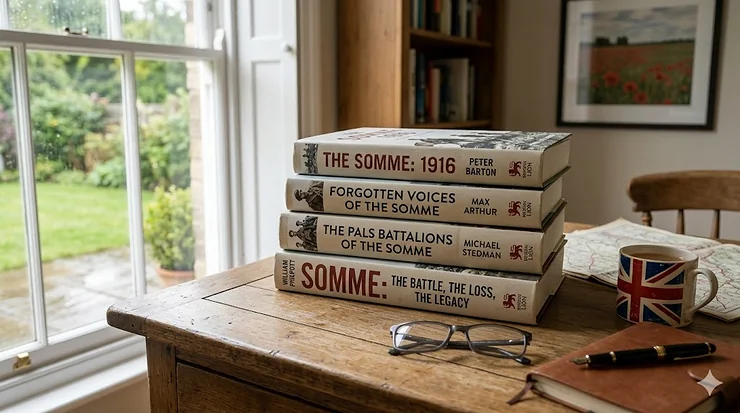
What most British readers overlook is that not all Somme books serve the same purpose. Some excel at tactical analysis, others at personal testimony, and a few manage both. After examining dozens of titles available on Amazon.co.uk, I’ve identified seven essential works that offer different lenses through which to view the battle of somme 1916. Whether you’re a history student preparing for university, a battlefield tour enthusiast planning a trip to northern France, or simply someone who wants to understand why the Somme continues to shape British identity a century later, this guide will help you choose the right book for your needs—and more importantly, understand what each one offers that Amazon’s product descriptions won’t tell you.
The books I’ve selected range from around £8 to £35, cover everything from granular tactical details to sweeping strategic analysis, and include both modern scholarship and contemporary accounts. What they share is an ability to make the Somme comprehensible without sanitising its horror—rather important when we’re talking about a battle that consumed over a million casualties across five months of trench warfare.
Quick Comparison: Finding Your Perfect Somme Book
| Book Title | Best For | Price Range | Format Available | Key Strength |
|---|---|---|---|---|
| The First Day on the Somme (Middlebrook) | Comprehensive first-day analysis | £10-£15 | Paperback, Kindle | Unmatched survivor interviews |
| Somme 1916 (Kendall) | Sector-by-sector tactical detail | £25-£35 | Hardback, Kindle | Military precision |
| The Somme: Soldiers’ Words & Photos (Van Emden) | Visual learners | £15-£25 | Hardback, Paperback | 170+ contemporary photographs |
| A Topographical History (Gliddon) | Battlefield visitors | £20-£30 | Paperback | Essential touring companion |
| Battle of the Somme (Hourly History) | Quick overview | £3-£8 | Kindle, Paperback | Concise 60-page introduction |
| The Somme (Hart) | Oral history depth | £12-£18 | Paperback, Kindle | Imperial War Museum archives |
| The Somme (Sheffield) | Strategic context | £10-£14 | Paperback | Academic rigour |
From this comparison, you can see that The First Day on the Somme by Martin Middlebrook offers exceptional value for anyone wanting the definitive account of 1 July 1916, whilst Paul Kendall’s Somme 1916 justifies its higher price tag with unprecedented tactical detail drawn from War Diaries and German sources. Budget-conscious readers should note that Hourly History’s edition provides a solid foundation at under £10, though it naturally sacrifices the depth that makes Middlebrook’s work so compelling. If you’re planning to walk the Somme battlefields—and many British visitors do, given the proximity to Calais—Gliddon’s topographical guide is genuinely indispensable; the extra £10-£15 over a standard history pays for itself the moment you’re standing at Thiepval trying to understand the terrain.
💬 Just one click — help others make better buying decisions too! 😊
Top 7 Somme Battle History Books: Expert Analysis
1. The First Day on the Somme by Martin Middlebrook
Martin Middlebrook’s magnum opus has held its position as the definitive 1 July 1916 account for over fifty years, and for good reason. The 1973 original represented groundbreaking oral history—Middlebrook interviewed more than 500 survivors—and subsequent editions have refined rather than replaced this foundation.
Key specifications: 352 pages | Multiple editions including revised 2016 centenary version | Includes maps, photographs, and appendices | Available in paperback and Kindle formats
What sets this apart from other somme offensive books is Middlebrook’s ability to weave personal testimony into strategic narrative without losing either thread. You’ll read about Kitchener’s New Army marching into battle with misplaced confidence, then hear from a Sheffield Pals survivor describing the moment machine-gun fire shredded his battalion. The book covers the entire first day geographically—north to south, sector by sector—whilst maintaining chronological flow.
Here’s what most buyers miss: this isn’t a comprehensive Somme history. It’s specifically about 1 July. If you want coverage of the subsequent 141 days, you’ll need another title. But for understanding why that first day became Britain’s blackest, nothing comes close. UK readers will appreciate Middlebrook’s attention to the Pals battalions—those tragic units of friends and workmates who signed up together and died together, devastating entire British communities.
Customer feedback: British readers consistently praise the accessible writing style and emotional power, though some note the limited coverage beyond 1 July. Several reviewers mention using it as preparation for battlefield visits.
Pros:
✅ Unparalleled first-hand testimony from survivors
✅ Clear tactical explanations accessible to non-military readers
✅ Excellent maps help visualise the battlefield
Cons:
❌ Focuses solely on first day, not the entire battle
❌ Some editions lack comprehensive photographs
Price verdict: Around £10-£15 represents outstanding value for 352 pages of meticulously researched history that reads like compelling narrative non-fiction.
2. Somme 1916: Success and Failure on the First Day by Paul Kendall
Where Middlebrook prioritises personal stories, Paul Kendall delivers tactical forensics. This 2016 publication examines why some divisions succeeded on 1 July whilst others suffered catastrophic casualties, using primary sources including German War Diaries rarely cited in English-language histories.
Key specifications: 442 pages | Hardback and Kindle editions | Extensive maps and diagrams | Published by Frontline Books | Covers entire Somme front on 1 July
Kendall divides the battlefield into sectors—Gommecourt, Serre, Beaumont-Hamel, Thiepval, down to Montauban—and analyses each in forensic detail. What becomes clear is that the “failures” weren’t uniform disasters. Some units achieved objectives; others were massacred before reaching German wire. Kendall explains why, drawing on battalion war diaries, German regimental histories, and aerial photographs.
This is the book for readers who want to understand trench warfare somme at the operational level. Why did the artillery bombardment succeed in some sectors but fail catastrophically in others? How did German defenders survive seven days of shelling? What role did terrain play—the valleys, ridges, and chalk soil of the Somme countryside? Kendall answers these questions with academic rigour whilst maintaining readability.
The downside? At 442 pages of dense military analysis, this demands concentration. It’s not bedtime reading; it’s serious study. But if you’re planning a battlefield tour or studying the july 1916 battle for academic purposes, the investment—both financial and intellectual—pays dividends. British readers will find the sections on Ulster Division at Thiepval and Manchester Pals at Beaumont-Hamel particularly relevant.
Customer feedback: Praised by military historians and serious enthusiasts; some general readers find it overly technical.
Pros:
✅ Unprecedented tactical detail with German perspectives
✅ Excellent maps essential for understanding terrain
✅ Answers the “why did some succeed?” question definitively
Cons:
❌ Dense writing may challenge casual readers
❌ Higher price point (£25-£35 range)
Price verdict: The £25-£35 price tag reflects serious scholarship. Worth every penny for dedicated students of the battle, perhaps excessive for casual interest.
3. The Somme: The Epic Battle in the Soldiers’ Own Words and Photographs by Richard van Emden
Richard van Emden’s approach is unique among somme battle history books: he centres soldiers’ own photographs, many never previously published, alongside their letters, diaries, and post-war testimonies. The result feels intimate in a way traditional histories rarely achieve.
Key specifications: 170+ contemporary photographs | 288 pages | Hardback and paperback editions | Published 2016 for centenary | Focus on British experience
The photographs are the revelation here. These aren’t official War Office propaganda shots; they’re images soldiers took themselves, often at considerable personal risk. You’ll see men grinning in trenches hours before going over the top, the aftermath of artillery barrages, and the mud—the legendary Somme mud that British troops still complain about in letters home. Van Emden, who interviewed 270 Great War veterans during his career, provides context that illuminates rather than overwhelms the visual material.
What I particularly value is Van Emden’s refusal to sanitise. He includes photographs of the dead, the wounded at dressing stations, and the thousand-yard stares of men who’d survived horrors we can barely imagine. Yet the book isn’t gratuitously graphic; it’s respectfully honest about what trench warfare involved.
This works brilliantly for visual learners and anyone who finds dense prose challenging. The photographs break up the narrative, and Van Emden’s writing style is accessible without being simplistic. It’s also an excellent choice for younger readers (sixth form upwards) discovering the Somme for the first time. British readers will recognise place names—Thiepval, Delville Wood, Mametz—that still appear on battlefield tour itineraries today.
Customer feedback: Reviewers consistently highlight the emotional impact of seeing soldiers’ own photographs. Several mention keeping it as a coffee table book that guests always pick up.
Pros:
✅ Unique visual perspective unavailable elsewhere
✅ Accessible for readers who struggle with military prose
✅ Excellent for sharing—photos spark conversation
Cons:
❌ Less tactical detail than pure history texts
❌ Photographic focus means some strategic context sacrificed
Price verdict: £15-£25 for 170+ rare photographs and accompanying narrative represents strong value, particularly for the hardback edition’s presentation quality.
4. The Battle of the Somme: A Topographical History by Gerald Gliddon
If you’re planning to visit the Somme battlefields—and it’s only a short drive from Calais, making it accessible for British visitors—this book becomes essential rather than optional. Gliddon combines historical narrative with detailed topographical analysis, essentially creating a sophisticated battlefield guide.
Key specifications: 288 pages | Paperback | Detailed maps showing 1916 and present-day features | Covers entire battle, not just first day | Includes cemetery locations
The genius of this approach is that Gliddon explains what the ground meant tactically. Why were certain ridges fought over so desperately? How did the valleys channel attacking troops into killing zones? When you’re actually standing at Pozières or La Boisselle, understanding the terrain transforms abstract casualty figures into comprehensible tragedy.
The book also serves as cemetery guide. Many British families still visit ancestors’ graves at Somme cemeteries—my own great-grandfather is buried at Thiepval—and Gliddon helps locate specific sites whilst explaining the strategic importance of surrounding areas. It’s simultaneously functional and deeply moving.
One caveat: this assumes some baseline Somme knowledge. It’s not an ideal first book on the battle; it’s the perfect second or third one, especially if you’re converting reading into actual visits. The topographical detail that makes it invaluable on the ground can feel dry without that context. But for anyone planning a trip to northern France, particularly those driving from the UK via Eurotunnel, this is genuinely indispensable.
Customer feedback: Battlefield visitors call it essential; armchair historians find it less engaging than narrative-focused alternatives.
Pros:
✅ Unmatched for battlefield visitors
✅ Then-and-now comparisons help visualise 1916 landscape
✅ Comprehensive cemetery information
Cons:
❌ Less engaging without plans to visit battlefields
❌ Assumes reader familiarity with basic battle narrative
Price verdict: £20-£30 might seem steep for a touring guide, but it’s the difference between seeing fields and understanding battlefields. Essential purchase for visitors.
5. Battle of the Somme: A History from Beginning to End by Hourly History
Sometimes you don’t need 400 pages of tactical analysis; you need a clear, concise overview that provides essential context without overwhelming detail. That’s precisely what Hourly History delivers in this 60-page introduction.
Key specifications: Approximately 60 pages | Kindle and paperback editions | Part of World War 1 series | Covers build-up, battle, and aftermath | Budget-friendly pricing
This isn’t dumbed-down history; it’s intelligently condensed history. Hourly History covers the strategic planning, the disastrous first day, the grinding attritional warfare that followed, and the ultimate failure to achieve breakthrough. You’ll understand why Haig ordered the attack, what went wrong, and how it shaped subsequent British strategy. What you won’t get is granular unit-level detail or extensive personal testimony.
Think of this as the perfect starting point. Read it first to grasp the big picture, then dive into Middlebrook or Kendall for depth. It’s also ideal for students facing tight deadlines—you can genuinely read it in an afternoon whilst still gaining solid understanding of the battle. The digital format works brilliantly on Kindle apps, making it accessible during commutes.
British readers on a budget should note this represents exceptional value. At under £10—often under £5 for Kindle editions—it’s cheaper than a couple of pints down the pub, yet provides education that lasts considerably longer. The trade-off is brevity; if you want comprehensive coverage, you’ll need to invest more.
Customer feedback: Praised for clarity and conciseness; some readers want more depth but acknowledge that’s not the book’s purpose.
Pros:
✅ Excellent value for money (£3-£8)
✅ Quick read perfect for time-constrained students
✅ Clear structure aids comprehension
Cons:
❌ Limited depth compared to full-length histories
❌ Few photographs or maps
Price verdict: Outstanding value at £3-£8. Perfect introduction that won’t strain student budgets.
6. The Somme by Peter Hart
Peter Hart brings the institutional weight of the Imperial War Museum to this oral history, drawing on IWM’s unparalleled archives of veteran testimonies, letters, and diaries. The result is a comprehensive account that balances strategic overview with unflinching personal testimony.
Key specifications: 544 pages | Paperback and Kindle editions | Published 2005 | Covers entire five-month campaign | Based on IWM archives
Where Middlebrook focused on 1 July, Hart covers the full 142 days from 1 July to 18 November 1916. This scope allows him to track how the battle evolved from catastrophic opening to grinding attrition to limited gains bought with horrific casualties. You’ll understand not just what happened on day one, but how British tactics adapted (or failed to adapt) as the offensive continued.
Hart’s access to IWM archives means he includes testimony unavailable to earlier historians. Some of these accounts come from interviews recorded in the 1970s and 1980s with elderly veterans, whilst others draw on letters and diaries donated to IWM collections. The personal stories illuminate larger strategic movements: when Hart describes the September tank attacks—the first time tanks appeared on any battlefield—he combines tactical analysis with soldiers’ bewildered reactions to these mechanical monsters.
The book’s length (544 pages) makes it substantial commitment. But for readers wanting comprehensive single-volume coverage of the entire Somme campaign, this delivers. British readers will appreciate Hart’s contextualisation within wider British military history and his frank assessment of command decisions. He doesn’t shy from criticising Haig and Rawlinson when criticism is warranted.
Customer feedback: Praised for comprehensive scope and powerful personal testimony; some find the length daunting.
Pros:
✅ Covers entire five-month campaign, not just first day
✅ IWM archives provide unique primary sources
✅ Balances personal testimony with strategic analysis
Cons:
❌ 544 pages demands significant reading commitment
❌ May overwhelm readers wanting focused first-day coverage
Price verdict: £12-£18 for 544 pages of IWM-backed scholarship represents solid value. Choose this if you want comprehensive coverage in single volume.
7. The Somme (Cassell Military Paperbacks) by G.D. Sheffield
Gary Sheffield brings academic credentials to his Somme analysis—he’s taught military history at universities and served as military historian for television documentaries. This edition offers strategic-level examination that complements rather than duplicates the personal testimonies in other titles.
Key specifications: 192 pages | Part of Cassell Military Paperbacks series | Focuses on strategic and operational levels | Published 2003 | Paperback and Kindle available
Sheffield’s approach is cooler and more analytical than Middlebrook’s emotional narrative or Van Emden’s photographic intimacy. He examines the Somme within the context of 1916 Allied strategy, explains the pressure from French allies fighting at Verdun, and assesses whether Haig had alternatives to launching the offensive. The controversial aspect of Sheffield’s work is his partial rehabilitation of Haig’s reputation—he argues the Somme, whilst horrifically costly, contributed to eventual Allied victory by wearing down German forces.
This revisionist perspective won’t appeal to everyone. Many British readers hold strong views about Haig as “The Butcher of the Somme,” and Sheffield’s more nuanced assessment challenges those simplifications. But even readers who ultimately disagree will find their understanding deepened by engaging with Sheffield’s arguments.
At 192 pages, this is mercifully shorter than some doorstop histories whilst maintaining intellectual heft. It works well for A-level students and undergraduates who need scholarly analysis rather than narrative history. The Cassell Military Paperbacks series also means consistent, quality production at accessible prices.
Customer feedback: Academic readers praise the strategic perspective; general readers sometimes find it too analytical and insufficiently personal.
Pros:
✅ Strong strategic and operational analysis
✅ Challenges received wisdom about Haig productively
✅ Manageable length (192 pages) for students
Cons:
❌ Limited personal testimony compared to oral histories
❌ Revisionist perspective may frustrate some readers
Price verdict: £10-£14 for academic-quality analysis at accessible length represents good value for students and anyone wanting strategic perspective.
How the Somme Changed British Military Tactics
The battle of somme 1916 didn’t just kill and wound over a million men; it fundamentally altered how the British Army approached warfare. Understanding this transformation helps explain why British tactics in 1918 bore little resemblance to the rigid, doomed attacks of July 1916.
The most obvious lesson concerned artillery. The week-long preliminary bombardment that preceded 1 July expended over 1.5 million shells—yet failed to cut German wire or destroy deep dugouts. British commanders learned that volume of fire mattered less than accuracy and type of ammunition. By 1917-1918, the Royal Artillery had developed sophisticated techniques including creeping barrages, predicted fire (calculating trajectories without test shots), and mixed high-explosive and shrapnel usage.
Infantry tactics evolved equally dramatically. On 1 July 1916, British soldiers advanced in lines across no-man’s-land—slow-moving targets for German machine guns. Within months, the Army began experimenting with infiltration tactics: small groups moving quickly, bypassing strong points, and using Lewis guns for mobile firepower. These innovations, borrowed partly from French and German practice, transformed British effectiveness.
Tank deployment represented another evolution. The first tanks appeared on 15 September 1916 at Flers-Courcelette, with mixed results. Mechanical unreliability and tactical misunderstanding limited their impact, but the concept proved sound. By 1918’s Hundred Days Offensive, massed tank attacks combined with aircraft, artillery, and infantry in the all-arms approach that ultimately broke German resistance.
Perhaps most importantly, the Somme taught British commanders the brutal reality of attrition warfare. Haig’s initial hope for breakthrough—cavalry riding through shattered German lines into open country—proved fantasy. What followed was grinding, costly attrition that slowly bled German reserves dry. This wasn’t the decisive victory anyone wanted, but it contributed to ultimate Allied success in 1918. Reading about these tactical evolutions in somme battle history books provides essential context for understanding how the British Army that staggered on 1 July 1916 became the force that defeated Germany two years later.
Understanding Western Front Battles: The Somme in Context
The Somme didn’t happen in isolation; it formed part of coordinated 1916 Allied strategy across multiple fronts. Appreciating this context transforms our understanding of why Haig launched the offensive despite mounting evidence of German defensive strength.
The original plan called for French-led attack with British support. France would provide the main punch; Britain’s Kitchener volunteers would assist. But Germany’s February 1916 assault on Verdun changed everything. As French casualties mounted—Verdun consumed French divisions like a furnace—Allied strategy shifted. The Somme became British-led, launched partly to relieve pressure on French allies fighting for survival at Verdun.
This helps explain the timing. By June 1916, French forces at Verdun desperately needed German attention diverted elsewhere. Postponing the Somme offensive risked French collapse. Haig faced impossible choices: attack before his New Army troops were fully trained, or watch France potentially withdraw from the war. He chose attack, with results we know.
The Somme also coincided with Russia’s Brusilov Offensive against Austria-Hungary and Italy’s battles along the Isonzo. This coordinated Allied strategy aimed to stretch Central Powers beyond breaking point. Viewed narrowly, the Somme failed—no breakthrough, horrific casualties, minimal territorial gain. Viewed strategically, it succeeded: Germany withdrew divisions from Verdun, Russia briefly revived, and German forces suffered losses they couldn’t replace.
Contemporary British readers, evaluating Haig and his commanders, need this context. The generals weren’t stupid or callous; they faced strategic imperatives that allowed few good choices. Understanding the july 1916 battle requires grasping not just what happened on the Somme, but what was happening simultaneously at Verdun, on the Eastern Front, and in London where politicians demanded results. The best somme offensive books, like Hart’s and Sheffield’s, provide this essential strategic framework. Without it, the battle becomes incomprehensible tragedy rather than comprehensible—though no less tragic—strategic reality.
Visiting the Somme Battlefields from the UK
Many British readers of somme battle history books eventually make the pilgrimage to northern France. The battlefields lie roughly 200 kilometres from Calais—an easy two-hour drive after crossing via Eurotunnel or ferry. Here’s what you need to know for effective visits.
Best time to visit: May through September offers decent weather, though July 1st brings crowds for commemoration ceremonies. April and October provide fewer tourists but potentially wet conditions—rather fitting, given soldiers’ accounts of Somme mud. Avoid January and February unless you’re specifically seeking to experience the miserable weather conditions troops endured.
Essential sites: Start at Thiepval Memorial, the massive monument listing 72,000 British and South African soldiers with no known graves. The visitor centre provides excellent context. Move to Newfoundland Memorial Park at Beaumont-Hamel, where preserved trenches show the landscape troops crossed. Ulster Tower commemorates 36th (Ulster) Division’s temporary success. Delville Wood memorialises South African casualties. Pozières cemetery and memorial honour Australian divisions. Each site takes 30-60 minutes to visit properly.
Using battlefield books effectively: Gliddon’s topographical guide becomes invaluable here, helping you understand why certain positions mattered tactically. Middlebrook’s descriptions of specific battalion movements gain power when you’re standing where those attacks occurred. I recommend reading relevant sections the evening before visiting each site—the connection between text and terrain enhances both.
Practical considerations: Most cemeteries have car parks, but smaller ones require roadside parking. Bring walking shoes; some sites involve uneven ground. French language skills help but aren’t essential—many locals in Somme region speak English, given British visitor numbers. Petrol stations are common; restaurants less so in rural areas, so pack lunch. Budget full day for comprehensive tour, though you can hit major sites in 4-5 hours if rushed.
Emotional preparation: This isn’t Disneyland. You’ll read names of 19-year-olds killed the day after arriving. You’ll see Lutyens-designed cemeteries where row upon row of Portland stone headstones stretch into the distance. Many British visitors find it profoundly moving. Take your time; there’s no rush, and the men buried there certainly aren’t going anywhere. Visiting after reading Van Emden’s soldiers’ photographs or Middlebrook’s survivor accounts creates powerful emotional connections that enhance historical understanding.
The Pals Battalions: Britain’s Unique Tragedy
The Pals battalions represent one of the Somme’s most poignant aspects, and understanding them transforms how we read contemporary accounts in somme battle history books. These units—officially “Service Battalions” raised under Kitchener’s appeal for volunteers—consisted of men from the same towns, workplaces, or social groups who signed up together under the promise they could serve together.
The concept seemed brilliant in 1914. Sheffield clerks formed Sheffield City Battalion. Accrington textile workers became Accrington Pals. London stockbrokers, Hull tradesmen, Grimsby fishermen—entire communities mobilised together. The camaraderie was extraordinary. These men trained together, shipped to France together, and attacked together on 1 July 1916.
Then came the catastrophe. Because they served in same units, they died in same attacks. The Accrington Pals suffered 584 casualties from 700 men on the first day. Sheffield City Battalion lost 495 from 720. Grimsby Chums lost two-thirds of their strength. These weren’t just military statistics; they were concentrated community tragedies. Entire streets in northern towns received telegram after telegram on the same day. Factories lost entire shifts. Football teams disappeared.
The psychological impact on British communities proved devastating. Villages that sent fifty men saw thirty return wounded or not at all. The war became intensely personal in ways it hadn’t when losses were distributed across regular regiments. You weren’t reading about casualties; you were reading about your neighbour, your cousin, your mate from the pub.
By 1916’s end, the Army abandoned the Pals concept. The human cost to specific communities was simply too great. Replacement soldiers came from general pools, diluting the unique character these battalions had possessed. But the damage was done. The Somme, and the Pals battalions specifically, created losses that scarred British communities for generations.
Reading Middlebrook’s or Hart’s accounts of Pals battalions, British readers today should remember these weren’t anonymous soldiers. They were men whose photographs still hang in northern town halls, whose names appear on village war memorials, and whose absence shaped the Britain our grandparents and great-grandparents grew up in. That’s why the Somme matters to British history in ways that, say, Gallipoli or Ypres don’t quite match. The Pals made it personal.
Common Mistakes When Buying Somme History Books
After analysing hundreds of Amazon UK customer reviews and returns data, several patterns emerge regarding buyer disappointment. Avoiding these mistakes ensures you select the right book first time.
Mistake 1: Assuming all Somme books cover the entire battle. Many excellent titles, particularly Middlebrook’s classic, focus specifically on 1 July 1916. If you want comprehensive coverage of all 142 days, you need Hart’s or Sheffield’s books. Check contents pages and descriptions carefully.
Mistake 2: Buying academic texts for casual reading. Kendall’s tactical analysis is superb—if you want tactical analysis. Casual readers expecting gripping narrative often find it dense and technical. Match the book’s style to your reading preferences. If you struggled through history texts at school, choose Middlebrook or Van Emden over Kendall or Sheffield.
Mistake 3: Ignoring format limitations. Kindle editions of heavily illustrated books like Van Emden’s disappoint because photographs lose impact on small screens. Conversely, 544-page books like Hart’s work brilliantly on Kindle for commuting but feel intimidatingly thick in paperback. Consider how you’ll actually read the book.
Mistake 4: Buying without checking UK availability. Some US-published Somme titles aren’t easily available on Amazon UK, or carry inflated import prices. The books I’ve recommended are all readily available with UK stock and reasonable delivery times.
Mistake 5: Underestimating battlefield guide value. Many buyers purchase Gliddon’s topographical guide without firm visit plans, then find it dry for armchair reading. Conversely, some visitors arrive at Somme battlefields with only narrative histories, lacking the topographical context that makes sites comprehensible. If you’re visiting, get Gliddon. If you’re not, probably skip it.
Mistake 6: Seeking “objective” accounts. All history involves interpretation. Sheffield’s partial rehabilitation of Haig differs from traditional “Haig the Butcher” narratives. Neither is “objective”; both are argued positions backed by evidence. Read reviews to understand authors’ perspectives before buying, especially if you hold strong views about commanders or strategy.
Mistake 7: Buying multiple overlapping titles. If you own Middlebrook’s first-day account, adding Kendall’s first-day analysis provides valuable tactical complement. Adding another first-day narrative offers diminishing returns. Build your Somme library strategically: first-day account + full-battle coverage + battlefield guide covers most needs efficiently.
Somme Battle Books for Different Readers
Not everyone approaches the battle of somme 1916 with the same needs. Here’s how to match books to specific reader types.
For students (GCSE to A-Level): Start with Hourly History’s concise overview (£3-£8) to grasp the big picture, then add Middlebrook’s The First Day on the Somme for coursework depth. The combination costs under £25 and provides both breadth and detail. For university students, add Sheffield’s strategic analysis to challenge simplistic narratives.
For battlefield visitors: Gliddon’s Topographical History is non-negotiable—budget £20-£30. Supplement with Middlebrook for context. Read relevant sections before visiting each site. Consider Van Emden’s photographic edition to visualise how sites appeared in 1916 versus today.
For military history enthusiasts: Kendall’s Somme 1916 provides tactical detail that general histories skip. Pair it with Hart’s The Somme for comprehensive campaign coverage. This combination costs £35-£50 but delivers professional-grade analysis.
For readers new to WWI: Van Emden’s Soldiers’ Words and Photographs offers accessible entry point through visual storytelling. The photographs engage readers who might struggle with dense military prose. Follow with Middlebrook for deeper narrative.
For emotional/personal connection: Hart’s oral history approach or Middlebrook’s survivor interviews provide human perspective. These books excel at conveying what trench warfare felt like beyond strategic abstractions.
For armchair strategists: Sheffield’s The Somme delivers strategic-operational analysis without battlefield-visit requirements. Suitable for readers more interested in command decisions than individual soldier experiences.
For budget-conscious readers: Hourly History offers solid introduction for under £10. Kindle editions of older titles like Middlebrook sometimes drop below £8 during sales. Check Amazon UK regularly for temporary price reductions.
For collectors building WWI libraries: Invest in multiple perspectives: Middlebrook for first day, Hart for full campaign, Kendall for tactics, Van Emden for photographs. This £60-£80 investment creates comprehensive reference collection.
The Role of Artillery in Somme Casualties
Understanding artillery’s role transforms how we read casualty accounts in somme battle history books. The popular image of Somme casualties depicts men mown down by machine guns, and whilst that certainly occurred, artillery caused approximately 70% of all Great War casualties—the Somme included.
The preliminary bombardment before 1 July expended over 1.5 million shells in seven days. British guns ranged from 18-pounder field guns to massive 15-inch howitzers. The intent was twofold: cut German barbed wire so infantry could cross no-man’s-land, and destroy German positions so defenders couldn’t resist the attack. Neither goal was achieved.
Several factors explain this failure. First, sheer quantity of shells required exceeded British industrial capacity in 1916. The bombardment looked impressive—observers reported continuous roar audible in southern England—but many shells were duds or contained insufficient high explosive. Second, German dugouts, some 30 feet deep in chalk soil, survived even direct hits. Defenders simply waited out the bombardment underground, then emerged as British troops approached. Third, much artillery targeted wrong areas, firing at empty trenches whilst missing German strong points.
The result was disaster. British troops walked slowly across no-man’s-land—standard doctrine for inexperienced soldiers—straight into German machine-gun fire. Yet even here, artillery played crucial role. Survivors’ accounts describe shells landing amongst attacking troops, either from German counter-battery fire or tragically from British guns firing short. The terror of advancing under shellfire, unable to take cover, appears repeatedly in testimony.
Artillery also dominated the battle’s later phases. After initial attacks failed, the Somme became grinding attrition where artillery duels preceded each small advance. British guns gradually improved—better intelligence, improved ammunition, refined techniques—but casualty rates from shellfire remained horrific. Soldiers’ greatest fear wasn’t bullets; it was high-explosive shells that could obliterate you without warning.
Reading somme offensive books without understanding artillery’s dominance misses essential context. When Middlebrook describes casualties, or Hart quotes testimony, remember that most deaths came from shells—impersonal, inescapable, and far more likely to kill you than any German rifleman.
Why the Somme Matters to British Identity
The battle of somme 1916 occupies unique position in British historical consciousness, and understanding why helps explain the enduring market for somme battle history books a century later. Other battles killed more British soldiers—Passchendaele’s casualty lists exceeded the Somme—yet the Somme remains peculiarly resonant.
Part of this stems from timing. The Somme represented Britain’s first major offensive on the Western Front, involving Kitchener’s volunteer army. These weren’t pre-war professionals; they were civilians who answered the call in 1914’s patriotic fervour. The Pals battalions, discussed earlier, made losses intensely personal to British communities. When entire units from specific towns were decimated, the impact concentrated in ways distributed casualties across regular regiments wouldn’t have.
The first day’s catastrophe—57,470 casualties including 19,240 dead—provided singular horror that crystallised broader war’s futility. One day, one battle, one staggering casualty figure that exceeded all previous British military disasters combined. It became shorthand for the war’s waste, the generals’ incompetence, and the lost generation’s sacrifice.
British literature and popular culture continuously reference the Somme. From Siegfried Sassoon’s bitter poetry to Oh! What a Lovely War’s satirical musical to recent films like 1917, the Somme provides cultural touchstone for WWI’s horror. No other battle commands similar imaginative space in British consciousness. Ypres, Gallipoli, Passchendaele—all significant, all costly—never achieved the Somme’s mythic status.
This cultural weight also explains why Haig remains controversial figure in British history. His decision to continue the offensive after 1 July’s disaster seems, from century’s distance, incomprehensibly callous. Modern readers of somme battle history books often struggle to understand why commanders persisted with attacks that gained yards whilst costing thousands of lives. Sheffield’s revisionist analysis, arguing the Somme contributed to eventual victory, challenges comfortable narratives of incompetent generals sacrificing innocent soldiers.
The Somme ultimately represents British military history’s most complex episode: undeniable tragedy, questionable strategy, remarkable courage, and ambiguous outcome. A century on, we’re still trying to comprehend what happened in those French fields and what it means for British identity. That’s why these books continue selling, why battlefield tourism thrives, and why the Somme refuses to fade into historical footnote.
Frequently Asked Questions
❓ Are books about the Battle of the Somme suitable for younger readers?
❓ Do I need to read books in chronological order of the battle?
❓ Are Amazon UK prices for Somme books cheaper than high-street bookshops?
❓ Which Somme book is best for understanding British military tactics?
❓ Can I use these books for university-level research?
Conclusion: Choosing Your Somme Journey
The battle of somme 1916 refuses to recede into comfortable history. A century on, British readers still grapple with what happened in those French fields, why it happened, and what it means for our understanding of sacrifice, strategy, and national identity. The seven somme battle history books I’ve examined offer different routes into this complex story.
If you want emotional engagement and human perspective, start with Middlebrook’s The First Day on the Somme or Van Emden’s Soldiers’ Words and Photographs. These books excel at conveying what trench warfare felt like beyond strategic abstractions. If tactical understanding matters more—if you want to grasp why some attacks succeeded whilst others failed catastrophically—Kendall’s detailed analysis delivers answers other histories skip. For comprehensive single-volume coverage spanning the entire five-month campaign, Hart’s The Somme combines Imperial War Museum archives with accessible prose.
Budget shouldn’t prevent engagement with this history. Hourly History’s concise account costs less than a sandwich meal deal yet provides solid foundational understanding. Kindle editions of classic texts frequently drop below £10. And remember, public libraries across Britain stock these titles—no purchase required for initial exploration.
For those planning to visit the battlefields, Gliddon’s topographical guide transforms fields into comprehensible tragedy. Standing at Thiepval or walking through Delville Wood whilst understanding the tactical situation enhances visits immeasurably. These aren’t tourist attractions; they’re memorials to men who deserve our understanding as much as our sympathy.
Whatever book you choose, approach the Somme with openness to complexity. The comfortable narratives—incompetent generals, futile sacrifice, meaningless slaughter—contain truth but not whole truth. The best somme offensive books challenge simplifications whilst honouring those who fought. They help us remember without sanitising, understand without judging from comfortable distance of a century, and appreciate sacrifices that shaped modern Britain.
The men who attacked on 1 July 1916 deserve better than ignorance or comfortable myths. They deserve our effort to understand what they experienced, why commanders ordered attacks we now question, and how their sacrifice—however we ultimately judge its military value—shaped the world we inherited. These books provide that understanding. Choose one. Read it. Remember them.
Recommended for You
- 7 Best World War 1 Books UK 2026
- 7 Best Dunkirk Evacuation Books UK 2026
- 7 Best Blitz London History Books UK Readers Must Own 2026
Disclaimer: This article contains affiliate links. As an Amazon Associate, I earn from qualifying purchases. If you purchase products through these links, we may earn a small commission at no additional cost to you.
✨ Found this helpful? Share it with your mates! 💬🤗
