
In This Article
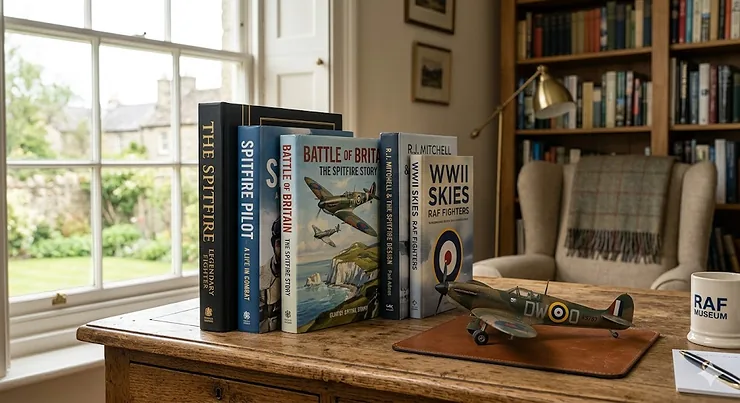
There’s something about the Spitfire that refuses to stay in the past. Walk into any British aviation museum, switch on an airshow livestream, or mention the name in a pub full of people who’ve never set foot inside a cockpit — and watch the room change. The elliptical wings. The Merlin engine’s unmistakable growl. The sheer audacity of the thing. Britain’s most iconic fighter aircraft isn’t just history. It’s identity.
Which is why, if you’ve decided to go deeper than a Wikipedia rabbit hole (though that’s a perfectly fine starting point), you need the right spitfire history books. Not all of them are created equal. Some are magnificent. Some are dry as the Sahara in July. Some make you feel as though you’re strapped into the cockpit at 20,000 feet over Kent, and some read like a procurement report from the Air Ministry. The difference matters enormously — because this story deserves to be told well.
The Supermarine Spitfire entered RAF service in 1938, flew through the entire Second World War, and remained in operational use until 1954. Nearly 20,500 were built across 24 variants, from the Battle of Britain Mk I to the griffon-engined Mk 24. It was designed by R.J. Mitchell — a Stoke-born engineer who died of cancer before he ever saw it fly — and it became the symbol of a nation’s defiance. The aircraft’s full operational and combat history is staggeringly rich, which is precisely why there’s a bookshelf’s worth of material to explore.
This guide cuts through the noise. Whether you’re buying your first spitfire history book or adding to a collection that’s already threatening to collapse the shelving unit, these seven titles — all available on Amazon.co.uk — are the ones genuinely worth your money in 2026.
Quick Comparison: Top 7 Spitfire History Books at a Glance
| Book | Author | Best For | Focus | Price Range |
|---|---|---|---|---|
| Spitfire: A Very British Love Story | John Nichol | General readers | Pilots & human stories | Around £10–£14 |
| First Light | Geoffrey Wellum | Memoir lovers | Pilot’s personal account | Around £8–£12 |
| The Story of the Spitfire | Ken Delve | All-rounders | Operational & combat history | Around £12–£18 |
| R.J. Mitchell: Schooldays to Spitfire | Gordon Mitchell | Design enthusiasts | Designer biography | Around £10–£16 |
| Spitfire: A Complete Fighting History | Alfred Price | Detail seekers | Technical & tactical | Around £15–£25 |
| How to Build a Spitfire | David Price | Hands-on enthusiasts | Build project + history | Around £18–£25 |
| The Spitfire Story | Peter R. March | Gift buyers & beginners | Visual overview | Around £8–£14 |
The comparison above gives you a useful map of the terrain. The real choice, though, comes down to what you want the book to do for you. Are you after the goosebumps of a firsthand pilot memoir, or the satisfaction of understanding how every rivet was placed? The story of the man who drew it on paper, or the men who flew it into fire? Different books answer different questions — and the best readers tend to end up with several.
💬 Just one click — help others make better buying decisions too! 😊
✨ Don’t Miss These Exclusive Deals!
🔍 Take your Spitfire library to the next level with these carefully selected books. Click on any highlighted title to check current pricing and availability on Amazon.co.uk. These picks will help you find exactly what you need!
Top 7 Spitfire History Books: Expert Analysis
1. Spitfire: A Very British Love Story — John Nichol
If you’re buying just one spitfire history book in 2026, make it this one. John Nichol — himself a former RAF fast-jet navigator and Sunday Times bestselling author — has written what many reviewers have called the definitive popular history of the aircraft. It won WHSmith’s Non-Fiction Book of the Year back in 2018 and has barely left the conversation since.
What makes it exceptional isn’t the technical detail (though there’s plenty of that). It’s the scope. Nichol pulls the story far beyond the summer of 1940 and the skies over Kent — reaching Malta, North Africa, the Far East, the D-Day beaches. He features aristocratic female ferry pilots, ground mechanics who kept the machines flying through the Blitz, and pilots who bailed out over occupied France and were never heard from again. The human architecture of the book is remarkable. You come away understanding not just what the Spitfire did, but why the British people loved it so fiercely, then and now.
The prose is accessible without ever being dumbed down — a trick that’s harder than it looks. UK readers particularly appreciate Nichol’s instinct for the British emotional register: understated grief, dry humour, pride that doesn’t quite dare call itself pride.
UK Amazon reviews consistently praise it as gripping and beautifully written. Prime-eligible, so you’ll have it on your doorstep quickly.
✅ Sweeping narrative scope
✅ Exceptional human stories, including women in aviation
✅ Beautifully paced and accessible
❌ Less detailed on pure technical specifications
❌ Covers many variants quickly rather than in depth
Price range: Around £10–£14 paperback. Outstanding value for the quality of the read.
2. First Light — Geoffrey Wellum
This is not like other spitfire history books. It is, in the most precise sense, primary evidence — a memoir written by the youngest Spitfire pilot in the Battle of Britain, who joined the RAF at seventeen and was flying combat sorties before most of his contemporaries had finished their A-levels.
Geoffrey Wellum had jotted notes in an exercise book during the war itself. Three and a half decades later, he expanded them into a full narrative. That gap — close enough to feel the heat, distant enough to reflect — gives First Light its extraordinary texture. Max Hastings called it one of the best memoirs about flying in war he’d read in years. He wasn’t wrong.
The Independent wrote that reading it, you feel you are in the Spitfire at 20,000 feet, ammunition spent, a German Heinkel on your tail. That’s not hyperbole. Wellum’s prose is spare and immediate in the cockpit sequences, tender and funny on the ground. The psychological toll of constant operations — the losses, the guilt, the near-collapse — is handled with a honesty that was unusual for the genre when the book first appeared.
It’s also available as a Kindle edition at a very comfortable price, which is useful if you prefer to travel light. The BBC adapted it as a television drama in 2010 — worth watching afterwards, though the book is considerably richer.
✅ Unrivalled authenticity — this man was there
✅ Brilliant prose, emotionally resonant
✅ Perfect companion to more technical reads
❌ Ends before the full arc of the war
❌ Less focus on the aircraft’s technical development
Price range: Around £8–£12. One of the best-value reads in aviation history.
3. The Story of the Spitfire: An Operational and Combat History — Ken Delve
Ken Delve’s book occupies a slightly different shelf from Nichol or Wellum — it’s more systematic, more thorough, and considerably more useful if you want operational data without wading through a PhD thesis. Think of it as the well-organised friend who brings a spreadsheet to the pub quiz and still manages to be fun company.
The book covers the Spitfire’s operational life from its earliest squadron deployments through to post-war service. There are extensive appendices — tactical trials data, comparative performance against German aircraft, detailed squadron listings — that make this a genuine reference work rather than just a narrative read. UK reviewers consistently praise its depth; one called it “truly impressive in the amount of information packed in.” The writing is engaging without being theatrical, which is exactly right for this kind of material.
What sets Delve apart is his use of primary sources and combat record analysis. This isn’t a book that glides over the complexities of the Spitfire’s development; it engages with them. The evolution from the Mk I through to later variants, the tactical lessons learned over the Channel, the performance data compared against the Bf 109 — it’s all here, explained clearly.
Worth pairing with Wellum’s First Light for the full picture: one gives you the data, the other gives you the feeling.
✅ Extensive appendices and tactical analysis
✅ Covers post-war Spitfire service
✅ Excellent value as a reference work
❌ More reference than pure narrative — not ideal bedtime reading
❌ Some UK buyers report occasional availability delays
Price range: Around £12–£18. Solid investment for the serious enthusiast.
4. R.J. Mitchell: Schooldays to Spitfire — Gordon Mitchell
Here is the book that answers the question most Spitfire readers eventually ask: who actually made this thing? Gordon Mitchell’s biography of his own father — the legendary Supermarine designer Reginald Joseph Mitchell — is the definitive account, written with the intimacy only a son could achieve and the rigour of someone who clearly understood the engineering.
R.J. Mitchell grew up in Stoke-on-Trent, served an apprenticeship in a steam locomotive works, and somehow ended up revolutionising British aviation from a factory in Southampton. He designed 24 aircraft in total, won the Schneider Trophy seaplane race three times for Britain, and created the Spitfire while battling terminal cancer. He died in 1937, aged 42, before the production aircraft ever flew. The prototype was later flown over the site where his ashes were scattered.
Gordon Mitchell traces all of this with affection and precision. He doesn’t hero-worship uncritically — the portrait of his father is complex, showing a man of formidable concentration who could be difficult, a perfectionist who pushed test pilots to their limits. The technical sections are detailed but never impenetrable. UK readers with an engineering background tend to rate it particularly highly, though it’s accessible to any motivated reader.
For a broader view of Mitchell’s full design career, Beyond the Spitfire: The Unseen Designs of R.J. Mitchell by Ralph Pegram (also available on Amazon.co.uk, around £20–£28) is an excellent companion piece covering the projects that never made it off the drawing board.
✅ Definitive biographical account, written by his son
✅ Covers all 24 Mitchell designs, not just the Spitfire
✅ Nuanced, honest portrait of a complex genius
❌ Technical sections may challenge non-engineering readers
❌ Older edition; some copies can be harder to source
Price range: Around £10–£16 depending on edition. Exceptional depth for the price.
5. Spitfire: A Complete Fighting History — Alfred Price
Alfred Price is, quite simply, one of the most authoritative voices on the Spitfire in print. A former RAF officer and air historian, he has written more credible material on British WWII aviation than almost anyone alive. Spitfire: A Complete Fighting History is his most comprehensive single-volume treatment, and UK readers who’ve worked through much of the available literature consistently rank it among the best researched books on the aircraft.
Price brings a methodical intelligence to the subject that never feels cold. His comparative analysis — how the Spitfire measured up against its opponents variant by variant, theatre by theatre — is the sort of material that serious aviation history readers find genuinely illuminating rather than merely informative. The tactical trials data, the combat records, the performance assessments: Price cites his sources carefully and argues his case clearly.
This is the book for the reader who has already devoured a narrative like Nichol’s and now wants the analytical layer beneath it. It answers questions like: how did the Mk V fare against the Fw 190 when the Germans introduced it over the Channel in 1941? What were the actual performance margins? Price doesn’t guess; he shows his working.
Available in hardback and paperback on Amazon.co.uk; some editions are well within the £25 bracket, which for a book this substantial represents good value.
✅ Exceptional research credentials
✅ Rigorous comparative analysis across variants and theatres
✅ The authority on technical and tactical performance
❌ Not the most beginner-friendly starting point
❌ Dense in places — best read in sections rather than straight through
Price range: Around £15–£25. The serious reader’s investment.
6. How to Build a Spitfire — David Price
This one is an outlier — and deliberately so. David Price, a Cumbrian author and military aviation writer, spent years building a full-scale replica Spitfire in his garden. Yes, his garden. The book tells that story in parallel with the aircraft’s own history, and the combination is, frankly, one of the most enjoyable reading experiences in the entire genre.
Published in October 2025 and already earning strong early reviews on Amazon.co.uk (one UK reviewer, writing in January 2026, called it a seamless blend of personal account and historical insight), How to Build a Spitfire works because Price’s project forces him to understand the engineering from the inside out. When he describes the elliptical wing or the Merlin engine’s engineering tolerances, it’s not abstract history — he’s been there with his hands. That gives the historical sections an unusually tactile quality.
For readers who’ve always wanted to understand the craft of the Spitfire — not just the legend but the physical reality of the thing — this is genuinely unmissable. It also makes a rather inspired gift for the aviation-obsessed person in your life who already owns the obvious titles.
UK delivery is prompt; it’s Prime-eligible and was in stock at the time of research.
✅ Unique dual-narrative structure — personal project + history
✅ Makes engineering feel alive and grounded
✅ Ideal gift for the enthusiast who has everything
❌ Less comprehensive on combat history
❌ Newer title — fewer UK reviews to draw on yet
Price range: Around £18–£25. Fresh, original, and rather hard to put down.
7. The Spitfire Story — Peter R. March
Every list needs its entry point — the book that works for the reader who is coming to the subject completely fresh, or who wants a beautifully presented overview rather than a 400-page deep dive. The Spitfire Story by Peter R. March is exactly that: a well-organised, clearly written, generously illustrated introduction to one of the great aircraft of the twentieth century.
It covers the development and history of the Spitfire from its genesis in the 1930s right through to the aircraft’s continued presence at airshows and in museums today — a story that’s still very much ongoing, given that the Battle of Britain Memorial Flight continues to keep these aircraft airworthy for the British public. The photographs are mostly contemporary, which improves production quality, though some readers feel that slightly reduces the sense of period.
For a gift purchase — Father’s Day, birthday, Christmas for the aviation-minded relative who doesn’t already own a shelf of spitfire history books — this ticks all the boxes: accessible, attractive, authoritative enough to satisfy, and priced at a point that doesn’t require serious deliberation.
✅ Ideal starting point for new readers
✅ Well-illustrated and attractively produced
✅ Good gift option at a modest price
❌ Not enough depth for seasoned enthusiasts
❌ Contemporary photos rather than period archive images throughout
Price range: Around £8–£14. Perfect for beginners and as a gift.
How to Read Your Way Through Spitfire History: A Practical Guide
There’s a sequence to this, and it matters. Start in the wrong place and you risk either being overwhelmed by technical minutiae before you have the narrative context to make sense of it, or falling so in love with the romantic version of the story that you never graduate to the genuinely fascinating complexities underneath.
For the complete beginner: Open with The Spitfire Story or John Nichol’s Spitfire: A Very British Love Story. Get the sweep of the narrative, the emotional architecture of why this aircraft matters. Then move to First Light to inhabit the story from inside the cockpit.
For the design-curious: Go straight to Gordon Mitchell’s biography of his father after your first narrative read. The engineering makes far more sense when you understand who was driving it, what pressures he was under, and what the alternatives looked like. The Science Museum’s online resources on British aviation design are a useful free supplement.
For the tactical analyst: Alfred Price is your destination. Spitfire: A Complete Fighting History rewards careful, methodical reading. Keep a notebook. Compare the variant specifications. Think about what the performance margins meant in actual dogfights over the Channel or the Mediterranean.
For the hands-on thinker: David Price’s How to Build a Spitfire will reframe everything you thought you knew about the engineering. Reading it after one of the more conventional histories is revelatory.
One common mistake: buying a highly technical reference work as your first spitfire history book. The specs and appendices are valuable, but only once you have the story to hang them on. Think of it like learning to drive — you need the feel of the road before the highway code makes intuitive sense.
Who Should Read Which Book? Real-World Reader Profiles
Understanding the landscape of spitfire history books is one thing. Knowing which one is yours is another. Here are three reader profiles worth considering.
The Retired RAF Enthusiast in the Cotswolds You’ve probably already read something in this space, but decades ago. You want depth, authenticity, and the kind of detail that rewards a quiet evening with a decent cup of tea. R.J. Mitchell: Schooldays to Spitfire and Alfred Price’s Complete Fighting History belong on your shelf. Pair them with First Light for the emotional counterweight.
The History Teacher in Manchester You need books that are engaging enough to recommend to sixth-formers who aren’t yet convinced that aviation history is relevant to their lives. Nichol’s Very British Love Story is your answer — it’s a proper page-turner that also happens to cover a crucial chapter in British history. Wellum’s memoir is your supplementary text.
The Aviation Weekend Visitor at Duxford You’ve just spent the morning watching a Battle of Britain Memorial Flight Spitfire do a slow roll over the Cambridgeshire flatlands and you want to go deeper. The Spitfire Story is the right gateway; How to Build a Spitfire will give you a completely new appreciation of what you just watched in the sky.
The Design That Changed Britain: Understanding What Makes Spitfire Books Valuable
The Spitfire is not merely an aircraft. It is — and historians, cultural commentators, and engineers all broadly agree on this — a crystallisation of a particular moment in British history. Understanding that makes the books richer.
R.J. Mitchell’s revolutionary elliptical wing wasn’t chosen for aesthetic reasons, though it happened to produce one of the most beautiful silhouettes in aviation history. It was an engineering solution to a specific problem: achieving the right lift-to-drag ratio while accommodating eight machine guns in the wing structure. The full technical history of the Supermarine design process is a case study in applied brilliance under extraordinary pressure.
The best spitfire history books understand this duality — that the machine was both a work of pragmatic engineering and an object that acquired genuinely mythological status in British culture. Books that focus only on the technical dimension miss why people care. Books that focus only on the heroic narrative miss why it worked. The titles in this guide mostly manage to hold both in balance, which is why they’re recommended here.
It’s also worth noting that the Spitfire’s story didn’t end in 1945. Variants continued in RAF service until 1954, and export models flew with over 30 nations. The Imperial War Museum maintains several airworthy and static examples that provide extraordinary context for any of these books — a visit to Duxford or the London site before or after reading is highly recommended.
✨ Don’t Miss These Exclusive Deals!
🔍 Ready to build your Spitfire library? Click any highlighted title to check current pricing and availability on Amazon.co.uk. Whether you’re after a personal memoir, a technical deep-dive, or a beautifully illustrated overview, there’s a perfect pick here for you!
Common Mistakes When Buying Spitfire History Books
Buying purely by page count. Thicker doesn’t mean better. First Light is relatively compact; it’s also one of the most powerful books in the genre. Judge by the quality of what’s inside, not the heft.
Ignoring edition dates. Some Spitfire books go through multiple editions with significantly updated content — Gordon Mitchell’s biography of R.J. Mitchell, for example, has appeared in several forms. Check publication dates on Amazon.co.uk before ordering; a newer edition often includes additional research.
Overlooking the author’s credentials. Alfred Price was an RAF officer and air historian. John Nichol is a former fast-jet navigator. Geoffrey Wellum flew Spitfires in combat. These are not the same as a generalist writer who has done six months of research. When buying aviation history, credentials matter considerably.
Buying multiple beginner books. If you’ve already read one solid introductory overview, the next purchase should go deeper — not sideways. Move up the ladder rather than along the shelf.
Missing the memoir genre entirely. A surprising number of aviation history enthusiasts have extensive collections of technical and operational histories but have never read a proper pilot memoir. First Light exists. There is no excuse.
Spitfire Design History: Features That Actually Matter in These Books
When evaluating spitfire history books, certain features separate the genuinely valuable from the merely adequate.
Primary sources vs. secondary synthesis. The best books either are primary sources (Wellum’s memoir) or use them extensively (Alfred Price, Ken Delve). Be wary of books that are essentially retellings of other books without original research.
Appendix quality. For technical and operational histories, the appendices tell you a great deal about the author’s rigour. Detailed variant specifications, squadron listings, and comparative performance data are signs of a serious work.
Photographic research. The Spitfire is a visually magnificent subject, and books that make real use of the archive — including period photographs from the RAF Museum, the IWM, and private collections — add significant value.
Scope beyond the Battle of Britain. The summer of 1940 is the famous chapter, but the Spitfire’s story runs from 1936 to 1954 and spans multiple continents. Books that treat the Battle of Britain as the whole story are missing roughly two-thirds of the aircraft’s history.
Updated variants coverage. The Spitfire evolved through 24 official marks and dozens of sub-variants. Books that engage seriously with this development — how each version addressed the limitations of the last — demonstrate genuine depth.
FAQ: Spitfire History Books
❓ What is the best spitfire history book for a complete beginner?
❓ Are there good spitfire history books specifically about R.J. Mitchell and the design process?
❓ Are Spitfire pilot memoirs available on Amazon.co.uk?
❓ How do I know which edition of a Spitfire book to buy on Amazon.co.uk?
❓ Are these Spitfire books suitable as gifts?
Conclusion: Building Your Spitfire Library
The Spitfire has now been inspiring books for over eighty years, and the genre shows absolutely no sign of running out of steam — which is rather appropriate for a machine built around a supercharged Merlin engine. What’s striking, reading across these seven titles, is how well the best of them hold up. Wellum’s memoir is as immediate as it was when it first appeared. Alfred Price’s research is as meticulous. Gordon Mitchell’s portrait of his father is as quietly moving.
If you’re building a library from scratch, start with Nichol for the sweep, Wellum for the feeling, and Mitchell for the engineering soul of the thing. Add Price when you’re ready to go analytical, and treat David Price’s How to Build a Spitfire as a wild card that will almost certainly become your favourite conversation piece.
These aren’t just books about an aeroplane. They’re books about ingenuity under pressure, about ordinary people doing extraordinary things in the sky over Britain, about a nation that found its symbol in the curve of an elliptical wing. They reward careful reading. They reward re-reading. And they make excellent company on a rainy British evening — which, let’s be honest, we have rather a lot of.
✨ Don’t Miss These Exclusive Deals!
🔍 Ready to start reading? Click any highlighted title in this guide to check current pricing and delivery options on Amazon.co.uk. Prime members enjoy next-day delivery on eligible titles — your Spitfire library could be with you by tomorrow morning!
Recommended for You
- 7 Best RAF History Books UK 2026: Expert Picks
- 7 Best Trench Warfare Books UK 2026
- 7 Best Somme Battle History Books That Bring 1916 to Life UK 2026
Disclaimer: This article contains affiliate links. As an Amazon Associate, I earn from qualifying purchases. If you purchase products through these links, we may earn a small commission at no additional cost to you.
✨ Found this helpful? Share it with your mates! 💬🤗
