

In This Article
There is something quietly magnificent about the Royal Navy’s story. An island nation — perpetually damp, resolutely stubborn — that spent three centuries ruling the waves, reshaping the world’s map, and producing some of the most gripping human drama ever committed to page. If you’ve ever stood on Portsmouth’s Hard, gazed up at the black hull of HMS Victory, and felt something stir in your chest, you’ll understand exactly why royal navy books occupy an entire shelf (or three) in so many British homes.

But here’s the thing: the literature is vast, wildly uneven, and occasionally impenetrable. For every Pulitzer-winning masterpiece, there’s a dry-as-bilge-water institutional account that reads like the minutes of a particularly underfunded committee meeting at the Admiralty. Finding the genuinely brilliant ones — books that make you miss your bus stop because you’re so engrossed in the Battle of Trafalgar — requires a bit of navigation.
That’s precisely what this guide does. Whether you’re a seasoned naval historian who can rattle off the order of battle at Jutland from memory, a curious newcomer who just watched a documentary on HMS Warspite, or someone hunting for the perfect gift for a retired Royal Navy veteran, this carefully curated selection has you covered. These are the royal navy books that actually deliver — combining scholarship, storytelling, and the kind of authentic detail that brings the Senior Service’s remarkable history roaring back to life.
All titles are available on Amazon.co.uk with UK delivery. Let’s get underway.
Quick Comparison: Best Royal Navy Books at a Glance
| Book | Author | Era Covered | Best For | Price Range |
|---|---|---|---|---|
| The Command of the Ocean | N.A.M. Rodger | 1649–1815 | Serious historians | £12–£18 |
| The Safeguard of the Sea | N.A.M. Rodger | 660–1649 | Complete beginners to scholars | £12–£16 |
| Jack Tar | Roy & Lesley Adkins | Napoleonic Wars | Social history fans | £10–£14 |
| Operation Pedestal | Max Hastings | WWII, 1942 | WWII readers, general audience | £10–£15 |
| Dreadnought | Robert K. Massie | WWI build-up | Biography lovers | £12–£16 |
| The Rules of the Game | Andrew Gordon | WWI / Jutland | Command theory buffs | £12–£18 |
| Royal Navy Yearbook 2025/26 | Tim Ripley | Modern RN | Current affairs / reference | £18–£25 |
At a glance, Rodger’s two-volume work dominates the scholarly end, while Hastings and Massie are your gateway drugs for readers who want history that reads like a thriller. The Royal Navy Yearbook 2025/26 stands apart as the only title covering the fleet as it exists today, making it indispensable if the modern Senior Service is what you’re after. Note that most paperback titles qualify for Amazon Prime free next-day delivery; the Yearbook is a larger-format hardback which may require checking delivery options.
💬 Just one click — help others make better buying decisions too! 😊
Top 7 Royal Navy Books: Expert Analysis
1. The Command of the Ocean: A Naval History of Britain 1649–1815 — N.A.M. Rodger
If there is a single indispensable book in the entire canon of British naval history, this is probably it. Rodger’s second volume in his trilogy — covering the period from the English Civil War’s aftermath through to Napoleon’s final defeat — is the kind of scholarship that makes you genuinely grateful to be literate. It’s magisterial, detailed, and utterly absorbing.
What separates this from lesser works is Rodger’s insistence on understanding the Navy as a social and political institution, not merely a collection of warships. He explains how the Admiralty evolved, how officers were trained and promoted, and why the British sailor became, by 1800, the most effective fighting seaman in the world. This isn’t dry institutional history — it’s an argument about how Britain became Britain. The spec sheet, so to speak: approximately 700 pages of dense, rewarding text, exhaustive footnotes, and appendices that naval researchers will return to for years.
This is not, to be honest, a book for the faint-hearted or the casual reader in search of a weekend page-turner. It rewards patience handsomely, but it demands it. Best suited to readers who are already comfortable with naval history and want something approaching a definitive account. UK customers should note the Penguin paperback edition represents the best value; the hardback commands a significant premium for essentially the same text.
UK reviewers consistently rate this as essential reading, and the Sunday Times called it “one of the greatest works of historical scholarship of our age” — which, for a history book, is rather the equivalent of a five-star Amazon rating.
✅ Unrivalled scholarly depth
✅ Covers social, political, and operational history
✅ The benchmark for all subsequent naval histories
❌ Dense reading — not a beginner’s book
❌ Some chapters can feel more like reference material than narrative
Around £12–£18 on Amazon.co.uk for the Penguin paperback. For the serious reader, it’s exceptional value.
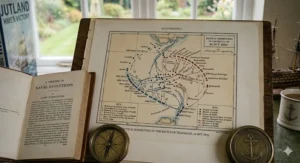
2. The Safeguard of the Sea: A Naval History of Britain, Vol. 1: 660–1649 — N.A.M. Rodger
The first volume of Rodger’s trilogy, covering everything from the Viking age to the eve of the Civil War. If The Command of the Ocean is the crown jewel, The Safeguard of the Sea is the foundation stone — and arguably the more surprising read, because most of us know embarrassingly little about English sea power before the Armada.
Rodger takes the reader through nearly a thousand years of maritime history with the same forensic thoroughness he brings to the later period, tracing how England’s relationship with the sea slowly, painfully evolved from Viking raids and ad hoc coastal defence into the beginnings of a professional navy under the Tudors. The section covering Henry VIII’s initial attempts to build a standing fleet is genuinely revelatory — and explains much about why Samuel Pepys’s later organisational reforms at the Admiralty were so consequential. The National Maritime Museum in Greenwich, which Rodger has been associated with throughout his career, holds many of the primary sources that underpin both volumes.
For the serious reader working through naval history chronologically, this is where to start. For anyone whose interest begins firmly with Nelson, it’s perhaps a secondary purchase — wonderful, but you can probably read Vol. 2 first without losing much. Available in Penguin paperback on Amazon.co.uk.
✅ Covers a thousand years of history no other book touches
✅ Same scholarly standard as Vol. 2
✅ Paperback edition excellent value for money
❌ Pre-Nelson period may feel remote to some readers
❌ Same density challenge as Vol. 2
Around £12–£16 on Amazon.co.uk.
3. Jack Tar: Life in Nelson’s Navy — Roy & Lesley Adkins
Here’s a book that does something most naval histories singularly fail to do: it tells you what it actually felt like. Not for the admirals. Not for the captains pacing their quarterdecks. For the men — the pressed sailors, the volunteers who’d run out of better options, the twelve-year-old powder monkeys who handed cartridges to the guns at Trafalgar.
Roy and Lesley Adkins (both Fellows of the Royal Historical Society, both based in Devon) have excavated diaries, letters, court martial records, and personal memoirs to reconstruct lower-deck life in extraordinary, often shocking detail. The floggings. The food — salt beef so hard it could be carved into ornaments and sold in port. The particular horror of battle at close range on a wooden ship, where the surgeon’s cockpit was directly below the gun deck and screams filtered up through the planks.
What most readers don’t anticipate is how funny this book sometimes is — the sailors’ slang, their letters home, their stubborn irreverence toward authority. Nelson’s navy was brutal and hierarchical, yes, but it was also a remarkably cosmopolitan institution, drawing men from across Britain, Ireland, the Caribbean, and beyond. The Telegraph called it “an enthralling book” and the Daily Mail said it would “make you think again” — and both, unusually, are correct.
This is the ideal book for readers who want social history over tactical analysis. Perfect gift material, too: accessible enough for a non-specialist, rich enough for someone already deep in the period. Widely available on Amazon.co.uk in paperback.
✅ Genuinely gripping social history from primary sources
✅ Accessible to readers with no prior naval knowledge
✅ A natural companion to any Napoleonic-era narrative history
❌ Not a tactical or operational history — battles aren’t the focus
❌ Some readers may find the thematic (rather than chronological) structure slightly disorienting
Around £10–£14 on Amazon.co.uk.
4. Operation Pedestal: The Fleet That Battled to Malta, 1942 — Max Hastings
In August 1942, the Royal Navy assembled its largest fleet since Jutland and sent it straight into a gauntlet of Axis submarines, torpedo boats, and over six hundred enemy aircraft. The objective was to keep Malta alive — to force a convoy of merchantmen through the Mediterranean to an island that was, by that point, on the verge of starvation. The losses were catastrophic. The outcome was, by the narrowest of margins, a British success.
Max Hastings — veteran war correspondent, author of more than twenty books, a writer who has spent his career arguing that real war is nothing like the Hollywood version — delivers what is widely considered the definitive popular account of this extraordinary operation. He is meticulous about the big picture (strategy, intelligence failures, command decisions) while simultaneously giving voice to the individual men: the destroyer captains, the tanker crews, the Hurricane pilots, the German U-boat commanders who were, it turns out, remarkably human.
For readers whose interest in the Senior Service runs primarily through the Second World War, this is an almost perfect starting point. It requires no prior knowledge of naval history; Hastings explains everything you need to know without ever being patronising about it. The Kirkus Reviews called it “another enthralling Hastings must-read,” and having read it twice, I’d struggle to disagree. Available as paperback and Kindle on Amazon.co.uk; the Kindle edition is particularly keenly priced.
✅ Gripping narrative that reads like a novel
✅ Meticulously researched without being inaccessible
✅ Balances strategic overview with human-level storytelling
❌ Some former Royal Navy officers have noted Hastings occasionally leans on junior ranks’ accounts at the expense of a more balanced command-level analysis
❌ Focused on a single operation — not a broad history
Around £10–£15 on Amazon.co.uk.
5. Dreadnought: Britain, Germany, and the Coming of the Great War — Robert K. Massie
If you want to understand why the Royal Navy found itself at Jutland in 1916, staring across the North Sea at the Imperial German High Seas Fleet, you need to read this book first. Massie — a Pulitzer Prize winner with a biographer’s gift for making historical figures feel shockingly alive — reconstructs the naval arms race between Britain and Germany in the decades before 1914, and in doing so tells the story of how two nations that had been friendly cousins talked themselves into catastrophe.
The characters are extraordinary. Jacky Fisher, the volcanic Admiral who dragged the Victorian Royal Navy screaming into the twentieth century and built HMS Dreadnought herself. Kaiser Wilhelm II, nursing his complex mixture of admiration and resentment for all things British. Winston Churchill, young, ambitious, and already half in love with the Navy. Massie writes about all of them with the kind of psychological acuity that you usually only find in literary fiction.
At around 1,000 pages, this is not a book you finish in a week. But it repays every hour invested. It is, among other things, a brilliant explanation of how arms races develop their own terrible momentum — a theme that has lost none of its relevance. The Wikipedia entry on the Anglo-German naval arms race provides useful supplementary context, but Massie’s narrative leaves that thoroughly in the shade.
✅ Superb biographical writing about Fisher, Churchill, and Wilhelm II
✅ Places the RN in its geopolitical context brilliantly
✅ A page-turner despite its size
❌ Very long — this is a commitment
❌ US-authored, so occasional American framing; British readers may notice the perspective
Around £12–£16 on Amazon.co.uk.

6. The Rules of the Game: Jutland and British Naval Command — Andrew Gordon
This is the book that naval officers read — at Dartmouth, at Greenwich, at staff colleges around the world. It is required reading in multiple navies, and reading it, you begin to understand why. Andrew Gordon set out to explain what went wrong at the Battle of Jutland in May 1916 — why the Grand Fleet, which held every tactical advantage, failed to destroy the High Seas Fleet — and ended up writing one of the most penetrating analyses of institutional culture and command psychology ever published.
Gordon’s central argument is that the Victorian Navy created a culture of rigid obedience and signal-dependence that fatally suppressed individual initiative at exactly the moment when initiative was most needed. He traces this culture back to Trafalgar itself: after Nelson’s death, the Navy made the mistake of trying to replicate his genius through rules rather than through the kind of independent thinking he actually embodied. It’s a sobering argument, and Gordon makes it with enormous forensic care and some quietly devastating passages about specific commanders.
This isn’t a light read. But for anyone seriously interested in how the Royal Navy actually worked — in what the history of naval command looks like from the inside — there’s simply nothing to compare with it. UK readers interested in leadership and organisational culture more broadly will find as much to chew on here as students of pure military history.
✅ Still required reading in naval colleges worldwide
✅ Brilliant on command culture and institutional psychology
✅ One of the finest military history books in any era
❌ Specialised — assumes some prior knowledge of WWI naval history
❌ Dense analytical passages can slow non-specialist readers
Around £12–£18 on Amazon.co.uk.
7. Royal Navy Yearbook 2025/26 — Tim Ripley
Every other book on this list looks backwards. This one, published in October 2025, looks squarely at the fleet as it stands right now — and it’s the only title that does so with any real authority.
Author Tim Ripley, a prolific defence journalist, has produced what is essentially the definitive annual reference guide to the modern Royal Navy: its ships, submarines, aircraft, personnel, operations, procurement plans, and strategic position. The 2025/26 edition covers everything from the operational status of the two Queen Elizabeth-class aircraft carriers to the Type 26 frigates programme, from the Navy’s role in NATO’s northern flank to its deployments in the Indo-Pacific. If you want to understand why the modern Senior Service looks the way it does — and why it operates as it does — this is where you start.
What differentiates a good yearbook from a mediocre one is the quality of the analysis layered over the data, and Ripley generally delivers. He doesn’t just list ships; he contextualises them within the broader debate about what the Royal Navy is for in the 2020s. For those interested in current Royal Navy fleet operations and doctrine, this provides essential context that you simply won’t find summarised elsewhere.
This is a larger-format hardback, priced accordingly. It’s worth every penny for naval professionals, defence enthusiasts, and gift-givers who want something contemporary and authoritative. Amazon Prime members should check delivery options as stock can be limited.
✅ The only up-to-date reference covering the modern RN
✅ Comprehensive fleet data, operations, and analysis
✅ Makes an excellent and distinctive gift
❌ Premium price for a yearbook
❌ Will date — buy the most recent edition only
Around £18–£25 on Amazon.co.uk.
How to Choose a Royal Navy Book: A Practical Guide for UK Buyers
If you’ve never bought a naval history book before, the sheer volume of available titles can feel faintly overwhelming. Here’s a framework to cut through it.
1. Start with your entry point. Are you interested in a specific era — Trafalgar, Jutland, the Battle of the Atlantic, the modern fleet? Start there, not at the beginning of naval history. Operation Pedestal (WWII) and Jack Tar (Napoleonic) are both excellent entry points for general readers.
2. Know what kind of history you enjoy. Tactical and operational history (what happened, how, and why the tactics worked or failed)? Gordon’s Rules of the Game and Hastings’s Operation Pedestal excel here. Social history (who were the people; what was daily life like)? Jack Tar is unrivalled. Strategic and institutional history (how did the Navy as an organisation evolve)? Rodger’s trilogy is the destination.
3. Consider reading depth. Rodger’s volumes and Gordon’s Rules of the Game are rewarding but demand patience and some background knowledge. Hastings and the Adkins are genuinely accessible to anyone.
4. Budget wisely. Paperback editions of Rodger, Adkins, and Hastings represent exceptional value — typically under £15 on Amazon.co.uk, often with Prime delivery. The Royal Navy Yearbook is the significant outlier, but as a reference it justifies the premium. All titles above £25 qualify for Amazon’s free standard delivery threshold.
5. Think about format. Most titles are available as Kindle editions at lower prices, which is worth considering for the longer Rodger and Massie volumes. There’s something to be said for a physical copy you can annotate, though — particularly for reference-heavy books like Rodger.
✨ Don’t Miss These Exclusive Deals!
🔍 Take your naval history reading to the next level with these carefully selected titles. Click on any highlighted item to check current pricing and availability on Amazon.co.uk. Whether you’re after sweeping strategic history or boots-on-the-deck social narrative, these picks will help you find exactly the right book.

Who Are These Books Actually For? Real-World Reader Profiles
The Retired Royal Navy Veteran (Portsmouth or Plymouth)
You served twenty years and you know your way around a diesel-electric submarine. You’ve lived the institutional culture Gordon describes in The Rules of the Game. Go straight there — it’ll resonate in ways that will probably annoy you and illuminate everything. Follow up with Rodger’s Command of the Ocean for the long historical view of the service you spent your career in. The Royal Navy Yearbook 2025/26 makes a fine addition to your shelf for tracking how the modern fleet has evolved since your time.
The History Teacher (Secondary School, Anywhere in the UK)
You’re teaching the First or Second World War and want to bring the naval dimension to life — because the standard curriculum gives it about half a page. Operation Pedestal is your answer for WWII: compelling, accessible, and genuinely moving in places. For WWI, Massie’s Dreadnought provides the essential context for why the war at sea developed as it did. The National Archives also holds digitised service records that can add extraordinary personal detail to classroom discussions.
The Christmas Gift-Buyer (Everywhere)
Your father or grandfather served, or simply loves British history. Jack Tar is the safest bet: beautifully written, accessible, handsomely presented as a paperback. Operation Pedestal is a close second. Both sit in the under-£15 range, come with free Prime delivery, and have the distinct advantage of not requiring any prior knowledge to enjoy.
Common Mistakes When Buying Royal Navy Books — And How to Avoid Them
Buying a book out of sequence. Rodger’s trilogy is numbered for a reason. You can read The Command of the Ocean independently (most people do), but starting at Vol. 3 — if and when Rodger publishes it — without the foundation of the earlier volumes is like joining a conversation halfway through.
Confusing popular history with academic history. Hastings and Adkins are popular historians writing for a general audience; Rodger and Gordon are academic historians writing (primarily) for specialists. Both are valuable, but they’re doing different things. Neither is wrong — they just have different purposes.
Paying over the odds for a hardback. Unless you specifically want a presentation copy, the Penguin and Abacus paperback editions of the Rodger and Adkins titles are identical in content and considerably cheaper. Check both new and used listings on Amazon.co.uk; many of these titles have been in print for years and used copies in excellent condition can be found for a few pounds.
Ignoring the Kindle editions. The longer titles — Rodger, Massie — are genuinely easier to navigate as e-books, where you can search terms and cross-reference without losing your page. If you’re a Kindle reader, the digital editions of most titles are meaningfully cheaper and deliver instantly.
Buying the US edition. A few of these titles have US paperback editions that occasionally appear cheaper on marketplace listings, but check that the seller ships to the UK; some don’t, and the return process under the Consumer Contracts Regulations, while solid, is a nuisance you don’t need.
Royal Navy Books vs Other Naval History Books: What Sets the Senior Service Apart
A question worth asking: why choose royal navy books specifically, rather than broader naval history or, say, American or German naval histories?
The honest answer is that the Royal Navy occupies a genuinely unique position in maritime history. Between roughly 1700 and 1945, no other naval force came close to its sustained dominance. The institutional evolution — from Tudor coastal defence to global imperial fleet to modern NATO partner — spans a longer continuous history than any comparable organisation. The Royal Navy, founded formally in 1546, is today the world’s sixth largest by tonnage, and it has never stopped operating in some capacity since its inception.
That continuity creates a richness of historical material that naval histories of other nations simply can’t match. American naval history is extraordinary but covers a relatively compressed timeframe. German naval history is fascinating but discontinuous — broken by two world wars and two rebuilt fleets. The Royal Navy’s story runs uninterrupted, from the defeat of the Armada in 1588 to HMS Queen Elizabeth currently somewhere in the Indo-Pacific.
| Feature | Royal Navy History Books | US Navy History Books | Other Naval Histories |
|---|---|---|---|
| Era covered | 500+ years continuous | ~250 years | Varies significantly |
| UK availability on Amazon.co.uk | Excellent | Mixed | Mixed |
| Primary source richness | Exceptional | Very good | Variable |
| Best for British readers | ✅ Natural cultural fit | ✅ Good for WWII Pacific | Depends on interest |
| Price range (UK paperback) | £10–£18 typical | £12–£20 typical | Highly variable |
For British readers, there is also something to be said for the cultural resonance. The Royal Navy is woven into British identity in ways that no foreign naval force can replicate. You may live 200 miles from the sea in the East Midlands, but the Senior Service shaped the country you live in — its trade routes, its empire, its legal traditions, and its idea of itself.
Long-Term Value: Building a Royal Navy Library on a British Budget
The good news is that building a genuinely excellent collection of royal navy books doesn’t require a remortgage. Most of the titles covered here are available in paperback for under £15, and the secondhand market on Amazon.co.uk is robust for all of them.
A sensible reading order, assuming you’re starting from scratch:
Year one (foundation): Jack Tar → Operation Pedestal → Dreadnought You’ll cover the Napoleonic era, WWII, and the inter-war period with three accessible, brilliantly written books. Total cost: under £40 in paperback.
Year two (depth): The Command of the Ocean → The Safeguard of the Sea Rodger’s scholarly framework transforms everything you learned in year one into a coherent narrative of how British sea power actually worked and why it mattered.
Year three (analysis): The Rules of the Game → Royal Navy Yearbook 2025/26 Gordon gives you the analytical framework; Ripley’s Yearbook brings you to the present day.
Total investment for a comprehensive Royal Navy library: roughly £80–£120 in paperback, substantially less if you use the secondhand market or favour Kindle editions. Amazon Prime members in most UK postcodes will have all paperbacks delivered next day, which is, if you’re building a reading list, a considerable convenience.
For those seeking further depth beyond Amazon, the National Museum of the Royal Navy in Portsmouth has an excellent bookshop stocking specialist titles not widely available elsewhere — well worth visiting if you’re in the area, and the museum itself is a remarkable experience.
FAQ: Royal Navy Books
❓ What is the best royal navy book for a complete beginner?
❓ Are royal navy books available on Kindle in the UK?
❓ Which royal navy book is best for understanding naval warfare strategy?
❓ Do royal navy books on Amazon.co.uk qualify for Prime delivery?
❓ Are there royal navy books specifically about the modern fleet?
Conclusion
The Royal Navy’s story is, in many ways, Britain’s story. An island that had no choice but to master the sea, and in doing so built something remarkable: a fighting force that for two centuries stood as the most powerful naval organisation the world had ever seen. The books covered here tell that story from almost every angle — the sailors who lived it, the admirals who led it, the politicians who funded it (or didn’t), and the strategists who tried, not always successfully, to understand it.
If you take only one thing from this guide, let it be this: don’t start with the densest option. Start with Jack Tar or Operation Pedestal, get hooked, and let the rabbit hole take you where it will. Rodger and Gordon will be waiting when you’re ready. The beautiful thing about this literature is that it rewards exactly as much as you put into it — and it never entirely runs out.
Every title featured here is available on Amazon.co.uk, most in both paperback and Kindle formats, with Prime delivery available across the UK. Check current pricing at the links above — prices shift, but the quality of these books decidedly does not.
✨ Don’t Miss These Exclusive Deals!
🔍 Ready to start your naval history journey? Click on any highlighted title to check current pricing and availability on Amazon.co.uk. Free standard delivery on orders over £25 — Prime members get it next day. These are the books worth making room for on your shelf.
Recommended for You
- Best Bomber Command Books 2026: 7 Essential UK Reads
- 7 Best Spitfire History Books UK 2026 – Must-Read Picks
- 7 Best RAF History Books UK 2026: Expert Picks
Disclaimer: This article contains affiliate links. As an Amazon Associate, I earn from qualifying purchases. If you purchase products through these links, we may earn a small commission at no additional cost to you.
✨ Found this helpful? Share it with your mates! 💬🤗
