
In This Article
There’s a particular kind of person who buys a physics books for beginners as a New Year’s resolution, reads the first forty pages with great enthusiasm, and then leaves it on the bedside table doing an excellent impression of a coaster. I should know — I’ve been that person more than once. The trouble isn’t intelligence. It’s that most “intro to physics” books were written by people who forgot what it felt like not to understand physics.
The good news is that a small, brilliant shelf of books exists specifically to fix that. Written by working physicists who happen to also be rather good writers, they explain black holes, quantum weirdness and the nature of time without assuming you remember anything from school beyond “F equals m a, probably.” Whether you’re after a Christmas present for a curious teenager, something to read on the 7:42 from Reading, or a genuine attempt to finally understand what Brian Cox is on about, this guide rounds up seven titles that consistently turn sceptics into the sort of person who brings up entropy at dinner parties. Slightly annoying for everyone else, admittedly, but rather satisfying for you.
Quick Comparison Table: Best Physics Books for Beginners (UK)
| Book | Format | Price Range (£) | Difficulty | Best For |
|---|---|---|---|---|
| A Brief History of Time | Paperback | £8–£10 | Beginner–Intermediate | Classic foundation reading |
| Seven Brief Lessons on Physics | Paperback | £7–£9 | Beginner | Short commutes, quick wins |
| Why Does E=mc²? | Paperback | £9–£12 | Beginner–Intermediate | Wanting the “why,” not just the “what” |
| Astrophysics for People in a Hurry | Paperback | £8–£10 | Beginner | Bite-sized chapters, busy readers |
| The Order of Time | Paperback | £8–£10 | Intermediate | Philosophically curious readers |
| Physics for Beginners (Usborne) | Hardback | £11–£15 | True beginner / teens | Gifts, younger readers, visual learners |
| The Theoretical Minimum | Paperback | £12–£16 | Intermediate–Advanced | Readers who actually want the maths |
A glance at that table tells its own story: there’s no single “best” physics books for beginners, only a best fit for you. If you want something you can finish on a single rainy bank holiday, Rovelli’s slim volume wins easily — it’s barely thicker than a Sunday supplement. If you’re after staying power and you don’t mind a bit of algebra creeping back in, The Theoretical Minimum earns its slightly higher price by genuinely teaching you to do physics rather than just admire it from a distance. And if this is for someone under fourteen (or an adult who simply prefers diagrams to dense paragraphs), the Usborne title is worth its premium — it’s the only one here built from the ground up for a UK school-age reader.
💬 Just one click — help others make better buying decisions too! 😊
7 Best Physics Books for Beginners — Expert Analysis
1. A Brief History of Time
A Brief History of Time by Stephen Hawking remains the book that launched a thousand physics obsessions, and there’s a reason it’s stayed in print for nearly forty years. Hawking takes on the big stuff — the Big Bang, black holes, the arrow of time — using a famous self-imposed rule of one equation per book (he allowed himself E=mc², and that’s about it). What most readers don’t expect is how funny parts of it are; Hawking’s dry asides about scientists arguing for decades over things that turned out to be obvious are proper laugh-out-loud moments on a train, which can be slightly awkward.
UK readers consistently rate it as one of those books “everyone should read once,” and the newer illustrated editions (with photographs and diagrams) make a noticeable difference if you’re a visual learner — worth checking which edition you’re getting on Amazon.co.uk, as the plain-text mass-market paperback and the illustrated edition are priced quite differently.
✅ Pros: a genuine modern classic; short chapters; widely available in UK libraries and charity shops if you want to try before buying new
❌ Cons: the cosmology chapters move fast; a few concepts (imaginary time, in particular) reward a second read
Price range: around £8–£10 for the standard paperback. Solid value for a book you’ll likely reread.
2. Seven Brief Lessons on Physics
If A Brief History of Time is a hearty Sunday roast, Seven Brief Lessons on Physics by Carlo Rovelli is an espresso — small, intense, and gone before you’ve quite registered how good it was. At under 100 pages, it’s become something of a phenomenon, and translated-from-Italian prose has an almost poetic quality that’s unusual for science writing. Rovelli covers relativity, quantum mechanics, particles, and even has a quietly moving final chapter on humanity’s place in the cosmos.
What most buyers overlook is just how re-readable this one is. Each “lesson” is genuinely brief — five to ten minutes — which makes it the rare physics books for beginners that fits into the gaps of a busy life: waiting for the kettle, the school run, a GP waiting room with questionable magazines.
✅ Pros: extremely short and digestible; beautifully written; a brilliant low-commitment entry point
❌ Cons: brevity means depth is sacrificed — treat it as a starter, not a main course
Price range: typically £7–£9, often among the cheapest titles on this list and frequently Prime-eligible for next-day delivery.
3. Why Does E=mc²? (And Why Should We Care?)
Brian Cox needs no introduction to anyone who’s switched on BBC Two on a Sunday evening, and Why Does E=mc²?, co-written with fellow University of Manchester physicist Jeff Forshaw, is the book version of that calm, slightly awestruck documentary voice. Unlike many “beginner” books that wave their hands at relativity and move swiftly on, this one actually derives E=mc² step by step — and somehow makes that process feel approachable rather than terrifying.
The real strength here is structure: rather than a grand tour of all of physics, it picks one famous equation and dismantles it completely, which gives the book a satisfying sense of progress. By the final chapter, you genuinely understand where the equation comes from, not just that Einstein was clever.
✅ Pros: rewarding sense of “getting it” by the end; strong British voice (literally — Cox narrates the audiobook); pairs well with the BBC’s Wonders documentary series for context
❌ Cons: a handful of pages involve following algebra with a pencil, which some readers find off-putting; pacing is slower than Rovelli’s book
Price range: around £9–£12 in paperback — a touch pricier than some on this list, but the depth justifies it for readers wanting more than a surface skim.
4. Astrophysics for People in a Hurry
Neil deGrasse Tyson’s Astrophysics for People in a Hurry does exactly what the title promises: chapters of four to six pages each, covering everything from dark matter to the chemistry of the cosmos, designed to be read in the time it takes to commute, queue, or — let’s be honest — avoid making eye contact on public transport. It became a surprise bestseller precisely because it removed the intimidation factor of a 400-page tome.
For UK readers, it’s worth knowing this one leans heavily on American framing and examples (NASA missions feature prominently), but the underlying physics is universal, and the chatty, confident tone translates well regardless of which side of the Atlantic you’re on. It’s a particularly good “is this hobby for me?” book — cheap enough to gift on a whim, short enough that finishing it doesn’t feel like homework.
✅ Pros: genuinely bite-sized chapters; covers an impressively wide range of topics; great for absolute beginners testing the water
❌ Cons: breadth over depth — don’t expect to come away an expert on any single topic; occasional US-centric references
Price range: around £8–£10, and one of the more frequently discounted titles on Amazon.co.uk.
5. The Order of Time
Rovelli again, but a different beast entirely. The Order of Time takes on the single strangest idea in modern physics: that “now” might not exist, that time doesn’t flow the same way everywhere, and that our everyday sense of past, present and future might be an illusion built by our own brains. It’s less a tour of physics and more a meditation — part science, part philosophy — and it’s the book on this list most likely to leave you staring at the ceiling at 11pm wondering what you’ve just read.
What stands out for British readers in particular is the pacing: this isn’t a book to rush through on a single train journey to Manchester. It rewards being read slowly, ideally with a notebook nearby, over several evenings — closer to poetry than a textbook in how it asks to be approached.
✅ Pros: genuinely mind-bending; gorgeous prose; sparks excellent dinner-party conversation (for better or worse)
❌ Cons: more abstract than the other entries here — not the one to start with if you want concrete, “how things work” answers; some sections drift into philosophy that purists may find frustrating
Price range: around £8–£10 in paperback.
6. Physics for Beginners (Usborne)
The odd one out on this list, and arguably the most useful — Physics for Beginners, published by the British company Usborne and written by Darran Stobbart with illustrations by Andrés Lozano, is aimed at teens and curious adults who want the concepts explained visually before tackling denser prose books. Usborne built its reputation on exactly this kind of friendly, richly illustrated non-fiction, and it shows: double-page spreads break down everything from forces to the structure of the atom using diagrams rather than dense paragraphs.
This is the title I’d point towards for a UK secondary-school pupil struggling with GCSE physics, or for an adult who’s tried one of the wordier books above and found their eyes glazing over. As a gift, it photographs beautifully too — hardback, colourful, and noticeably more “give-able” under a Christmas tree than a Penguin paperback.
✅ Pros: visual-first approach suits a wide range of learning styles; published in the UK, so spelling, units and curriculum framing feel natural; sturdy hardback that survives a school bag
❌ Cons: aimed at a younger or more casual audience, so adult readers wanting depth will outgrow it quickly; less “story,” more reference
Price range: around £11–£15, reflecting the hardback format and illustration quality — still well under the £25 Amazon.co.uk free-delivery threshold if bundled with another title.
7. The Theoretical Minimum: What You Need to Know to Start Doing Physics
For the reader who’s worked through two or three of the above and thought “right, but how do I actually do this” — The Theoretical Minimum by Leonard Susskind and George Hrabovsky is the answer. Born from Susskind’s wildly popular Stanford continuing-education lectures, it’s the only book here that includes proper worked exercises, and it doesn’t shy away from calculus and vectors. This is “popular science” in the sense that it’s written for non-professionals, but it expects you to roll your sleeves up.
The honest verdict: this is the most demanding entry on the list, and it’s not for everyone. But for the specific reader it’s aimed at — someone who’s enjoyed the conceptual books and now wants the actual mechanics, pun very much intended — nothing else here comes close. It’s also, refreshingly, the book most likely to still be useful to you in five years’ time, sitting on a shelf as a genuine reference rather than a one-read curiosity.
✅ Pros: real mathematical grounding without university fees; excellent as a bridge to formal study; companion volumes cover further topics if you get hooked
❌ Cons: requires comfort with basic algebra and some calculus; pacing is closer to a course textbook than a “read in bed” book
Price range: around £12–£16, the most expensive on this list, but arguably the best value per hour if you’re serious about going further.
Top 7 Physics Books for Beginners: Specification Comparison
| Book | Pages (approx.) | Reading Time | Maths Required | Edition Notes |
|---|---|---|---|---|
| A Brief History of Time | 256 | 4–6 hrs | Minimal | Check standard vs illustrated edition |
| Seven Brief Lessons on Physics | 96 | 1–2 hrs | None | Translated from Italian |
| Why Does E=mc²? | 288 | 5–7 hrs | Light algebra | Audiobook narrated by Brian Cox |
| Astrophysics for People in a Hurry | 224 | 3–4 hrs | None | US-centric examples |
| The Order of Time | 240 | 4–5 hrs | None | Best read slowly |
| Physics for Beginners (Usborne) | 96 | 2–3 hrs | None | UK-published, illustrated hardback |
| The Theoretical Minimum | 288 | 8–10 hrs+ | Algebra & calculus | Companion volumes available |
The pattern that jumps out here is the rough split between “reading” books and “working” books. Five of the seven are designed to be consumed the way you’d read a memoir — start to finish, no pen required — while only The Theoretical Minimum (and arguably the Usborne title, in a gentler way) asks you to actually engage with the maths. If your goal is simply to understand physics conceptually, the reading-book route is faster and far less intimidating. If your goal is to eventually study physics formally, or you just enjoy the satisfaction of solving things, starting one of the “reading” books alongside The Theoretical Minimum gives you the best of both — context from one, mechanics from the other.
How to Actually Get Through a Physics Book (A Practical Guide)
Buying the book is the easy part. Here’s what actually works, based on what derails most first attempts:
Read in short, regular sessions, not marathons. Twenty minutes a day beats a single three-hour Sunday session every time — physics concepts need time to settle, and most of these books are structured in short chapters precisely so you can stop at natural breaks. The British commute is, frankly, perfectly designed for this: a Rovelli “lesson” fits neatly between Clapham Junction and Victoria.
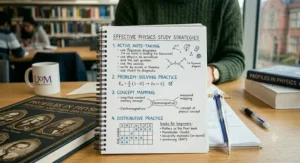
Keep a notebook nearby for the denser titles. For Why Does E=mc²? or The Theoretical Minimum, don’t be afraid to jot down a diagram or rework an equation in your own handwriting — it sounds old-fashioned, but writing things out by hand genuinely helps the maths-shy brain keep up.
Don’t fight the urge to skip ahead. If a chapter isn’t landing, it’s fine to read the next one and come back. Several of these authors deliberately revisit ideas from different angles later in the book, so a concept that seemed impenetrable on page 40 often clicks on page 110 once you’ve seen it framed differently.
Pair with free video content for visual reinforcement. Many of these authors have given talks or have related material from organisations like the Royal Institution, whose public lecture archive is an excellent (and free) companion to anything covering relativity or quantum theory.
Real UK Readers: Which Book Suits You?
The curious commuter (London/Manchester/Birmingham): Someone squeezing reading into 25-minute Tube or tram journeys wants short, self-contained chapters that survive interruptions — Seven Brief Lessons on Physics or Astrophysics for People in a Hurry are built for exactly this rhythm, and both slip easily into a coat pocket.
The parent buying for a Year 10 GCSE student: A pupil finding physics dry at school often responds far better to the Usborne Physics for Beginners, with its diagrams and bite-sized explanations, than to another dense revision guide. It won’t replace classroom study, but it reliably makes the subject feel less like a wall of formulae.
The retired enthusiast in a Cotswolds village, finally getting round to “that physics thing”: With more uninterrupted reading time available, A Brief History of Time followed by The Order of Time makes a satisfying pair — classic foundations followed by a more reflective, philosophical follow-up, ideal for slow evenings when the British weather has, predictably, ruled out the garden.
The career-changer considering an Open University physics module: The Theoretical Minimum is the realistic starting point here — it’s the closest thing on this list to an actual taste of undergraduate study, and working through its exercises before committing to a paid course (the Open University offers several relevant introductory modules) is a sensible (and considerably cheaper) way to test your appetite.
✨ Don’t Miss These Picks!
🔭 Whichever profile sounds like you, click through to check current availability and delivery options on Amazon.co.uk — Prime members can often get next-day delivery on the paperback titles.
How to Choose Physics Books for Beginners in the UK
- Start with your “why.” If you want general knowledge for conversation and curiosity, prioritise short, narrative-driven books (Rovelli, Tyson). If you’re aiming towards formal study, prioritise books with exercises (The Theoretical Minimum).
- Check the maths tolerance honestly. A book that promises “no equations” but then includes several pages of algebra will frustrate you more than one that’s upfront about it from the start.
- Consider the format for your reading habits. Paperbacks are lighter for commuting; the Usborne hardback is better suited to being left on a coffee table or used as a reference.
- Look at publication and edition dates. Cosmology moves fast — a book from the 1990s won’t reflect more recent findings on, say, gravitational waves or exoplanets, even if the core physics (relativity, thermodynamics) hasn’t changed.
- Read the first chapter sample before buying. Amazon.co.uk’s “Look Inside” feature is genuinely useful here — author voice varies hugely, and what works for one reader (Rovelli’s lyrical style, say) might grate on another who prefers Tyson’s punchier delivery.
- Factor in delivery and Prime eligibility. If you’re buying as a gift with a deadline, checking Prime next-day eligibility before you fall in love with a specific edition saves a last-minute scramble.
- Don’t buy all seven at once. Start with one or two, finish them, and let your reaction guide the next purchase — physics books for beginners work best as a gradual staircase, not a stack you feel guilty about.
Common Mistakes When Buying Physics Books for Non-Scientists
The most frequent mistake is buying based on fame alone. Hawking’s book is brilliant, but if you’re drawn to it purely because everyone’s heard of it, you might find Rovelli or Tyson a gentler on-ramp — there’s no prize for starting with the hardest option.
A second common slip is ignoring the edition. Several classics exist in multiple formats — standard paperback, illustrated, anniversary editions — at noticeably different prices on Amazon.co.uk. If you specifically want the photographs and diagrams in A Brief History of Time, double-check you’re ordering the illustrated edition rather than the plain text.
Third: assuming “popular science” means “no effort required.” Even the gentlest books on this list ask you to sit with genuinely strange ideas — that’s the point, and rushing through them defeats the purpose. And finally, a distinctly British problem: buying a hefty hardback for commuting. The Usborne title is gorgeous, but it’s not what you want wedged into a bag on the 18:05 from Paddington.
Popular Physics Books vs Physics Textbooks: What’s the Difference?
It’s worth being clear-eyed about this distinction, because the two get conflated constantly. Popular physics books — everything on this list except arguably The Theoretical Minimum — are written to explain ideas, using analogy, narrative and minimal notation. Textbooks, by contrast, are written to train you to solve problems, with formal definitions, derivations and problem sets, and they assume a level of mathematical fluency that most adult readers haven’t touched since school.
The danger zone is buying a proper undergraduate textbook (the kind referenced in physics degree reading lists) expecting it to read like Seven Brief Lessons. It won’t — and many people abandon physics as “not for them” after a bruising encounter with a textbook that was never meant for casual reading in the first place. If The Theoretical Minimum feels manageable and enjoyable, that’s actually a good signal that a textbook-style resource (or an Open University introductory module) might genuinely suit you. If it feels like wading through treacle, stick to the narrative side of the shelf — there’s nothing remotely lesser about that choice.
Reading Physics Books on a Typical British Day
There’s something quietly fitting about reading books on the nature of time and the universe while waiting for a delayed train, or watching rain streak down a window during yet another grey Tuesday. Several of the authors on this list lean into exactly that kind of everyday, slightly absurd context — Rovelli in particular writes as though he’s aware that most readers will be encountering quantum mechanics somewhere between the school run and putting the bins out.
Practically speaking, the shorter titles (Seven Brief Lessons, Astrophysics for People in a Hurry, the Usborne book) suit the stop-start nature of UK commuting and shift patterns far better than the denser ones. If your reading time tends to be in short, interrupted bursts — waiting in the school car park, ten minutes before a Zoom call, the queue at the Post Office — lean towards those first. Save The Order of Time and The Theoretical Minimum for situations with genuine stretches of quiet: a long train journey to visit family, a wet Sunday afternoon, or — let’s be honest — the bath, several of these books having survived a light spritz of bubble bath in the name of research.
Frequently Asked Questions
❓ What is the best physics book for a complete beginner?
❓ Are these physics books for beginners available on Amazon.co.uk with fast delivery?
❓ Do I need to know maths to read a physics book for beginners?
❓ What's a good physics gift book for a teenager in the UK?
❓ How long does it take to read a typical physics book for beginners?
Conclusion
If there’s one thing this list proves, it’s that “physics books for beginners” isn’t a single category — it’s a small spectrum running from “lovely bedtime read” to “actual taste of a physics degree.” None of these seven books require you to have enjoyed school science, and several of them are written by people who seem to delight in the fact that you didn’t. Start with whichever one matches your reading habits rather than your ambitions; the ambitions tend to follow once the first book’s finished. And if in doubt, Rovelli’s slim little volume remains, for my money, the single best £8 you can spend on feeling slightly cleverer by Sunday evening.
For further reading on the people and ideas behind these books, the Wikipedia entry on Stephen Hawking and the BBC’s science and environment section are both useful starting points, while UK students considering physics further afield may find the UK Government’s guidance on STEM subject choices a helpful reference for next steps.
✨ Ready to pick your first read?
📚 Take your physics journey further — click through to compare these titles and check current pricing on Amazon.co.uk!
Recommended for You
- 7 Best Cold Case Investigations Books UK 2026 – Gripping True Crime Picks
- Best Cold Case Books UK 2026: 7 Unputdownable True Crime Picks
- Jack Ripper Casebook: 7 Best Books Every True Crime Fan Needs in 2026 (UK)
Disclaimer: This article contains affiliate links. As an Amazon Associate, I earn from qualifying purchases. If you purchase products through these links, we may earn a small commission at no additional cost to you.
✨ Found this helpful? Share it with your mates! 💬🤗
