In This Article
There’s a specific kind of chaos that happens when you try to learn baking from the internet alone: forty tabs open, three contradictory oven temperatures, and a sourdough starter you’ve named but don’t quite trust. A good cookbook fixes that chaos in a way no scrolling ever will. Finding the best baking books isn’t about hoarding pretty hardbacks for the coffee table — it’s about picking the two or three that actually teach you something, correct your technique, and get reached for again and again long after the “new book smell” has faded.
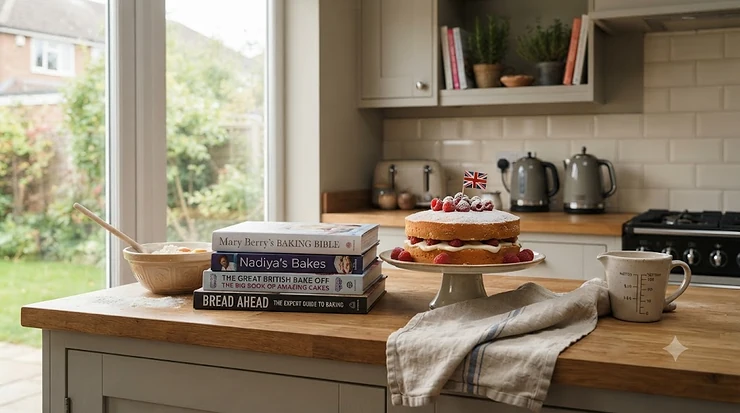
What makes a book genuinely one of the best baking books rather than just a nice-looking one? It comes down to three things: recipes that are tested and reliable, explanations that teach the “why” behind a method rather than just the steps, and a voice that keeps you turning pages instead of abandoning ship at the first slightly technical paragraph. On Wikipedia’s overview of baking the process is described as heat transforming batters and doughs into something with a firm crust and a soft centre — and honestly, that’s not a bad way to think about a great baking book too: solid enough to hold its shape under scrutiny, soft enough to be genuinely enjoyable to use.
This guide rounds up seven real, currently available titles covering everything from foolproof British classics to serious bread science, so whether you’re chasing a decent sponge or your first proper boule, there’s a match here. We’ll compare them side by side, break down who each one actually suits, and dig into the bits Amazon’s product page never tells you — like which book you’ll still be flicking through in five years, and which one quietly gathers dust after week two.
Quick Comparison Table
Before we go deep on all seven, here’s the lay of the land. This table is your at-a-glance cheat sheet — the full breakdown with price ranges and star ratings follows in the next section.
| Book | Best For | Format |
|---|---|---|
| Mary Berry’s Baking Bible | All-round beginners and family bakers | Hardcover |
| Jane’s Patisserie Easy Favourites | Quick, shareable bakes and social-media-style treats | Hardcover |
| The Great British Bake Off: Big Book of Baking | Fans wanting variety and GBBO-style challenges | Hardcover/Kindle |
| Bread: River Cottage Handbook No.3 | Absolute beginners to bread | Hardcover |
| Baking School: The Bread Ahead Cookbook | Serious home bakers wanting bakery-level bread and doughnuts | Hardcover |
| The Contemporary Cake Decorating Bible | Anyone wanting to actually decorate, not just bake | Hardcover |
| The Perfect Loaf | Sourdough obsessives who want the science explained | Hardcover |
Looking at the spread, there’s a natural split between books that teach broad, general baking confidence (Mary Berry’s Baking Bible, The Great British Bake Off: Big Book of Baking) and specialist titles that go deep on one discipline, whether that’s bread (Bread: River Cottage Handbook No.3, Baking School: The Bread Ahead Cookbook, The Perfect Loaf) or decoration (The Contemporary Cake Decorating Bible). If you only buy one book, a generalist makes sense; if you already bake regularly, a specialist title tends to deliver far more value per page.
💬 Just one click — help others make better buying decisions too!😊
Top 7 Baking Books: Expert Analysis
1. Mary Berry’s Baking Bible — the reassuring all-rounder every British kitchen needs
The standout here is sheer breadth: over 250 recipes spanning cakes, biscuits, bread, and traybakes, all revised and updated from the original bestseller. Mary Berry’s Baking Bible isn’t trying to be clever — it’s trying to be correct, every single time, which is precisely why it’s stayed in print and in demand for years.
Recipes are written in Berry’s famously precise, no-nonsense style: exact quantities, clear timings, and none of the vague “bake until golden” instructions that trip up newer bakers. That precision matters practically — it means a Victoria sponge actually rises evenly instead of doming and cracking, because the method accounts for oven variance rather than assuming you own a professional convection oven.
Based on the spec comparison with other generalist titles, this book earns its “bible” tag through consistency rather than flash. It’s aimed squarely at people who want a dependable reference they’ll reach for on a random Tuesday, not a book built for Instagram styling. Reviewers consistently report that recipes work first time, which for a baking book — where a single wrong measurement can sink a whole bake — is the single most valuable trait a title can have.
Pros:
- ✅ Over 250 tested, reliable recipes in one volume
- ✅ Clear, beginner-friendly instructions with no guesswork
- ✅ Covers bread, cakes and biscuits, not just one discipline
Cons:
- ❌ Photography is functional rather than aspirational
- ❌ Light on advanced techniques for experienced bakers
At around the £15-£20 range, Mary Berry’s Baking Bible represents genuinely strong value for a book you’ll likely use weekly rather than occasionally — check current price before buying, as offers fluctuate.
2. Jane’s Patisserie Easy Favourites — best for quick, crowd-pleasing bakes with minimal fuss
What most buyers overlook about this one is that it’s built for real weeknight energy, not showpiece baking. Jane’s Patisserie Easy Favourites compiles the blogger-turned-author’s most popular recipes — think biscoff traybakes and cookie dough — into a format designed for speed and reliability over technical ambition.
The recipes lean heavily on accessible ingredients from any UK supermarket and rarely demand specialist kit, which matters if you’re baking around a full-time job rather than treating it as a weekend hobby. Steps are short, photographed generously, and pitched at a level where a nervous first-timer won’t feel patronised or overwhelmed.
Aggregated reviewer sentiment for Jane Dunn’s books is consistently strong — buyers repeatedly note that recipes turn out exactly as pictured, a claim that genuinely can’t be said for every glossy cookbook on the shelf. That reliability, paired with the book’s social-media-native style, explains why it’s become one of the fastest-selling baking cookbook bestsellers in the UK market over the past couple of years.
Pros:
- ✅ Extremely beginner-friendly with short, clear methods
- ✅ Recipes consistently match the finished photos
- ✅ Ingredients are supermarket-standard, no specialist sourcing
Cons:
- ❌ Limited depth for bakers wanting technical mastery
- ❌ Recipe style skews sweet-heavy with less savoury variety
Sitting under the £10 mark, this is one of the most affordable entries here, and honestly one of the best value-for-money picks if your goal is bakes that actually get eaten rather than admired from a distance.
3. The Great British Bake Off: Big Book of Baking — best for fans wanting show-style variety
The standout feature is scale — this compendium pulls together recipes spanning the show’s various themed weeks, from bread to patisserie to spiced bakes, giving it a genuinely wide net that few single-author books can match.
Because it draws on multiple contestants’ and judges’ approaches rather than one voice, The Great British Bake Off: Big Book of Baking ends up teaching a broader range of techniques than most generalist books manage — you’ll bump into pastry, choux, meringue and bread all under one cover. That variety is a double-edged sword: brilliant for keeping things interesting, but it means depth on any single technique is necessarily shallower than a dedicated specialist title.
What most buyers overlook is that this works particularly well as a gifting book precisely because it has mass appeal — GBBO’s fanbase is enormous, and recognising recipes from the show adds a layer of enjoyment that a purely functional cookbook can’t replicate. Reviewers frequently mention buying it specifically as a present, then keeping their own copy once they realise how much they use it.
Pros:
- ✅ Huge variety of techniques and bake styles in one book
- ✅ Recognisable GBBO branding makes it a popular gift
- ✅ Good entry point for exploring several baking disciplines
Cons:
- ❌ Less depth per technique than a specialist title
- ❌ Some recipes assume prior baking confidence
Priced in the mid-£10s to £20s depending on format, it sits comfortably in the middle of our range — solid value if variety matters more to you than specialisation.
4. Bread: River Cottage Handbook No.3 — best for total beginners to bread-making
Daniel Stevens built this one around a genuinely simple premise: teach one reliable bread method properly before throwing dozens of variations at the reader. Bread: River Cottage Handbook No.3 focuses on foundational technique — hydration, kneading, proving — rather than assuming you already understand why dough behaves the way it does.
That foundation-first approach means the practical payoff is real: once you understand why a wetter dough produces a more open crumb, you can start adjusting recipes with confidence instead of blindly following instructions. It’s the difference between following a recipe and actually understanding bread, which is exactly the gap most bread beginners fall into.
Reviewers consistently praise the handbook’s clarity and its refusal to over-complicate what is, at its core, a fairly forgiving process once you know the basics. A recurring theme in aggregated feedback is that this book demystifies bread for people who’d previously written it off as “too technical” — which, given how intimidating sourdough culture can look from the outside, is a genuinely useful service.
Pros:
- ✅ Teaches core bread theory, not just individual recipes
- ✅ Written for genuine beginners with no assumed knowledge
- ✅ Builds confidence to adapt and experiment later
Cons:
- ❌ Fewer show-stopping or advanced bread recipes
- ❌ Photography is more rustic than glossy
At under £15, this is one of the cheapest ways into proper bread understanding, and arguably the smartest first purchase for anyone who’s only ever used a bread machine.
5. Baking School: The Bread Ahead Cookbook — best for bakery-level bread and doughnuts at home
The standout advantage is authenticity: this book comes directly from Bread Ahead, the London bakery and training school, which means the techniques inside are the same ones taught to paying students rather than adapted for a mass-market audience.
Beyond sourdough, Baking School: The Bread Ahead Cookbook covers doughnuts, viennoiserie, and enriched doughs — territory most bread books avoid because it’s genuinely harder to get right at home. Based on the spec comparison with other bread titles here, this is the one that pushes hardest into professional-adjacent technique, including guidance on shaping, scoring, and troubleshooting that goes well beyond “knead for ten minutes.”
What the spec sheet won’t tell you, but reviewer sentiment suggests, is that this book rewards patience rather than speed — it’s not a weeknight bread book. Buyers who stick with it report genuinely bakery-quality results, but there’s a learning curve, and aggregated feedback flags that a few recipes assume a level of dough-handling confidence that newer bakers might not yet have.
Pros:
- ✅ Real bakery techniques, not simplified home versions
- ✅ Covers doughnuts and enriched dough, rare in bread books
- ✅ Detailed troubleshooting for common bread problems
Cons:
- ❌ Steeper learning curve than beginner bread books
- ❌ Some recipes require specialist equipment or long timelines
Expect to pay in the £20-£25 range for this one — a fair ask given the specialist knowledge packed in, but it’s a step up in commitment as well as price from Bread: River Cottage Handbook No.3.
6. The Contemporary Cake Decorating Bible — best for learning proper icing and piping technique
Lindy Smith’s book stands out because decorating, not baking, is the actual subject — over 150 techniques covering buttercream, fondant, piping, and sugarcraft, aimed at people who’ve already got the sponge sorted and want the finish to match.
That specificity is the whole point. The Contemporary Cake Decorating Bible treats decoration as a craft with its own rules — consistency ratios for buttercream, temperature control for fondant, angle and pressure for piping — rather than an afterthought tacked onto a recipe. Understanding those variables in practice means the difference between a smooth, professional-looking finish and the slightly lumpy, air-bubbled result most home bakers are used to.
Aggregated reviewer sentiment highlights the step-by-step photography as a particular strength, with users repeatedly noting that techniques which look intimidating in theory become manageable once broken into the book’s smaller stages. It’s a common complaint in user reviews that some of the more elaborate designs require kit most people don’t already own — piping tips, turntables, fondant smoothers — so factor that into your budget.
Pros:
- ✅ Genuinely teaches decorating skill, not just designs to copy
- ✅ Clear step-by-step photography for tricky techniques
- ✅ Wide range from beginner buttercream to advanced sugarcraft
Cons:
- ❌ Requires investment in decorating-specific equipment
- ❌ Less focus on the cake recipes themselves
Sitting in the £15-£20 range, this is the clear pick if your cakes already taste great but look a bit… homemade, in the less flattering sense of the word.
7. The Perfect Loaf — best for serious sourdough science and craft
Maurizio Leo built a devoted following through his blog before this book arrived, and the standout feature is depth: The Perfect Loaf treats sourdough as both craft and science, explaining fermentation, hydration percentages, and dough temperature with a rigour most bread books skip entirely.
That scientific framing has real practical payoff. Understanding why a starter needs a specific feeding ratio, or how ambient temperature shifts fermentation time, means you can troubleshoot a flat or gummy loaf instead of just shrugging and trying again with no idea what went wrong. Based on the spec comparison with other bread titles in this list, this is comfortably the most technically thorough — closer to a reference text than a casual weekend recipe book.
Reviewers consistently describe this as the book that finally made sourdough “click” after other resources left them confused, with the aggregated sentiment particularly strong around its troubleshooting sections. A recurring note in feedback is that the sheer volume of technical detail can feel like a lot up front — this isn’t a book you skim on day one and fully absorb by day two.
Pros:
- ✅ Deep, genuinely useful explanation of fermentation science
- ✅ Excellent troubleshooting for common sourdough failures
- ✅ Covers sweets and enriched bakes beyond plain sourdough
Cons:
- ❌ Dense for readers wanting quick, casual recipes
- ❌ Higher price point reflects its length and production quality
At £25-£30, it’s the most expensive book on this list, but for anyone serious about sourdough, it’s arguably the one purchase that replaces a dozen contradictory YouTube videos.
Practical Usage Guide: Getting the Most From Your Baking Book
Buying the right book is only half the job — how you actually use it in your first month determines whether it becomes a kitchen staple or a shelf ornament. Start by reading the introduction chapter properly before jumping to recipes; most baking books, including Mary Berry’s Baking Bible and The Perfect Loaf, front-load essential technique explanations that make every subsequent recipe easier.
A common mistake in the first 30 days is substituting ingredients before you’ve made a recipe as written even once — swap self-raising for plain flour, or reduce sugar “to be healthier,” and you’ve changed the chemistry before you understand the baseline result. Bake the recipe exactly as printed first, note what worked, then adjust on repeat attempts.
For maintenance, treat your book like a working tool, not a display piece: use pencil notes in margins for oven-temperature tweaks specific to your kitchen, sticky tabs for go-to recipes, and keep it somewhere accessible rather than pristine on a high shelf. If allergens are a household concern, it’s worth cross-referencing recipes against the UK government’s allergen labelling guidance before adapting ingredient lists, particularly for gluten or nut substitutions in bread and cake recipes.
One optimisation trick that rarely gets mentioned: photograph your results and file them by recipe page number. Six months later, that visual record tells you instantly which version of a recipe actually worked, saving you from repeating the same fixable mistake.
Real-World Scenarios: Which Baking Book Suits You?
The nervous beginner — Say you’ve never baked beyond a boxed mix, and the idea of “proving” dough sounds faintly medical. Jane’s Patisserie Easy Favourites or Mary Berry’s Baking Bible are the sensible starting points: short ingredient lists, forgiving methods, and enough early wins to build real confidence before anything technical gets asked of you.
The weekend bread convert — Perhaps you’ve watched enough sourdough videos to feel ready, live somewhere with a reasonably warm kitchen, and have a spare afternoon most Saturdays. Bread: River Cottage Handbook No.3 builds the fundamentals first; once that clicks, Baking School: The Bread Ahead Cookbook or The Perfect Loaf are natural next steps depending on whether you want bakery breadth or sourdough depth specifically.
The cake-obsessed gift-giver — If birthdays and celebrations in your circle now come with an expectation of a homemade centrepiece, your bake already tastes fine — it’s the finish that needs work. The Contemporary Cake Decorating Bible closes that specific gap, while The Great British Bake Off: Big Book of Baking keeps things varied enough that you’re not decorating the same three cake shapes on repeat.
How to Choose the Best Baking Books for Your Kitchen
Picking well means matching the book to your actual habits, not your aspirations. Here’s a practical framework:
- Identify your current skill level honestly. A technically dense book bought “to grow into” often just sits unused — start where you genuinely are.
- Decide generalist versus specialist. One broad book covers more ground; a specialist title goes deeper on bread, cakes, or decoration specifically.
- Check the recipe count against your baking frequency. A weekly baker gets more value from 250+ recipes than an occasional one who’ll only ever use a handful.
- Look at ingredient accessibility. Books built around specialist flours or imported ingredients cost more to actually cook from, beyond the cover price.
- Weigh photography against instruction depth. Glossy styling photographs are lovely, but step-by-step process shots teach technique far more effectively.
- Consider format. Hardcovers survive kitchen spills and repeated use better than paperbacks, which matters for a book you’ll reference for years.
- Read aggregated review sentiment, not just star ratings. A 4.7-star average tells you less than recurring specific comments about recipes actually working.
Baking Cookbook Bestsellers vs Niche Specialist Guides
It’s worth being honest about the trade-off between chasing baking cookbook bestsellers and picking a niche specialist title, because they solve genuinely different problems. Bestsellers like Mary Berry’s Baking Bible and Jane’s Patisserie Easy Favourites earn their sales through broad, dependable appeal — they’re written to work for the widest possible audience, which means fewer surprises but also less depth on any single technique.
Specialist guides such as The Perfect Loaf or The Contemporary Cake Decorating Bible trade that broad appeal for genuine mastery in one lane. On paper, this means a bestseller gets you competent faster across more bake types, while a specialist book gets you genuinely skilled in fewer areas, but noticeably better at them. Neither approach is wrong — it depends whether you want a reliable all-rounder or you’ve already found the discipline that’s hooked you.
In practice, most serious home bakers end up owning both types eventually: a bestseller as the dependable daily driver, and one or two specialist titles for the areas they’ve fallen properly in love with.
Bread Baking Books: What Sets the Best Apart
Bread is arguably the discipline where the right book matters most, because small variables — hydration, ambient temperature, flour protein content — compound quickly into visibly different results. The strongest bread baking books, like Bread: River Cottage Handbook No.3, Baking School: The Bread Ahead Cookbook, and The Perfect Loaf, share one trait: they explain the reasoning behind ratios rather than just listing grams of flour and water.
What separates a decent bread book from a genuinely great one is troubleshooting depth. Anyone can list a recipe for a basic loaf; far fewer books explain why your crumb turned out dense, why your crust didn’t blister properly, or why your starter stalled halfway through its rise. The Perfect Loaf in particular treats these failures as teaching moments rather than dead ends, which is precisely the kind of practical value a rewritten Amazon listing simply can’t replicate.
For UK bakers specifically, it’s also worth noting that British flour protein content differs from American brands referenced in some imported titles — a detail that BBC Good Food’s baking fundamentals course touches on when covering white bread dough, and one that’s easy to overlook if you’re following a book written primarily for a different market.
Cake Decorating Books: From Beginner Buttercream to Showstoppers
Cake decorating books occupy a slightly different niche to baking books proper, because the core skill they teach — piping, icing, structural support for tiered cakes — is closer to a craft discipline than a cooking one. The Contemporary Cake Decorating Bible is the standout here precisely because it treats buttercream consistency and fondant handling as technical variables worth understanding, not just steps to copy blindly.
The real-world performance gap between someone who’s read a decorating book properly and someone who’s winging it from YouTube clips tends to show up in consistency — smooth buttercream finishes, evenly spaced piping, cakes that don’t bulge or crack under fondant. That consistency comes from understanding ratios and temperature, exactly the kind of detail a specialist decorating book prioritises over a general baking guide.
If you’re choosing between a general baking book with a decorating chapter tacked on versus a dedicated decorating title, go dedicated once you’re past total beginner stage — the depth difference is substantial, and it shows in the finished cake.
British Baking Books: Why Homegrown Guides Still Win
There’s a reasonable argument that British baking books hold an edge over American imports for UK readers, and it comes down to more than just spelling conventions. Mary Berry’s Baking Bible and The Great British Bake Off: Big Book of Baking are written around UK ingredient availability, British oven conventions, and metric measurements as standard, removing a layer of conversion friction that imported titles add.
There’s also a cultural fluency to British baking books that’s hard to quantify but easy to notice — recipes for classics like Victoria sponge, scones, or a proper fruit cake are calibrated to British taste expectations (less sweet, generally, than American equivalents) rather than adapted after the fact. Reviewers consistently note this as a quiet but real advantage, particularly for traditional bakes where authenticity matters.
That said, British baking books aren’t inherently better across every category — bread and sourdough, for instance, is an area where some of the strongest technical writing currently comes from specialist authors regardless of nationality. Use British titles as your foundation for classics, and don’t be afraid to look wider for specific disciplines.
Baking Techniques Books: Building Real Skill, Not Just Recipes
There’s a meaningful difference between a recipe book and a genuine baking techniques book, and it’s worth understanding before you buy. A recipe book tells you what to do; a techniques book tells you why it works, which means the knowledge transfers to recipes the book doesn’t even contain. The Perfect Loaf and Baking School: The Bread Ahead Cookbook both lean heavily into this category — explaining fermentation science, gluten development, and dough handling in ways that make you a genuinely better baker, not just a better follower of instructions.
The practical payoff of technique-focused books shows up when a recipe goes wrong. Someone who’s only ever followed recipes tends to abandon a failed bake with no idea what happened; someone who understands the underlying technique can diagnose the issue — under-proved dough, over-mixed batter, an oven running hot — and correct it next time. That diagnostic ability is arguably the single most valuable thing a baking book can teach, and it’s exactly the kind of depth Amazon’s product description never captures.
Home Baking Guides for Every Skill Level
Not every home baker wants the same thing from a book, which is why matching guide to skill level matters more than chasing whichever title has the flashiest cover. The table below breaks down our picks by where you’re actually starting from.
| Skill Level | Recommended Book | Why It Fits |
|---|---|---|
| Complete beginner | Jane’s Patisserie Easy Favourites | Short, forgiving recipes with minimal technical jargon |
| Confident home baker | Mary Berry’s Baking Bible | Broad recipe range with reliable, tested methods |
| Bread beginner | Bread: River Cottage Handbook No.3 | Teaches fundamentals before variety |
| Bread enthusiast | The Perfect Loaf or Baking School: The Bread Ahead Cookbook | Deep technical and bakery-level knowledge |
| Cake decorator | The Contemporary Cake Decorating Bible | Specialist icing and piping technique |
This breakdown makes one thing fairly clear: there’s rarely a single “best” home baking guide, only the best one for where you currently stand. A common problem-solving approach is to buy one book matched to your current level, exhaust its core recipes over a few months, then move up the table rather than sideways into another book pitched at the same level.
If you’re baking around dietary restrictions — gluten-free, dairy-free, or egg-free substitutions — cross-check any recipe adaptations against reliable labelling guidance before serving to guests with allergies, since substituted ingredients can introduce allergens that weren’t in the original recipe.
Common Mistakes When Buying Baking Books
The single biggest mistake is buying based on cover photography alone — a gorgeously styled shot of a finished bake tells you nothing about whether the instructions inside will actually get you there. Look past the cover to sample pages or a “look inside” preview before committing.
A second common pitfall is buying multiple books that cover the same ground. Two generalist titles with heavy recipe overlap waste money that could’ve gone toward one generalist plus one genuinely different specialist book. Before purchasing, check whether a new title actually fills a gap in what you already own.
Buyers also frequently underestimate ingredient accessibility. A stunning bread book built around imported flour varieties or a decorating book requiring specialist tools adds hidden costs well beyond the cover price — factor that in before assuming a cheaper book is automatically better value.
Finally, don’t ignore format. A paperback that falls open flat is genuinely more useful at a floury workstation than a beautiful hardback that won’t stay open without a weight on it — a small detail, but one that affects daily usability far more than most buyers expect going in.
Long-Term Cost & Maintenance
A baking book is a one-off purchase, but its real value plays out over years of use — which makes the £15-£30 range genuinely modest compared to the cost of failed bakes, wasted ingredients, and the time spent troubleshooting recipes with no explanation behind them.
| Factor | Baking Books | Free Online Recipes |
|---|---|---|
| Consistency | Tested, edited, reliable | Highly variable quality |
| Technique depth | Often includes “why,” not just “how” | Rarely explains reasoning |
| Structure | Organised, cross-referenced | Scattered across sites |
| Cost | One-off £10-£30 | Free, but time-costly to filter |
| Longevity | Years of repeated reference | Links break, content disappears |
The comparison above makes the ROI case fairly plainly: while free online recipes cost nothing upfront, the time spent filtering unreliable results and troubleshooting unexplained failures adds up to a real, if invisible, cost. A well-chosen book like Mary Berry’s Baking Bible, used weekly over several years, works out at pennies per use — genuinely hard to beat for value, even against free alternatives.
Maintenance-wise, books also age better than bookmarked webpages, which have a habit of disappearing, being redesigned, or vanishing behind paywalls. A physical baking book on your shelf in five years’ time is still exactly as useful as the day you bought it.
Frequently Asked Questions
❓ What is the best baking book for a complete beginner in the UK?
❓ Which baking book do most home bakers recommend first?
❓ Are bread baking books worth buying if I've only used a bread machine before?
❓ What's the difference between a baking cookbook and a baking techniques book?
❓ How much should I expect to pay for a good baking book in 2026?
Conclusion
Choosing among the best baking books really comes down to matching a title to where you actually are, not where you’d like to be in some imagined baking future. If you want one dependable book that covers nearly everything, Mary Berry’s Baking Bible remains a genuinely hard title to beat. If bread has properly got its hooks in you, the trio of Bread: River Cottage Handbook No.3, Baking School: The Bread Ahead Cookbook, and The Perfect Loaf gives you a clear path from first loaf to serious sourdough science. And if your bakes already taste great but look distinctly homemade, The Contemporary Cake Decorating Bible closes that gap properly.
None of these seven are filler picks — each earns its spot through genuine specialisation, reliable results, and aggregated reviewer sentiment that backs up the claims rather than contradicting them. Whichever you choose, the real test isn’t how good it looks on the shelf; it’s whether you’re still reaching for it in a year’s time.
✨ Don’t Miss These Exclusive Deals!
🔍 Take your baking to the next level with these carefully selected books. Click on any highlighted title to check current pricing and availability. These guides will help you create authentic bakes your family will genuinely love!
Recommended for You
- British Fish and Chips Cookbook: 7 Best Picks for Chippy Fans (2026)
- 7 Best Traditional British Recipes Books for UK Kitchens (2026)
- Best British Cookbooks: 7 Kitchen Classics for 2026
Disclaimer: This article contains affiliate links. As an Amazon Associate, I earn from qualifying purchases. If you purchase products through these links, we may earn a small commission at no additional cost to you.
✨ Found this helpful? Share it with your friends! 💬🤗
